Online Reporter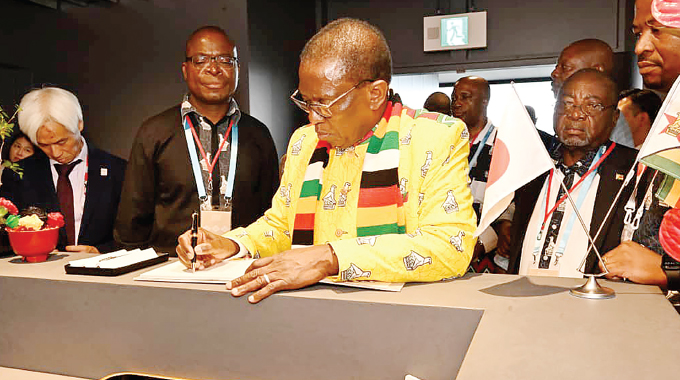
Debra Matabvu, in Osaka, Japan
PRESIDENT Mnangagwa has implored global investors, particularly those from Japan, to seize the abundant opportunities in Zimbabwe’s key economic sectors, describing the country as a land of “unmatched possibilities”, while declaring that it is open for business, trade, tourism and innovation.
Addressing the Zimbabwe National Day official ceremony at the ongoing World Expo 2025 in Osaka, Kansai, President Mnangagwa said the country was endowed with growing investment potential across the strategic mining, infrastructure, agriculture, energy, manufacturing, ICT and tourism sectors.
International partners, he said, need to be part of Zimbabwe’s journey towards transformation into an empowered, modern, prosperous and highly industrialised country within the next five years.
“We invite the people of Japan, along with other global partners, investors and friends, to help us add the fine print to our broad investment canvass, towards shared prosperity for our respective countries and peoples,” he said.
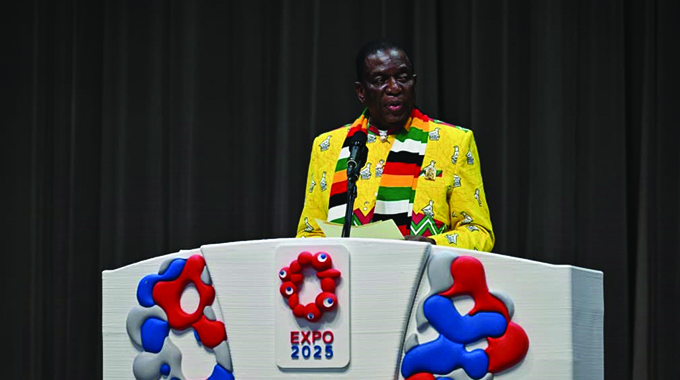
“The message is clear: Zimbabwe is open for business; open to investment; open to trade; open to innovation; open to tourism and partnerships which are, Beyond Limits.”
Zimbabwe’s economic growth, projected at around six percent this year, the President said, was being driven by bold policy reforms, infrastructure development and increasing focus on value addition in mining and agriculture.
“Our economic blueprint, the National Development Strategy, is bold, responsive, people-centred and transformative,” he said.
“The multi-pronged policy reforms adopted by my Government have seen our economy being among the fastest growing in the Southern Africa region, with this year’s GDP growth expected to be around 6 percent.
“Infrastructure rehabilitation and modernisation present immense possibilities for investment from Japanese partners.
“These relate to transport networks, along with other key enablers in the energy sector, renewables, ICT, water and sanitation.”
The President highlighted the mining sector as one of the country’s biggest investment draws, citing its diverse geological endowments in precious metals and stones, hydrocarbons and industrial minerals.
“Focus is now on value addition and beneficiation through the establishment of the requisite industrial base and manufacturing concerns,” he said.
In infrastructure, he pointed to projects such as the rehabilitation of transport networks, the North-South Corridor, and power generation initiatives that present “immense possibilities for investment from Japanese partners.”
A Memorandum of Understanding signed during the Expo with Japanese firms in the motor industry, he added, could help revitalise Zimbabwe’s public transport sector and unlock regional benefits.
“More opportunities exist for partnerships and investments in infrastructure development,” said the President.
“The MoU signed at the sidelines of this Expo, in relation to the motor industry, has the potential to boost the public transport sector not only in Zimbabwe but the region as a whole.
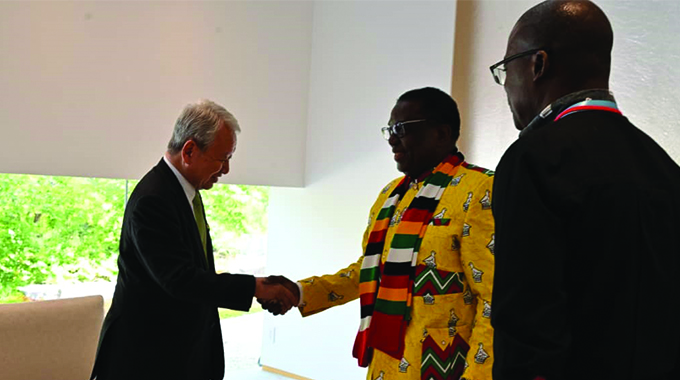
“Leveraging on the renowned expertise of Japan in innovation, science and technology, Zimbabwe is ready to partner and welcome investors from Japan to accelerate our industrialisation and modernisation agenda.”
The President also singled out agriculture as a sector ripe for expanded co-operation, particularly in irrigation development, dam construction and mechanisation.
“The ongoing quest to build greater climate change resilience and adaptation in agriculture stands to benefit from stronger Zimbabwe-Japan co-operation.
“Construction of dams is continuing, with investments required for water conveyancing and agriculture mechanisation towards increasing the total land area under irrigation.”
He praised Japanese support for the Nyakomba Irrigation Scheme, which he said had improved food security and household incomes for rural communities.
He added: “From the Government side, the number of irrigation schemes for communal and smallholder farmers is ever-increasing.
“We look forward to increased cooperation to broaden these key developments.”
The President also showcased Zimbabwe’s tourism potential, with the country boasting world-class destinations such as Victoria Falls and the country’s vast national parks as major attractions.
He expressed hope that post-Expo engagements would help boost Japanese tourist arrivals to Zimbabwe beyond pre-pandemic levels.
“Among the assortment of tourist attractions is the world-famous, mighty and majestic Victoria Falls, locally known as Mosi Oa Tunya, ‘The smoke that thunders’,” he said.
“This is also a World Heritage Site and one of the Seven Natural Wonders of the World.
“Our country, Zimbabwe, boasts an impressive concentration of wildlife, as a result of the Government’s robust conservation efforts.
“Our national parks and safaris, which constitute about 70 percent of the total land area, are home to over 270 mammal species, 670 bird species and 256 reptile species, among others.
“The ‘Big Five’, namely the elephants, rhinos, lions, buffaloes and leopards, are in abundance, roaming safely in the wild.
“Worth noting is the elephant population, which is the second largest in the world at over 82 000, while that of our rhino is in fourth and exceeds 1 000.”
On the sidelines of the Expo, Zimbabwe held its inaugural Zimbabwe–Japan Business Forum, which the President said created a “conducive space” for business leaders from both countries to explore partnerships.
“Leveraging on the renowned expertise of Japan in innovation, science and technology, Zimbabwe is ready to partner and welcome investors from Japan to accelerate our industrialisation and modernisation agenda.”
President Mnangagwa also urged greater collaboration in human capital development, particularly in technology and emerging fields such as artificial intelligence, robotics, fintech and data science, noting that over 60 percent of Zimbabwe’s population is under the age of 30.
Accompanying the President were the Foreign Affairs and International Minister, Professor Amon Murwira, Chief Secretary to the Office of the President and Cabinet (OPC), Dr Martin Rushwaya, and several other senior Government officials.
The event was also attended by the Japanese government.
The Expo, which began in April and runs until October 13, has attracted 158 countries and seven international organisations.
Zimbabwe’s pavilion has emerged as one of the most visited, showcasing investment opportunities, tourism attractions, and the country’s technological ambitions through immersive experiences like virtual reality tours.