Online Reporter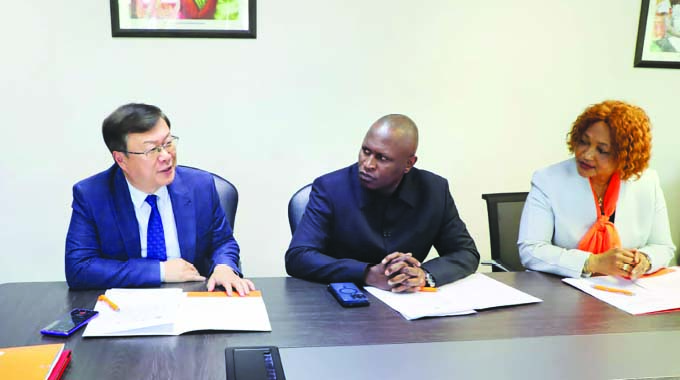
Chronicle Writer
GOVERNMENT, China and the United Nations Population Fund (UNFPA) on Tuesday celebrated the successful completion of a life-saving health assistance project for women and girls affected by Tropical Cyclone Idai.
The project, supported by the China South-South Cooperation Assistance Fund (SSCAF) and implemented by UNFPA in partnership with the Ministry of Health and Child Care, has significantly strengthened maternal healthcare in the cyclone-ravaged districts of Chipinge and Chimanimani.
More than 60 000 women have benefited from emergency obstetric and neonatal care services provided through the initiative.
Speaking at the signing ceremony of the completion certificate in Harare, Chinese Ambassador to Zimbabwe, Zhou Ding, described the project as a “shining example of successful tripartite co-operation” among China, UN agencies and the Zimbabwean Government.
“I would like to express my deepest appreciation to UNFPA for your dedication to bringing this great initiative to fruition, and to the Government of Zimbabwe, especially the Ministry of Health and Child Care, for your partnership and valuable support,” he said.
Amb Zhou said the initiative represents lives saved, communities strengthened and a future rebuilt with dignity.
“I’d also like to extend my heartfelt thanks to all those who have poured their hearts into this shared accomplishment. Their dedication has transformed lives, bringing security and dignity to mothers and children in the cyclone-affected regions,” he said.
The Health Assistance Project focused on restoring and enhancing maternal and child health services in areas severely affected by the devastating 2019 cyclone. As part of the intervention, three maternity waiting homes were refurbished and nearly 300 health professionals were trained in specialised maternal care, enhancing the capacity of local health facilities to handle childbirth emergencies.
“These achievements transcend mere statistics; they represent lives saved, families strengthened and communities empowered,” said Amb Zhou.
He said by equipping healthcare professionals with essential skills and tools and creating safer, more dignified conditions for childbirth, this project has delivered real, lasting change where it is needed most.
“It has also significantly complemented the Zimbabwean Government’s effort in reducing maternal mortality,” said Amb Zhou.
He said the initiative complements Vision 2030 and is consistent with China’s Global Development Initiative and the UN Sustainable Development Goals.
“This reflects our shared commitment to building a global community of health for all. Health is not a privilege, it is a fundamental human right, the foundation of a dignified life and the bedrock of a thriving society,” said Amb Zhou.
“When we invest in healthcare, we are investing in people, and in a more equitable future for all.”
Amb Zhou also highlighted China’s long-standing partnership with Zimbabwe’s health sector, dating back to the 1980s. Since 1985, China has deployed 22 medical teams comprising over 200 experts, provided infrastructure support such as Chinhoyi and Mahusekwa Hospitals, and supplied millions of Covid-19 vaccines during the pandemic.
The Ambassador stressed that China remains committed to working with Zimbabwe and international partners under frameworks such as the Forum on China-Africa Co-operation (FOCAC) and South-South co-operation to support Zimbabwe’s health and development goals.
“As we mark this milestone, we renew our collective resolve to build a world where no disaster can silence the cry of a healthy child, and every mother can give birth safely and with dignity,” he said.
UNFPA Country Representative, Mrs Miranda Tabifor lauded the project as a vital contribution to Zimbabwe’s efforts to reduce maternal mortality and build disaster-resilient health systems. “
She said the project brought hope to women and girls whose access to healthcare had been compromised by the cyclone.
“This event marks a significant milestone in the collaborative journey between the two countries to improve maternal health and reduce maternal mortality through strategic South-South Cooperation,” said Mrs Tabifor.
“The project which was funded by the People’s Republic of China and implemented by UNFPA in partnership with the Ministry of Health and Child Care is a show of the spirit of partnership in addressing the reproductive health needs of women in humanitarian crises.”
Tropical Cyclone Idai struck eastern Zimbabwe in March 2019, leaving a trail of destruction, displacing thousands, and overwhelming already fragile health services in Chimanimani and Chipinge. The cyclone’s aftermath exposed pregnant women to unsafe delivery conditions, spurring the need for targeted emergency health interventions.
China invested US$1,24 million through UNFPA to support the Government of Zimbabwe in responding to the crisis with a focus on strengthening provision of quality maternal health.
The project had a three-pronged approach to addressing challenges that pregnant women were facing in accessing quality maternal health care services in the cyclone affected districts.
The focus was on the provision of reproductive health medical equipment and medicines to health institutions in affected districts to enhance their capacity to provide emergency care services for pregnant women and new-borns.
It also included building capacity of health workers in emergency obstetric and neonatal care, the use of anti-shock garments for managing bleeding and the refurbishment of maternity waiting homes at three severely affected health facilities which were Mutambada Mission Hospital, Chipinge District Hospital and Birchenough Bridge District Hospital.