Chronicle Editor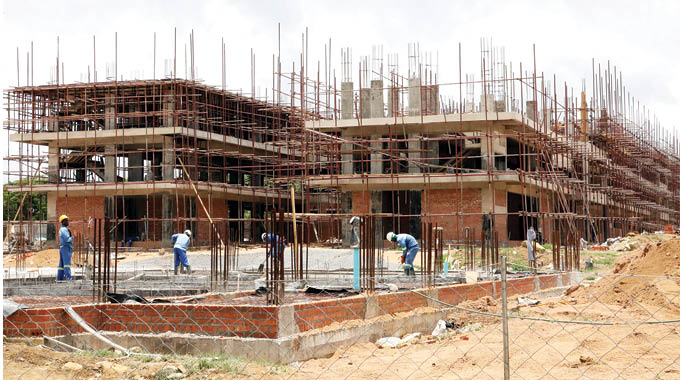
Dumisani Nsingo, Senior Business Reporter
ACTIVITY in the construction industry is at its lowest ebb largely due to the inflationary pressures prevailing in the country and effects of the coronavirus (Covid-19) outbreak, officials have said.
Reliance Construction chief executive officer and Zimbabwe Building Contractors Association past president Mr Obert Sibanda said activity in the construction industry was subdued largely due to the slow down in the country’s economic growth.
“At the moment the industry is feeling the pinch because normally whenever there is an economic downturn, construction is the first to collapse and the last to recover when there is a turnaround. As such you find that quite a number of projects have been suspended,” he said.
Mr Sibanda, however, said there was a sizeable number of infrastructural development projects being carried out in the country.
“There are a few projects that are being pushed but generally construction activity is not at its best. Suffice to say we have seen a few roads being constructed and rehabilitated. For instance, there is lot of activity along the Harare-Beitbridge highway with about five to six contractors there. Obviously because of Covid-19 there are some activities that are taking place at hospitals across the country,” he said.
Mr Sibanda further noted that construction activities were still taking place in areas that were affected by Cyclone Idai early last year as well as the upgrading of the Hwange Power Station. Property expert and Knight Frank-Bulawayo managing partner Mr Oswald Nyakunika reiterated that a number of capital projects were taking long to be completed owing to the prevailing macro-economic environment in the country.
“As you are aware the topical issue has been Egodini (Mall and Intermodal Public Transport Interchange) project in Bulawayo where nothing is happening and it appears the project has been suspended. The major reason why such projects have been delayed or suspended is the current financial instability associated with the local currency. It has made it difficult to control projects cost escalations and it is impossible to predict entry yields in those circumstances,” he said.
South African company Terracotta was awarded the tender for the project in 2017, touted as a game changer in the city, but has failed to develop the area within the set deadlines.
The contractors started work in March 2018, destroying infrastructure at the site of the project, paving way for construction activities to begin but to date nothing has taken place. Upon completion, the mall will have 50 shops, a bus terminus, commuter omnibus bays and modern informal trader bays with storage counters as well as taxi association offices.
“I’m convinced budgets for current projects like (the refurbishment work at) Econet (building) formerly Kingdom Bank building are in United States dollars. It (US dollar) is a fairly stable currency and return estimates are easily predictable,” said Mr Nyakunika.
He said the real estate consultancy firm has a number of pending projects, which it was managing but has since consulted its clients to temporarily halt undertaking them as it watches events on the economic front unfold.
“We have a number of projects in the pipeline but would rather advise clients to wait until the economy stabilises,” said Mr Nyakunika.
He further noted that there was likely to be many voids at most office buildings in the Central Business District (CBD) as most businesses are struggling to stay afloat due to the effects of Covid-19.
“As if this is not enough property investments have not been spared by Covid-19. It has affected many businesses to such an extent that one in 20 may find it difficult to survive. This is likely to increase voids and rent arrears in many buildings. Many businesses are opting to work from home and that is likely to reduce demand for office space,” said Mr Nyakunika.
He also hinted that most tenants in residential areas were likely to struggle to pay rentals as their sources of income have been greatly affected by the Covid-19 outbreak.
“Many residential tenants took advantage of Covid-19 deferred rent payments. Now that the rent moratorium has been lifted, many will struggle to pay rent plus arrears. The recent announcement to pay civil servants’ allowances in US dollars is also likely to force landlords to demand their rentals in US dollars. Many investors prefer the US dollar because it’s a stable currency and as such it retains value,” said Mr Nyakunika. @DNsingo


 Online Reporter