George Maponga in Mwenezi
ZIMBABWE has made commendable strides towards morphing into an upper- middle-income society by 2030 with Information, Publicity and Broadcasting Services Minister Dr Zhemu Soda expressing satisfaction with progress in the implementation of high impact projects in spheres such as mining, agriculture coupled with value-addition and beneficiation projects that now were also spawning rural industrialisation and modernisation, countrywide.
Dr Zhemu commended the impact of transformative projects in various sectors of the economy that have been implemented or were at various stages of implementation under the Second Republic that dovetail with President
Mnangagwa’s Vision of making Zimbabwe an upper-middle-income society by 2030.
The country’s gross domestic product (GDP) was now on an upward trajectory thanks to signature projects that were directly impacting on the lives of citizens with most of these projects feeding into the National Development Strategy (NDS2) which is the gateway to an upper-middle-income society.
The Cabinet Minister expressed satisfaction with the socio-economic impact of various projects implemented under the Second Republic in Masvingo where jobs have been created with rural industrialisation and modernisation now in full swing.
He toured Bikita Minerals Sinomine where a hybrid processing plant has been commissioned at a cost of over US$70 million to produce 60 000 tonnes spodumene (lithium) concentrate, 5 000 tonnes of a high value mineral known as cesium and large quantities of petalite. Bikita Minerals Sinomine has also discovered a new rare mineral which they have aptly named, Bikitaite, which looks to be a promising metal though it’s still unclear what it will be used for.
The mine will also produce tantalite with the commissioning of a new hybrid processing plant in sync with President
Mnangagwa’s call for value addition and beneficiation.
The Chinese-owned mine has also poured over US$20 million in a power project that comprised building of a 132kV line that provided access to electricity to thousands of rural households in Bikita, Zaka and Gutu.
Dr Zhemu also toured the US$14,6 million Great Zimbabwe Hydro Power Project at Lake Mutirikwi which is now feeding 5MW into the national grid and has obliterated power cuts in Masvingo City following its commissioning in late 2024. The project also created hundreds of direct and indirect jobs.
The Cabinet Minister said the hydro power project dovetailed with the Second Republic’s thrust for the nation to gravitate towards clean, renewable energy noting that similar projects would be developed at other dams especially in
Masvingo province which has arguably the highest dam density in Zimbabwe.
He also visited the trumpet interchange project being built by Masimba Construction in Masvingo City as part of the rehabilitation of the Harare-Masvingo-Beitbridge highway that is being implemented by the Second Republic.
‘’The trumpet interchange project near Masvingo Polytechnic and the new Chimusana Bridge together with the Second Chevron Bridge will help ease congestion and improve the flow of traffic along the north-south corridor that links Zimbabwe to South Africa and also to the Central African interior. This project is testament to President
Mnangagwa’s vision of improving the ease of doing business through speedy movement of goods and people and is in line with Vision 2030,’’ said Dr Zhemu.
The Minister also visited the Nuanetsi Ranch in Mwenezi where eight local private investors are developing a 30 000-hectare greenbelt that will be under sugarcane, citrus and lucerne.
This project which is being implemented by local private investors in partnership with the Development Trust of Zimbabwe dovetails with the Second Republic’s rural industrialisation and modernisation drive as a new town is envisaged at Nuanetsi where it reaches its crest.
Employment will also be created as agri-processing industries will be opened and an ethanol plant being amongstop high value projects that will make DTZ and its partners the Second largest employer after the Government in
Zimbabwe, directly employing more than 15 000 workers.
Over US$70 million has been sunk in the project to date with more than 500 hectares of virgin land now under sugar cane. Minister Soda toured Honzero Agro Projects and Lyonais Enterprises where swathes of land is now under sugar cane. Honzero is targeting a citrus estate with an initial 100 hectares set to be developed beginning 2027.
The Nuanetsi green corridor project uses water drawn from Tugwi-Mukosi Dam and to date the venture has created more than 1200 direct jobs.
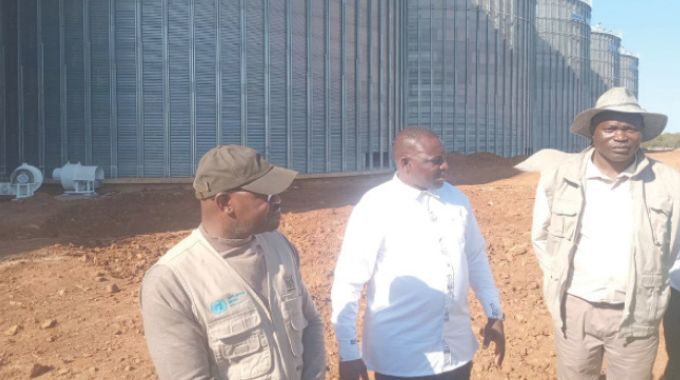
Dr Soda also toured the seven artificial intelligence-powered GMB silos that are under construction at Rutenga Growth Point and set for completion in two months’ time.
He noted that the silos will enhance food security in Mwenezi as the huge granaries can safely store grain for up to five years. They have a combined capacity of 56 000 tonnes and will mostly stock surplus traditional grains such as millet, sorghum and rapoko grown by most farmers in the arid Mwenezi and nearby Chiredzi and Chivi districts.
The minister’s tour ended at the Sustainable Agriculture Technology (SAT)-run multi service centre at the growth point where SAT in partnership with the local community and the Mwenezi Rural District Council built a plant that processes sunflower and caster beans seed, sesame and also paprika. The plant has created hundreds of jobs and has already started supplying the local market with high-value and healthy sesame, caster bean and sunflower oil.
According to Minister Soda, the opening of the plant would benefit the local economy as it was now stemming from the smuggling of sesame from southern Masvingo into Mozambique and swindling of local farmers by unscrupulous traders from that country.
Mwenezi, Chiredzi and parts of Chivi rural farmers produce sesame which accounts for about 40 percent of gross national output.
Besides the multi-service centre, SAT is also offering practical courses in areas such as solar power and sesame production at its training school at Rutenga Growth Point.
‘’The high impact projects that we have toured across Masvingo province show that Zimbabweans are driving the implementation of transformative projects that are growing our GDP and driving our nation towards becoming an upper middle-income economy. Jobs are being created and more electricity-generation projects are being implemented to make sure we have enough power to drive our economy,’’said Dr Soda.
‘’There is evidence of ongoing rural industrialisation and modernisation with new towns and business centres either taking shape or about to do so in the near future and all this shows that President Mnangagwa’s policies and programmes are having a direct impact on the lives of our people and this is in line with NDS2 which will feed into Vision 2030.’’
The Cabinet minister also challenged the media to tell a positive story about the transformative and high impact projects that are in full swing under the Second Republic and stimulating rural industrialisation and modernisation in line with the leaving no one and no place behind mantra.
Permanent Secretary for Masvingo Provincial Affairs and Devolution Dr Addmore Pazvakavambwa, who accompanied Dr Soda, paid tribute to President Mnangagwa for implementing the high impact projects saying
Masvingo province was firmly on course to become a US$ 8 billion economy in GDP terms by the year 2030. Dr Soda was accompanied on the tour by the permanent secretary in his ministry Mr Nick Mangwana.