Online Reporter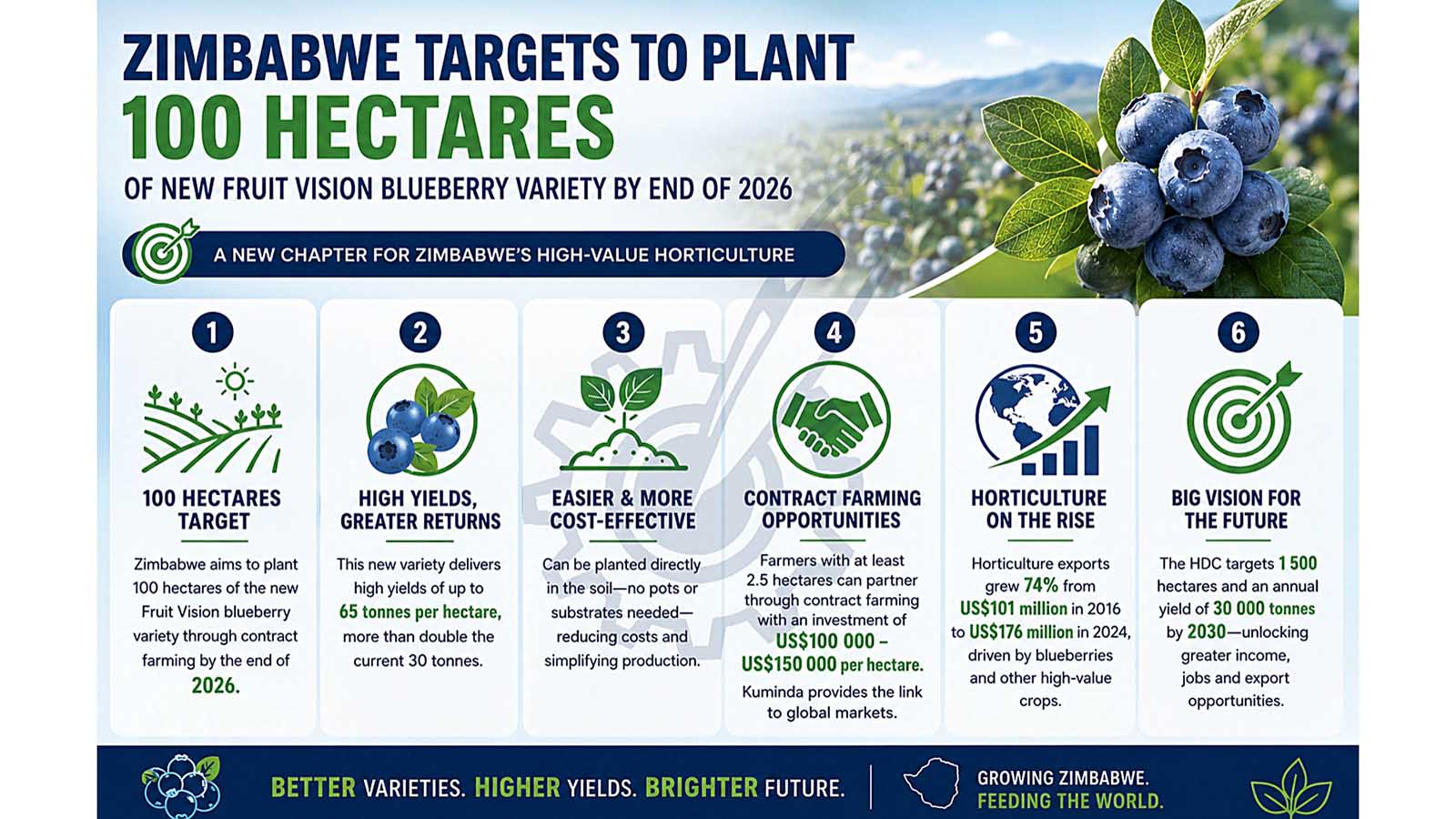
Edgar Vhera
Specialist Writer – Agribusiness
ZIMBABWE has targeted to plant 100 hectares of the new Fruit Vision blueberry variety by the end of this year through contract farming, a local company has revealed.
Kuminda’s chief executive, Mr Clarence Mwale, said his company was calling farmers from different sectors to register for contracting to plant the new blueberry variety.
Kuminda is a multi-national company founded in Zimbabwe and jointly owned by Messrs Mwale and Fred Matenga. The company helps local farmers by linking them with international markets.
“We have established the first 10 hectares of 50 ha at MatFarm in Marondera, while preparations are already starting for another 20ha in Chinhoyi,” he said.
“We are contracting farmers to grow our varieties, and we are optimistic that 100ha will be achieved by the end of 2026.”
Kuminda has signed an agreement for exclusive rights to Dutch breeder Fruit Vision’s blueberries. Kuminda is the first company to grow such a variety.
The company holds the master license for Southern Africa and boasts of expertise in cold storage, greenhouse structures, soil and substrates, finance and banking and small-scale value chain development.
Mr Mwale said his company conducted trials for two years in Mvurwi, and they were successful.
The new blueberry variety has the added advantage of high yields of up to 65 tonnes per hectare, up from the current 30, and it can be planted directly in the soil rather than in pots or in a trench filled with a growing medium in high-density plantings.
Blueberry is a high capital-intensive crop that requires technology and precision, with its success hinging on partnerships with banks, local and diaspora investors.
Mr Mwale said they were looking for small-scale farmers with access and ability to finance high-value crops and also those in irrigation schemes as cooperatives who can be financed by the Government or development partners to partake in this lucrative crop.
The minimum hectarage for contracting is 2,5 hectares and an initial investment of between US$100 000 and US$150 000 per hectare is required, the costs can be reduced significantly if the farm has the right type of soil and there is no need for planting in pots and substrates.
Trees will be imported by Kuminda from Agriom BV in the Netherlands, who are developers of the Fruit Vision varieties. The varieties are co-owned by the developer and the off-taker, Onuba Fruit, a Spanish company.
Blueberry, a globally acclaimed superfood, has anchored the resurgence of Zimbabwe’s horticulture sector, whose exports surged 74 percent from US$101 million in 2016 to US$176 million in 2024.
The blueberry marketing season runs between April and October, with 60 percent of the product harvested between August and October.
Zimbabwe’s Unique Selling Proposition (USP) in the blueberry industry is its quality, size, flavour, texture, taste and production time.
This makes them popular in many markets around the world. Blueberries are rich in antioxidants. They are also low in calories and high in vitamins C and K, making them a key part of a healthy diet.
The country’s early-season window gives local growers a competitive edge, allowing them to enter global markets ahead of other producers.
The Horticultural Development Council (HDC) is targeting to expand production from the current 800 hectares to 1 500ha to reach an annual average yield of 30 000 tonnes.
An investment of US$108 million is required in blueberries to achieve the 2030 target.
The country’s new agriculture roadmap, the Agriculture Food Systems and Rural Transformation Strategy 2: 2026-30 (AFSRTS 2) states that the horticulture sector has rebounded as a result of investments in high-value crops such as blueberries and avocados, export market diversification and resuscitation of conventional horticulture development and better sector coordination.
AFSRTS 2 revealed that under Rural Development 8.0 initiatives, further growth of the domestic and export horticulture was anticipated.
“From experimental plantings of blueberry in 2008 and first commercial exports in 2017, production skyrocketed from US$1 million in 2018 to US$50 million by 2024, with volumes surging by 351 percent since 2020,” read AFSRTS 2.