Online Reporter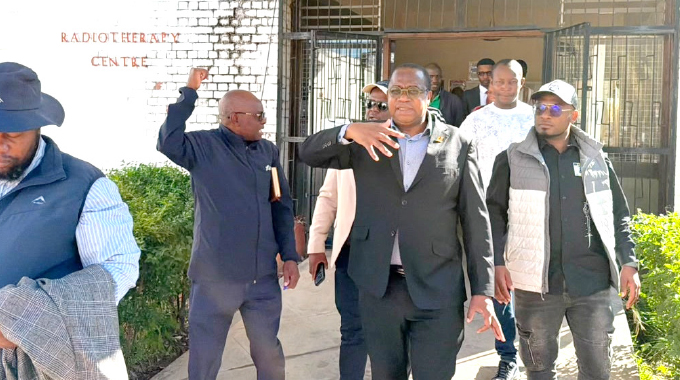
Robin Muchetu, Health and Gender Editor
THE Government has pledged to acquire the full range of machinery required for cancer diagnosis and treatment in Zimbabwe, as proceeds from the Sugar Content Tax continue to fund the modernisation of the country’s health sector.
Speaking during a tour of the Radiotherapy Centre at Mpilo Central Hospital in Bulawayo yesterday, Minister of Finance, Economic Development and Investment Promotion Professor Mthuli Ncube said the Second Republic was committed to ensuring that Zimbabweans can access comprehensive cancer treatment services locally.
He asked hospitals to make requests for the machines as well as making sure the infrastructure to house them is available, so that the acquisition can be done at the earliest possible time.
The latest commitment comes after the delivery of new cancer treatment equipment to Mpilo Central Hospital and Parirenyatwa Group of Hospitals last Friday, with installation of the first batch of machines already underway.\

“We want to provide you with the entire value chain and ecosystem for treating cancer patients. We really want to make sure you are up to date with the latest equipment. The Second Republic is very serious about upgrading the quality of health services to the greater population of Zimbabwe. What we have in Mpilo is what we have in Parirenyatwa, an upgrade of the radiotherapy section,” said Prof Ncube.
He said the Government would continue procuring additional cancer treatment equipment using revenue generated through the Sugar Content Tax on beverages.
“We will keep going because the Sugar Content Tax in beverages is being paid all the time and we will keep acquiring additional machines. I was asking earlier whether requests have been put for machines for dealing with prostate and cervical cancer. So, I have actually triggered them to ask for this,” he said.
“First of all, they have to construct an area for those, then we will purchase the machines and put in the order as soon as possible so that those cancers can also be taken care of.”
Prof Ncube said the Government’s objective was to establish a comprehensive cancer treatment system capable of handling all major forms of the disease.
“It will be wonderful to have the entire array of equipment, machinery and technology to deal with all manner of cancers that we see, so that we can offer comprehensive radiotherapy services at key hospitals like Mpilo and Parirenyatwa,” he said.
The Minister witnessed ongoing installation works at Mpilo, where a low-energy linear accelerator designed to treat cancers located close to the skin has already been installed and is expected to become operational by the end of June.
Preparations are also underway for the installation of higher-energy cancer treatment machines that recently arrived in the country.
“So, we have bought cancer machines and the installation has already been done. A new low-energy cancer machine has already been installed for cancers that are typically close to the skin. The area for the higher-energy machines, which have also arrived in the country, is being prepared and installation will begin soon,” he said.
“This means that we will significantly improve the quality of radiotherapy services, not only for Bulawayo, but for the Matabeleland provinces, Midlands and the rest of the country because this is a referral hospital.”
The US$30 million cancer equipment programme is being funded through proceeds from the Sugar Content Tax, which Government introduced as part of broader measures to address non-communicable diseases while generating resources for healthcare infrastructure.
Prof Ncube described the acquisition of cancer treatment equipment as a long-term investment rather than an expenditure.
“It is an investment. When you invest in a healthy population, you are investing in growth. Clearly it is an investment and it is aligned with our National Development Strategy 2,” he said.
He said the ongoing rehabilitation of Mpilo Central Hospital under the Presidential Hospitals Rehabilitation Programme was also contributing to economic growth through job creation, particularly for young people.
“The act of constructing this infrastructure is adding to economic growth. Rather than just upgrading the quality of the health facility, it is a job-creating activity. I was very impressed to see young people at the construction site. We need more youth to be employed,” said Prof Ncube.
The Minister said he was impressed by the progress made at Mpilo, where extensive refurbishment works are transforming hospital infrastructure.
“I toured the hospital and I am pleased with the developments so far. The renovations have completely repurposed all the rooms and they will move from block to block. This C Block will be completed in the next two months and it will be ready no later than August. It will change the face of Mpilo Hospital,” he said.
Prof Ncube also toured the hospital’s solar power plant, which was installed through a partnership between Government and the United Nations Development Programme (UNDP).
He said reliable electricity was critical for health institutions, particularly those operating specialised medical equipment.
“We are pleased that we have upgraded services here, but also in terms of having reliable power supply. We have seen the solar installation here, which is able to power various units within the hospital, including laboratories and the maternity ward. We must make sure there is reliable power because we cannot have machines going down in a hospital that should constantly provide services,” he said.
The Government officials said equipment being replaced at Mpilo and Parirenyatwa will be redistributed to other health institutions across the country, expanding Zimbabwe’s overall capacity to diagnose and treat cancer.