Chronicle Editor
Harare Bureau
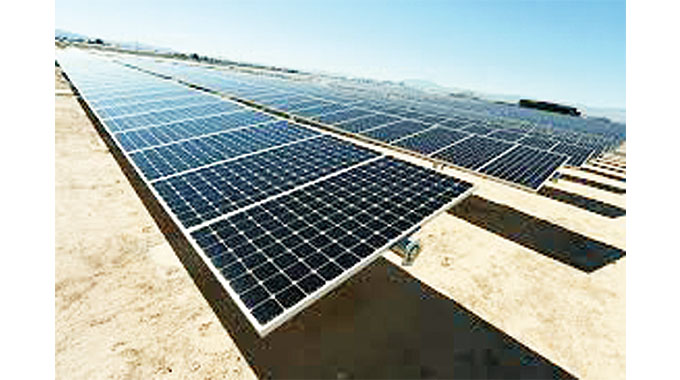
ZIMBABWE has witnessed modest investments in renewable energy by local private investors, particularly in solar as the country seeks to boost renewable capacity to 1 100MW by 2025, Energy and Power Development secretary, Engineer Gloria Magombo, has said.
She told our Harare Bureau in an interview that solar projects with the capacity to generate 70MW would be commissioned this year.
Most of the projects are being financed by private companies, insurance firms and pension funds.
Some of the investors include cement producer PPC (30MW), Caledonia Mining Corporation (12,5 MW) and Harava (5MW).

Electricity shortages in Zimbabwe have seen many companies and households investing in solar energy to ensure uninterrupted supplies.
“It’s not yet at the scale that we want it to be, but there is traction,” said Eng Magombo.
The Zimbabwe National Renewable Energy Policy, launched in 2019 has set the target of achieving a renewable capacity of 1 100 MW or 16,5 percent of overall electricity supply by 2025.
By 2030, it targets 2 100 MW or 26,5 percent of the overall supplies, a position the country also presented to the COP26 in Glasgow, United Kingdom, which is in line with its pledge to reduce greenhouse emissions by 2030.
The policy also aims to have installed 250 000 solar geysers, increase the use of the institutional and domestic biogas digesters, promote use of solar mini-grids and solar water pumping solutions as well as boost the use of renewable technologies.
To encourage investments into renewables, Zimbabwe is offering incentives including duty and tax exemptions and prescribed asset status to pension and insurance companies.
“We are urging investors; local and foreign to take advantage of these incentives,” said Eng Magombo.
“What we see at the moment is the participation of local investors and we hope this will also provide confidence to foreign investors.”
She also said some local investors were having challenges in developing proposals to bankability level due to funding challenges and advised to take advantage of the Projects Preparation and Development facility being offered by the Infrastructure Development Bank of Zimbabwe.
More than 35 African countries, Zimbabwe included and well over 1 000 major companies have committed to cut emissions in line with the goals of the 2015 Paris agreement on climate change, which seeks to keep global warming below two degrees Celsius and strive for a ceiling of 1,5 degrees by 2030.
Investments in renewables would be driven by off-grid standalone home systems, and mini and huge solar plants.
Globally, investments in renewable energy continue to grow and gain momentum, but are still far from being enough to avert the effects of climate change, the latest data by the International Renewable Energy Agency shows.
By the end of 2021, global renewable generation capacity amounted to 3 064 gigawatts (GW), increasing the stock of renewable power by 9,1 percent, the report says.
Although hydropower accounted for the largest share of the global total renewable generation capacity with 1 230 GW, IRENA’s Renewable Capacity Statistics 2022 shows that solar and wind continued to dominate new generating capacity.
Together, both technologies contributed 88 percent to the share of all new renewable capacity in 2021.
Solar capacity led with a 19 percent increase, followed by wind energy, which increased its generating capacity by 13 percent, the report says.
“This continued progress is another testament to renewable energy’s resilience. Its strong performance last year represents more opportunities for countries to reap renewables’ multiple socioeconomic benefits.
However, despite the encouraging global trend, our new World Energy Transitions Outlook shows that the energy transition is far from being fast or widespread enough to avert the dire consequences of climate change,” says IRENA director-general, Francesco La Camera.
“Our current energy crisis also adds to the evidence that the world can no longer rely on fossil fuels to meet its energy demand. Money directed to fossil fuel power plants yields unrewarding results, both for the survival of a nation and the planet.
“Renewable power is increasingly becoming the norm across the globe. We must mobilise the political will to accelerate the 1,5°C pathway.”
To achieve climate goals, renewables must grow at a faster pace than energy demand. However, many countries have not reached this point yet, despite significantly increasing the use of renewables for electricity generation, says the report.



 Online Reporter