Online Reporter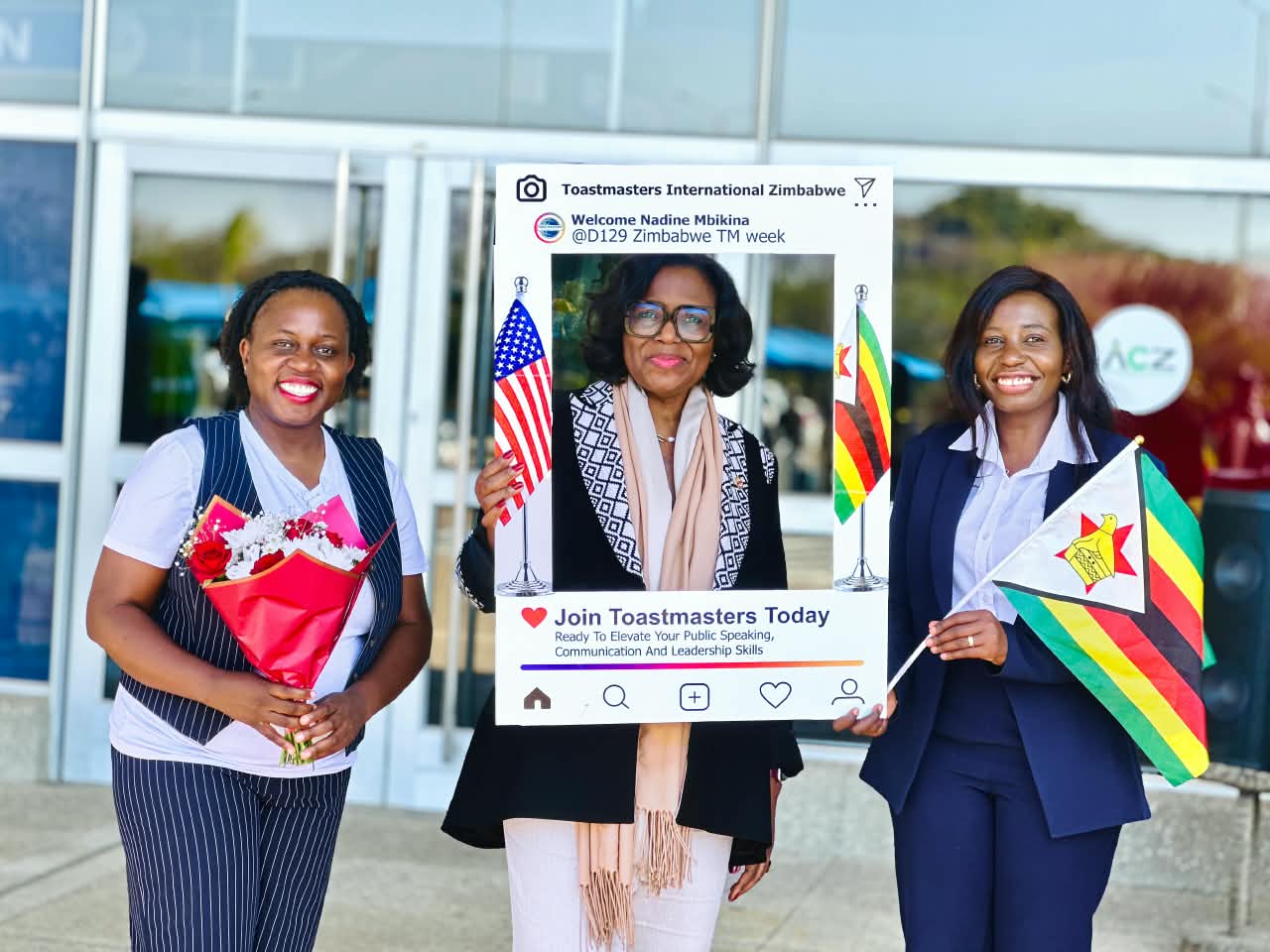
Mbulelo Mpofu [email protected]
THE ongoing Zimbabwe Toastmasters Week is taking communication and leadership development beyond traditional conference spaces, with the programme bringing the Toastmasters experience to communities in Bulawayo, Gweru and Harare.
The Zimbabwe Toastmasters Expo, which began in Bulawayo on August 30 and ran until September 1, moved to Gweru for a day before heading to Harare, where the programme will conclude on September 6.

Distinguished Toastmaster Nadine Mbikina, a Toastmasters International leadership and communication expert who oversees Africa, is the guest speaker at the Expo, bringing a continental perspective to discussions around leadership, communication and personal development.
For Toastmasters International District Director Future Moyo, a Bulawayo-born leader, the initiative is about more than a week of activities.
Zimbabwe Toastmasters Week is part of a broader strategy to make Toastmasters more visible and accessible to Zimbabweans who could benefit from structured leadership and communication development.
“The inspiration for Zimbabwe Toastmasters Week is deeply personal and profoundly strategic at the same time,” Moyo said.
District 129 covers seven countries – South Africa, Zimbabwe, Zambia, Malawi, Angola, Mozambique and Eswatini – with a vision of ensuring that every member grows, every club thrives and every part of the region has access to Toastmasters.
Moyo said the week was inspired by the leadership of Zimbabwe Division Directors Regai Gwande and Praexidis Dekwende, who chose to take Toastmasters directly into communities rather than waiting for people to discover the organisation.
“Zimbabwe Toastmasters Week, running from 30 August to 5 September 2026, is our answer to that gap,” she said.
The week has therefore become an opportunity to introduce new audiences to an organisation that Moyo believes is often misunderstood as merely a public speaking club.
She said Toastmasters should instead be viewed as a leadership development system used by about 270 000 members in 150 countries.
“We want business leaders who attend this week to leave knowing that Toastmasters is not a public speaking hobby – it is a leadership development system,” she said.
Moyo also sees the programme as a potential gateway for educators, young professionals and entrepreneurs to access practical leadership development.
The need, he argued, is particularly evident in a country with a large pool of talented and ambitious people who may not always have access to structured platforms for transforming their potential into leadership capacity.
Among the challenges Toastmasters seeks to address is what Moyo described as the “confidence gap”.
She said many capable people, particularly women and young professionals, have the ability to lead but may struggle to confidently articulate their ideas, advocate for their positions or speak under pressure.
“Public speaking anxiety is not a personality flaw. It is a skill deficit that structured training can close,” she said.
Toastmasters provides a practical environment in which members can develop those skills through speeches, meetings, evaluations and peer feedback.
Another challenge is the transition from being a technical specialist to becoming an organisational leader.
Moyo said Zimbabwe has many highly qualified professionals who are increasingly required to manage teams, engage stakeholders and communicate organisational strategy despite not necessarily having received formal leadership training.
Toastmasters, he said, provides an experiential approach in which members learn by participating rather than simply listening to lectures.
“Members do not sit in a classroom. They lead meetings, deliver speeches, evaluate peers, and receive honest feedback in real time,” she continued.
Stakeholder communication is another area where Moyo believes the Toastmasters model can make a difference.
Organisations, he said, risk losing trust when they cannot communicate effectively with employees, boards, clients and communities.
Toastmasters consequently places emphasis not only on speaking but also on listening, evaluation and adapting communication to different audiences.
The participation of Mbikina, who oversees Toastmasters activities across Africa, has added another dimension to the Expo.
Moyo said her presence demonstrates the growing importance of the African continent within Toastmasters International while providing Zimbabwean participants with an opportunity to engage with a wider regional perspective.
“Africa is not at the edge of the Toastmasters world. Africa is a priority. And Zimbabwe is a specific and exciting frontier within that priority,” said Moyo.
For individuals, the benefits of Toastmasters begin from the earliest stages of membership.
Moyo explained that new members typically deliver an introductory speech known as the Ice Breaker, creating an opportunity to overcome initial fears while receiving constructive feedback from fellow members.
He said the process gradually develops competencies in persuasive communication, strategic leadership, public speaking, active listening and mentoring.
The organisation also offers potential benefits to businesses and other institutions, with Moyo arguing that stronger communication can contribute to better meetings, presentations, client interactions and team management.
Educators can similarly use the model to complement formal education by helping students develop critical thinking, argumentation and the ability to communicate complex ideas clearly.
For entrepreneurs, the ability to communicate a business vision can also determine whether potential investors, partners and customers understand and believe in the idea being presented.
“There is no passive observation in Toastmasters. Every member participates. Every member grows,” Moyo said.
His personal connection to Zimbabwe, and particularly Bulawayo, has also shaped his approach to the District Director role.
“I was born in Bulawayo. The city that raised me is the city whose people I want to serve with everything this role makes possible,” she said.
Moyo said he had made three commitments upon accepting the District Director position: putting members at the centre of every decision, ensuring that no part of the region feels forgotten, and leading with the courage and commitment to growth that Toastmasters instilled in him.
For her, Zimbabwe Toastmasters Week represents those commitments in action.
“It is personal because I know what Toastmasters did for me. It gave me a voice I did not know I had,” she continued.
Looking beyond the Expo, Moyo has outlined an ambitious five-year vision for Toastmasters in Zimbabwe.
She wants to see clubs operating in every major city, including Bulawayo, Harare, Gweru, Mutare and Masvingo, while also expanding into other communities.
She envisions corporate Toastmasters clubs being embedded within leading Zimbabwean organisations, university clubs helping students develop confidence before entering the job market, and community clubs reaching townships and smaller towns.
The broader objective is to ensure that leadership development is not restricted by geography, profession or economic background.
“We want every Zimbabwean community that needs a Toastmasters club to have one. We want every Zimbabwean who wants to grow as a leader to have a place to do that,” Moyo said.
Zimbabwe Toastmasters Week is moving towards its conclusion in Harare on September 6, and the programme is therefore positioning itself as more than a showcase of public speaking.
It represents an attempt to widen access to leadership development while creating a national network of people equipped to communicate ideas with greater confidence, clarity and conviction.
For Moyo, the ultimate ambition is to build a locally rooted platform capable of helping Zimbabwe develop the next generation of leaders.
– Follow on X @MbuleloMpofu