Online Reporter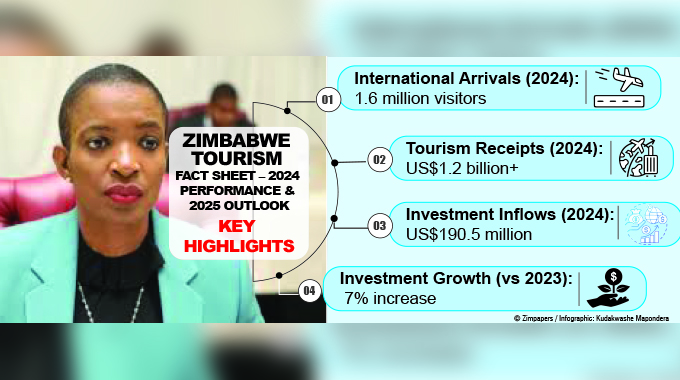
Nqobile Bhebhe in Mutare
ZIMBABWE’S tourism industry has emerged as one of the country’s most resilient economic pillars, shrugging off global shocks to generate more than US$1,2 billion in receipts from over 1,6 million international visitors in 2024, while drawing record investment inflows of US$190,5 million, Tourism and Hospitality Industry Minister Barbara Rwodzi has revealed.
Tourism, recognised under the National Development Strategy 1 (NDS1) and its successor NDS2 as a key pillar towards achieving an upper-middle-income economy by 2030, is fast emerging as one of the most resilient and growth-oriented sectors in Zimbabwe.
Addressing delegates at the ongoing Sanganai/Hlanganani/Kumbanayi World Tourism Expo Investment Conference in Mutare yesterday, Deputy Minister Tongai Mnangagwa, speaking on behalf of Minister Rwodzi, said the surge in arrivals and investments reflects deliberate efforts to position Zimbabwe as a premier destination for both leisure and business travel.
“The results are clear. Despite global economic challenges, Zimbabwe’s tourism sector has demonstrated resilience and growth. In 2024, Zimbabwe welcomed over 1,6 million international arrivals, which translated to over US$1,2 billion receipts,” she said.

“A total of US$190,5 million worth of investment was realised in the same year, representing a seven percent growth from 2023.”
Minister Rwodzi attributed the impressive performance to a combination of factors, including improved air connectivity, strategic marketing of the destination Zimbabwe and the country’s enduring peace and stability.
“The receipts were spurred by enhanced air connectivity, aggressive destination marketing, peace and stability, which are the hallmarks of our nation,” she noted.
The minister said the investments recorded in 2024 were largely driven by attractive opportunities and a noticeable increase in international arrivals, setting the tone for stronger performance in 2025 and beyond.
“The 18th edition of the Expo, running under the theme: ‘Unlocking Tourism Investment Opportunities for Local Economic Development’, could not have come at a more opportune time,” she said.
Minister Rwodzi said the expo highlights the country’s shared determination to harness tourism as a driver of inclusive growth, provincial empowerment and national transformation.
“It reminds us that tourism investment must go beyond national balance sheets, but to transform livelihoods at the community level. That’s inclusive tourism growth,” she said.
Minister Rwodzi emphasised that tourism is no longer a peripheral economic activity but now stands as a strategic lever for economic diversification, contributing to job creation, foreign currency earnings and rural development.
“Tourism is not just an industry; it is a strategic lever for economic diversification. Our policies, incentives, and partnerships are, therefore, aligned to ensure that every dollar invested in Zimbabwean tourism creates multiple streams of benefits for investors, for local businesses and for ordinary citizens,” she said.
The minister said the recently launched Tourism and Hospitality Industry Policy (2025–2030) provides a strong strategic framework for future growth.
“Its pillars are not theoretical; they are actionable commitments, sustainability and eco-friendly tourism practices to safeguard our environment and inclusivity to ensure communities are direct beneficiaries of tourism growth, innovation and digitisation to enhance competitiveness,” she said.
l Full story on www.chronicle.co.zw
“With these pillars, our direction is clear: we are creating an enabling environment for investment, modernising infrastructure, and ensuring that sustainability remains at the core of our growth.”
Organised by the Ministry of Tourism and Hospitality Industry in collaboration with the Zimbabwe Tourism Authority (ZTA), the annual Sanganai/Hlanganani/Kumbanayi Expo has grown into Africa’s premier tourism marketplace. It showcases the continent’s rich travel offerings while facilitating serious business engagement.
This year’s edition blends exhibitions, business-to-business networking, knowledge-sharing sessions, and cultural showcases — a dynamic mix aimed at stimulating growth across the tourism value chain.
Delegates will benefit from interactive sessions on emerging travel trends, digital transformation, and sustainability, while structured networking platforms will connect buyers and suppliers in pursuit of long-term commercial partnerships.
A flagship highlight of this year’s programme is the Tourism Scholastica Symposium, which brings together universities and colleges to unpack new tourism models, explore innovations, and strengthen the vital nexus between academic research and industry development.
The 2025 edition of the Expo carries added significance, coming just weeks after the unveiling of the National Tourism and Hospitality Policy (2025–2030), which places tourism at the heart of Zimbabwe’s economic transformation agenda.