

 Online Reporter
Rutendo Nyeve, Victoria Falls Reporter
ZIMBABWE and Zambia have reaffirmed their unwavering commitment to strengthening bi-national relations, with a sharp focus on ensuring hassle-free movement for visitors and traders in a bid to transform their shared border into a seamless conduit for economic growth.
The two neighbouring states took a concrete step towards this vision yesterday, as senior Government officials converged in Livingstone, Zambia, for a High-Level Dialogue on tourism and trade cross-border management.
The meeting, a direct implementation of the vision articulated by Presidents Mnangagwa and Hakainde Hichilema, saw Zimbabwe represented by its Deputy Minister of Tourism and Hospitality Industry, Tongai Mnangagwa, and Zambia by its Minister of Tourism, Rodney Sikumba.
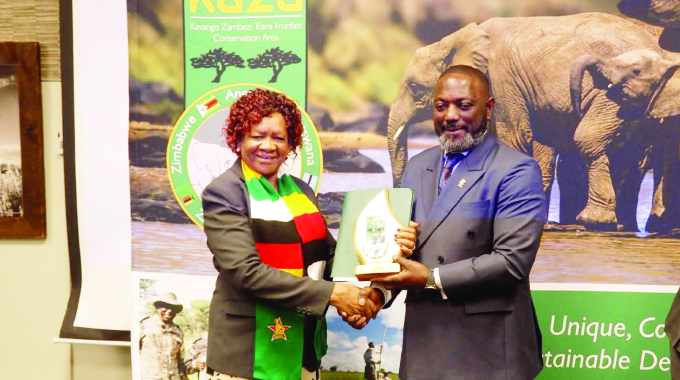
The dialogue follows a fruitful Bi-National Commission held by the two Heads of State in Harare last week, signalling a top-driven, co-ordinated push for deeper integration. This renewed vigour for co-operation is further amplified by the recent gazetting of the Victoria Falls Border Post to operate 24 hours a day — a landmark decision set to revolutionise travel and trade within the key tourism corridor.
Addressing the meeting, Deputy Minister Mnangagwa echoed the sentiment of the two Presidents, emphasising that the people of both nations are one people, separated only by the river. He called for collective resolve to translate this leadership vision into tangible action on the ground.
“Guided by the vision of our Presidents, we as Ministries of Tourism remain committed to ensuring seamless, hassle-free movement for visitors. Victoria Falls and Livingstone, two vibrant tourism hubs at the heart of the Kaza region, thrive when our collaboration is strong, when our borders are easy to cross, and when our people work together in harmony,” said Deputy Minister Mnangagwa.
He noted that the meeting included key arms of Government from both sides entrusted with border facilitation, security, immigration, customs, transport and tourism, underscoring the holistic approach being taken to address cross-border challenges.
The high-level dialogue was funded by the World Bank Group, which facilitated the proceedings. Mr Nathan Belete, the World Bank Division Director for Malawi, Tanzania, Zambia and Zimbabwe, underscored the critical importance of trade and tourism for both nations.
“Zambia and Zimbabwe share a long history, and I recently heard the two Presidents refer to their nations as twins. It is, therefore, not just befitting but necessary that we gather here to reflect on their remarkable collaboration,” said Mr Belete.
He provided compelling data to highlight the sector’s potential, noting the strong post-Covid-19 rebound with international arrivals reaching about 1,6 million in Zimbabwe and 22 million in Zambia in 2024.
Mr Belete also revealed that trade between the two nations totalled a substantial US$460 million in 2024.

However, the World Bank Director did not shy away from pinpointing the persistent challenges that threaten to stifle this growth. He identified non-tariff barriers as a major hindrance to progress.
“Non-tariff barriers — such as complex border procedures, overlapping requirements and inconsistent visa policies — continue to hinder the efficient movement of people and goods. Congestion at key crossings like Victoria Falls and Kazungula increases costs and reduces the competitiveness of the Livingstone–Victoria Falls border as a trade and tourism hub,” he said.
Mr Belete further cited infrastructure and connectivity gaps, including limited access roads and constrained domestic air links, as factors restricting investment and longer visitor stays.
Despite these challenges, the mood in Livingstone was overwhelmingly optimistic, focused on solutions and collaborative action.
Both Mr Belete and Deputy Minister Mnangagwa highlighted key initiatives such as harmonising visa regimes, including expanding the Kaza UniVisa, and joint marketing of the majestic Victoria Falls as low-hanging fruit with immense potential.




 Bongani Ndlovu