
Rumbidzayi Zinyuke
Senior Health Reporter
When Ms Nyasha Sayi from Epworth received the long-acting injectable HIV prevention drug Lenacapavir at its launch on February 19, it was more than just a medical intervention — it was a step towards protecting the health of her unborn children.
“I got the injection on February 19 when it was launched, and I have not experienced any side effects since then. As women, we face many challenges. Sometimes we even get sexually transmitted infections despite being married. So, for those of us who still want to have children, the lives and health of our future children are in our hands,” she said.
“If I am protected, then the children I will give birth to will also be protected. That is the reason I decided to make sure that I get the injectable PrEP (pre-exposure prophylaxis),” she said.
Like many women, Ms Sayi sees the twice-yearly injectable drug as a practical alternative to the daily oral PrEP.
“If you still want to give birth, Lenacapavir is one of the choices available to us. The good thing is that it is administered only twice a year, so there is little chance that you will forget, unlike the oral PrEP, which must be taken daily. This makes it a much better option for many of us,” she said.
For Ms Faith Chimfombo, the innovation offers hope in preventing infections before they happen.
“The rollout of Lenacapavir is a very important programme because it has come to give us hope. I got tested and was found negative, and I went on oral PrEP. When this injectable came, I did not hesitate to switch. I have not experienced any negative side effects, and I want to encourage other women to also take it,” she said.
Another resident, Mrs Piwai Svapani, believes the jab can help mothers safeguard their babies.
“This injection is important for pregnant women because it allows us to protect our unborn children. Even those who are breastfeeding are protected. I got tested and was negative, and I want to keep it that way.
“I want to encourage women who still want to get pregnant to go and get tested and join the programme if they are at risk,” she said.
For young women like Ms Netsai Maruvu, the injection represents a practical tool for protecting future families.
“We encourage women to get the injection because it protects them all the time. I also plan to go and get the injection because, from what we have been taught, it is effective, especially for us young women who want to have children,” she said.
HIV-free generation
Their experiences reflect a wider national effort as Zimbabwe intensifies its fight against HIV.
Zimbabwe’s journey towards an HIV-free generation is set to gain new momentum with the introduction of Lenacapavir, which could significantly reduce new infections among women of childbearing
age.
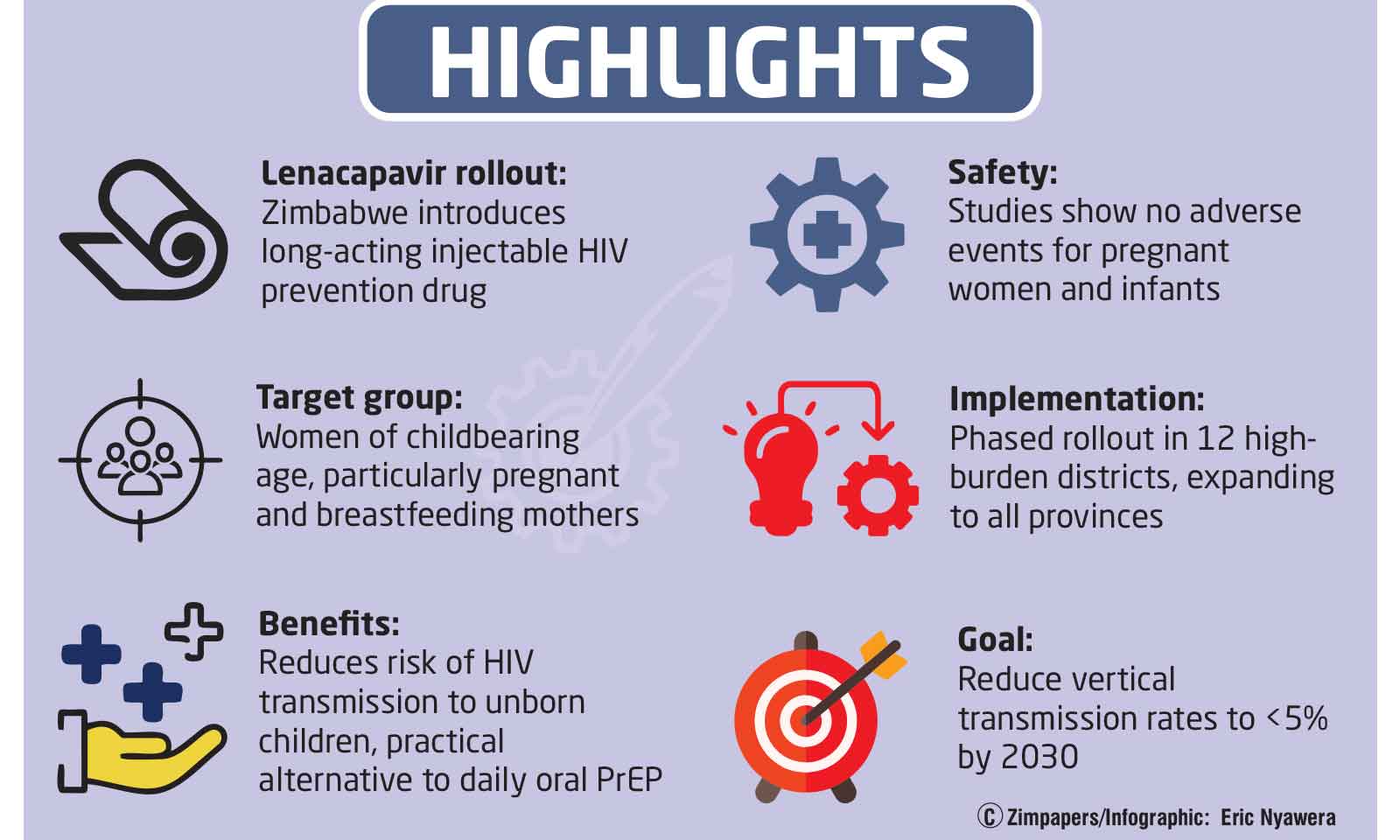
The injection, introduced last month, is being hailed as a potential breakthrough in preventing new infections among women, particularly during pregnancy and breastfeeding, periods when acquiring HIV/AIDS can place infants at risk of infection.
Health data shows adolescent girls and young women aged between 15 and 24 remain among the groups most vulnerable to HIV infection, with infection rates several times higher than those of males of the same age.
This age group also accounts for a significant proportion of pregnancies in Zimbabwe.
According to health authorities, about a third of pregnancies occur among girls and young women aged 15 to 24, while more than half occur among women aged 15 to 30, highlighting the importance of strengthening HIV prevention tools for women in their reproductive years.
Ministry of Health and Child Care national prevention of mother-to-child transmission (PMTCT) and paediatric HIV care and treatment coordinator Dr Angela Mushavi said the introduction of Lenacapavir could transform prevention efforts.
“Within our programmes, about 10 percent of women who book their pregnancies will be HIV positive, which means 90 percent are negative. We want this population to remain negative.
“They should not acquire a new HIV infection during pregnancy or breastfeeding.
“Otherwise, if they acquire a new HIV infection, they will transmit it to the infant, and it will defeat our goal of eliminating mother-to-child transmission of HIV.
“So, Lenacapavir is a game-changer and we welcome it,” she said.
The country has made significant progress in reducing mother-to-child transmission of HIV through widespread HIV testing and the provision of antiretroviral therapy to pregnant women living with the virus.
However, health experts say new infections among women who initially test negative during pregnancy remain a key challenge.
Lenacapavir, Dr Mushavi said, will complement existing prevention strategies by protecting HIV-negative mothers from acquiring new infections.
“From the studies that have been conducted, they have seen that for women who become pregnant whilst receiving Lenacapavir, there were no noticeable adverse events to their infants.
“So, we know that it is safe for a pregnant woman to take pre-exposure prophylaxis and to use Lenacapavir. The same also applies to mothers who are breastfeeding; they can safely use Lenacapavir during that period,” she said.
Health authorities will continue monitoring outcomes through pharmacovigilance systems to ensure the safety of both mothers and infants as the drug is rolled out.
The rollout of Lenacapavir is being implemented in phases, with 46 500 people across 12 high-burden districts expected to receive the drug.
The programme will eventually expand to all provinces as availability increases.
The Government is also developing the next national HIV strategy for 2026 to 2030, which will guide the country’s response in the coming years.
“By 2030, we want 95 percent of all pregnant women who are positive to be receiving antiretroviral treatment for their own health and preventing vertical transmission.
“We also want to scale up pre-exposure prophylaxis, including the long-acting injectable Lenacapavir, among women who are negative so that we prevent new infections in the population that will give us babies.
“Ultimately, we are aiming to reduce vertical transmission rates to less than 5 percent by 2030,” added Dr Mushavi.
As Zimbabwe intensifies efforts to eliminate new HIV infections among children, innovations such as Lenacapavir are expected to play a decisive role in safeguarding both mothers and the next generation.