Online Reporter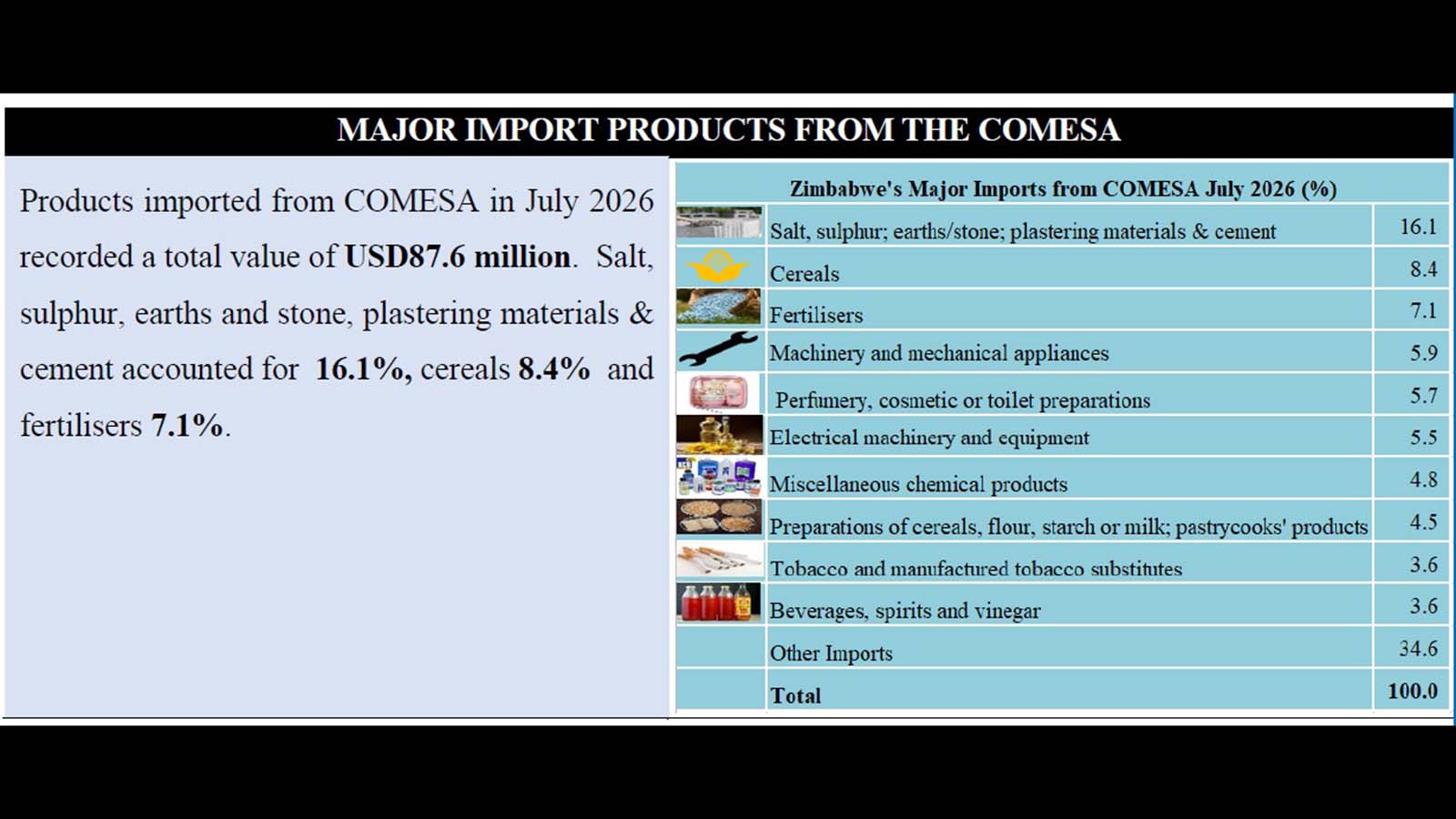
Business Reporter
Zimbabwe’s trade imbalance with the Common Market for Eastern and Southern Africa (COMESA) has deepened significantly, with imports outstripping exports by a ratio of more than three to one during July 2026, according to newly released trade data.
Exports to the regional bloc totalled a modest US$28.8 million, while imports from COMESA member states surged to US$87,6 million, leaving Zimbabwe with a substantial trade deficit of US$58,8 million for the month.
Iron and steel products emerged as the dominant export, accounting for 30,6 percent of the total export value, followed by coke and semi-coke of coal at 12,1 percent, bituminous coal not agglomerated at 8,1 percent, and cigarette tobacco at 6,5 percent.
Other notable exports included partially or wholly stemmed tobacco at 3,5 percent, maize seed at 3,1 percent, and corrugated paperboard cartons at 3,0 percent. Electrical energy exports contributed a mere 1,5 percent to the total export basket. Collectively, the top ten export products represented 71,7 percent of all exports, with the remaining 28,3 percent classified under “other exports.”
On the import side, salt, sulphur, earths and stone, alongside plastering materials and cement, topped the list, constituting 16,1 percent of all imports. Cereals followed at 8,4 percent, while fertilisers accounted for 7,1 percent. Machinery and mechanical appliances made up 5,9 percent, and perfumery and cosmetic preparations represented 5,7 percent.
Electrical machinery and equipment, miscellaneous chemical products, cereal preparations, tobacco products, and beverages each contributed between 3,6 percent and 5,5 percent of the import total. The “other imports” category comprised a substantial 34,6 percent, underscoring the diversity of goods flowing into Zimbabwe from the regional market.
The significant trade imbalance raises concerns about the competitiveness of Zimbabwean industry and the country’s ability to penetrate regional markets effectively. The heavy reliance on a narrow range of primary and semi-processed exports—particularly iron and steel, coal products, and tobacco—contrasts sharply with the more diversified import basket, which includes manufactured goods, agricultural products, and industrial materials.
Analysts suggest that the widening deficit may place additional pressure on Zimbabwe’s foreign currency reserves and could necessitate policy interventions to stimulate domestic production and value addition. The data highlights the urgent need for strategies to boost local manufacturing capacity and reduce dependency on regional imports.
The figures come as COMESA member states continue to pursue deeper economic integration under the bloc’s free trade area arrangements, which aim to eliminate tariffs and non-tariff barriers among member countries. However, the current trade dynamics suggest that Zimbabwe is yet to fully capitalise on the opportunities presented by regional market access.
Efforts to address the imbalance will likely focus on enhancing the competitiveness of Zimbabwean goods, improving production efficiencies, and identifying new export opportunities within the COMESA market. The government and industry stakeholders are expected to convene in the coming months to deliberate on measures to reverse the unfavourable trade trends.
The July 2026 data serves as a critical indicator of the structural challenges facing Zimbabwe’s trade relations within the region and underscores the imperative for targeted economic reforms to foster sustainable export growth.
Zimbabwe is set to host the 25th Common Market for Eastern and Southern Africa (COMESA) Heads of State and Government Summit on 22 October 2026 at the new Parliament Building in Mt Hampden. By hosting the event, the country will take over the rotational bloc chairmanship from Kenya for the 2026–2027 term.