Online Reporter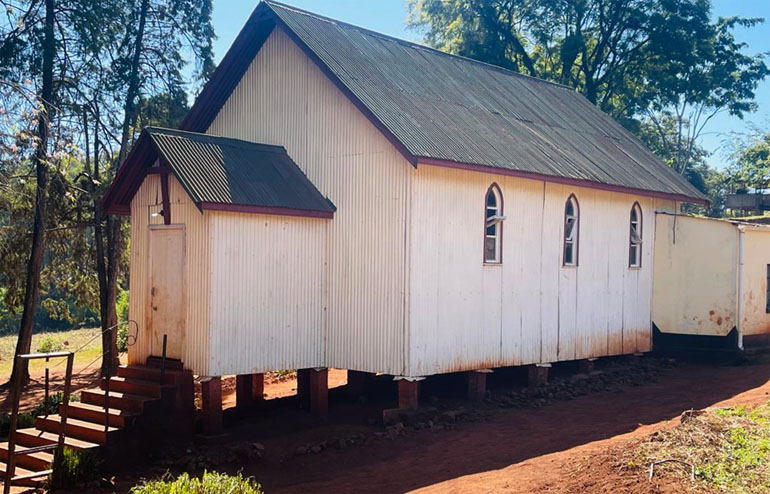
Lloyd Makonya
Correspondent
AMID the bustle that defines present-day Penhalonga, just north of Mutare, stands a quiet yet enduring testament to faith and history, St Michael and All Angels Church.
Tucked within the evolving social and economic landscape shaped by centuries of gold mining, this modest Anglican chapel offers more than a place of worship.
It is a living monument to Zimbabwe’s colonial past, a repository of memory and a symbol of the resilience that underpinned the early growth of Mutare.
Constructed between 1901 and 1910, the church is believed to have been built by local miners, artisans and townsfolk whose lives were intricately tied to the gold-rich seams of Penhalonga and the nearby Rezende Mine.
Its architecture reflects a simple, yet striking Edwardian style of corrugated iron walls supported by timber framing, tall lancet windows, original fittings and early electrical features such as visible insulators.
Though modest in size, with seating for approximately 40 congregants, the church was designed to foster intimacy and reflection.
Every element, from its hand-fashioned pews to its enduring structure tells the story of a community that drew, not only from the earth’s mineral wealth, but also from a deep well of spiritual faith.
To fully appreciate the significance of St Michael and All Angels, one must consider its surrounding landscape.
The discovery of gold in the late 19th century transformed Penhalonga from a quiet valley into a vibrant hub of commerce and migration. This development laid the groundwork for Old Umtali, the precursor to modern-day Mutare.
As settlers moved eastward from Fort Hill into the fertile valleys below the mountains, Penhalonga became both a staging ground for expansion and a sanctuary for spiritual life.
At the heart of this transformation stood the church, a place where marriages were solemnised, children baptised and lives commemorated.
Inside, a poignant roll of honour lists British servicemen and women, including members of the British South Africa Police, medical corps and volunteer regiments who served during the First World War.
Their names offer a solemn reminder of a small community’s connection to global events, adding historical depth to the church’s spiritual significance.
Today, St Michael and All Angels continue to serve as an Anglican place of worship, with Sunday services maintaining traditions of hymn and scripture.
At the same time, it quietly welcomes visitors and pilgrims retracing spiritual roots, historians exploring colonial narratives and tourists seeking an authentic encounter with the past. Set against a backdrop of change, the church remains unassuming yet steadfast and a witness to over a century of transformation.
Stepping inside, one is met with a profound sense of stillness.
The wooden beams, filtered light and hushed interior evoke echoes of prayers offered across generations.
In an era where modern development often obscures historical footprints, St Michael and All Angels Church stands firm as a spiritual and historical anchor in Penhalonga.
It is where the story of the gold rush intersects with the Gospel and where the foundations of Mutare’s urban identity quietly took root.
For both the devout and the historically curious, a visit to this sacred site offers more than a glimpse into the past, it offers a deeper connection to the enduring spirit that shaped a community and a city.