Online Reporter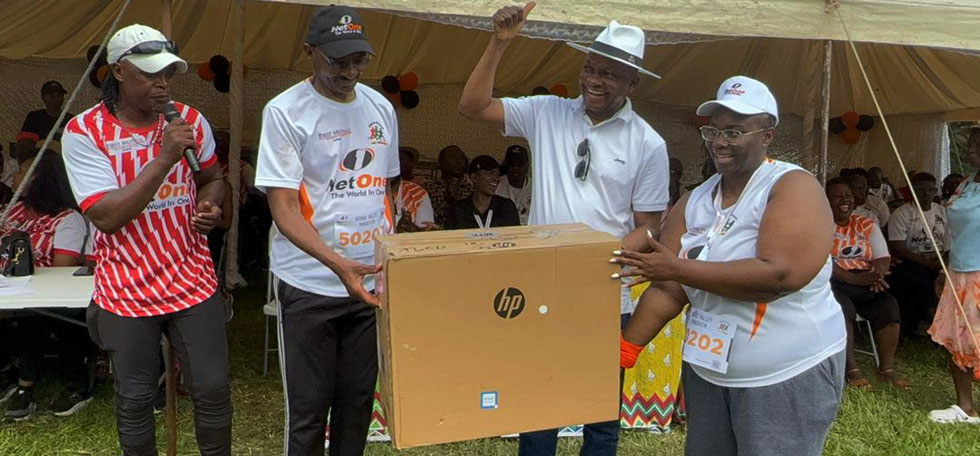
Moffat Mungazi
Post Reporter
LEADING telecommunications solutions provider, NetOne, is stepping up efforts to bridge the digital divide by accelerating rural communities’ inclusion in information and communication technologies after giving computers and accessories to schools in Mutasa District.
The donation of 12 computers and accessories was handed over to Senator Chief James Mutasa by the giant network provider’s Group Chief Executive Officer, Engineer Raphael Mushanawani during the NetOne Albun Honde Valley Marathon held at the Eastern Highlands Plantations last Saturday.
Engineer Mushanawani said the gesture reiterates NetOne’s commitment to the broader initiative of speeding up rural communities’ digital inclusion.
“As NetOne, we found it prudent to give 12 computers and accessories to schools here in Mutasa District where we have just staged the Honde Valley Marathon. The process was done in consultation with Chief Mutasa to ensure that the most deserving beneficiaries are the recipients.
“This gesture is one of our several innovative strategies to enhance rural communities’ information and technology inclusion so as to close the digital gap with their urban counterparts. We operate in these communities and have deployed and developed telecommunications infrastructure that promotes digital literacy and community engagement,” he said.
Engineer Mushanawani said the gadgets improve the beneficiary schools’ connectivity to the global village as well as help them explore other opportunities.
“These computers are a means to an end such that they will improve the learners’ access to information and communication technology. This is important in enhancing their exploration of the world through internet connectivity, while also tapping into the opportunities such initiatives create,” he said, adding that NetOne will continue building more and improving existing telecommunications infrastructure to enhance seamless internet connectivity and access to affordable digital technologies.
“Today’s world has become a rapidly advancing digital era and access to technology is, therefore, the vital foundation on which economic growth, social progress and global connectivity is built,” said Engineer Mushanawani.
NetOne, he added, also donated sanitary pads and copies of the President’s book “A Life of Sacrifice: A Biography of Emmerson Mnangagwa” to help learners relate with the inspirational experiences of the man championing Zimbabwe’s economic development and social transformation.
Receiving the donation, Chief Mutasa commended NetOne for being a responsible corporate citizen that gives back to the community.
He described the gesture as bringing positive impact on the educational development and social inclusion of the district.
“Mutasa District is grateful to NetOne for this donation of 12 computers and accessories. This will go a long way in helping the schools, especially those in Honde Valley and along the border with Mozambique, to implement comprehensive digital education programmes through smart learning. Equipped with technology, educational resources and internet connectivity, literacy and learning opportunities will be significantly improved for rural learners.
“We are in the process of having solar power installed at some of the schools. All these initiatives are welcome developments as the computers are crucial in helping the recipient schools acquire, process, store and disseminate its records, documents, videos and pictures conveniently. In a way, this is also empowering the schools by enabling them to carry out e-learning and e-commerce,” said Chief Mutasa.
The traditional leader added that they will seek to engage other corporate entities to assist in building computer labs at different schools to promote the acquisition of crucial digital literacy skills.
Government is on a national drive to ensure that schools integrate and incorporate digital technology in teaching and learning while also enhancing technological infrastructure development to anchor rural digitisation.
Telecommunications companies are also expanding network coverage in marginalised areas to complement Government’s drive to digitise rural communities.
The combined efforts have culminated in the ongoing rollout of 5G technology and the construction of base stations in underserved regions.
All these initiatives are steps in the right direction towards achieving the national aspiration of having an empowered and prosperous upper-middle income economy through Vision 2030 by ensuring that no one and no place is left behind by fostering inclusivity and easy access to technology.