Vusumuzi Dube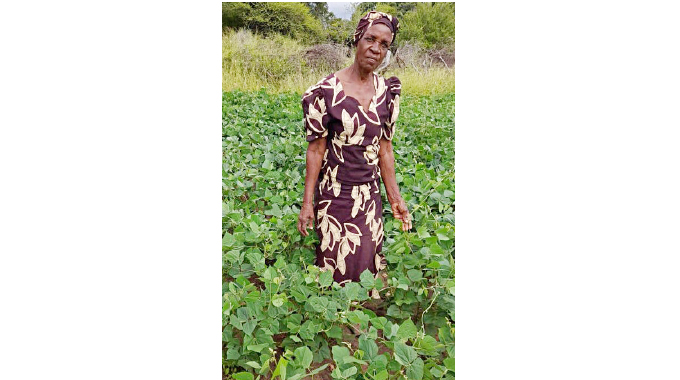
Judith Phiri , Business Reporter
Deep in the drier landscape, Mangwe District farmer, Mrs Monica Ndlovu has adopted agro-ecology technologies of composted fertilisers to achieve higher crop yields and fodder production for her livestock.
The 78-year-old widow from Simelamela village, Ward 15 Makhubu has over the years lost a number of livestock to poverty deaths, while her cropping had also been not successful. Mangwe District in Matabeleland South falls in the natural region five characterised by highly erratic rainfall patterns and poor soils in some areas.
With the advent of the Enhanced Resilience for Vulnerable Households in Zimbabwe project, Mrs Ndlovu and a number of farmers in her area have received trainings on agroecological technologies of fodder production, composting technologies and seed starter packs of both fodder crops and traditional grains.
The farmers have been able to withstand shocks and enhance their food nutrition and security.
“We had been having challenges of inaccessibility of fertilisers due to lack of financial muscle to procure it and the distance to the agro-dealers saw us as farmers having to solely depend on growing crops without fertilisers leading to reduced yield and eventually leaving us with little to feed our families.
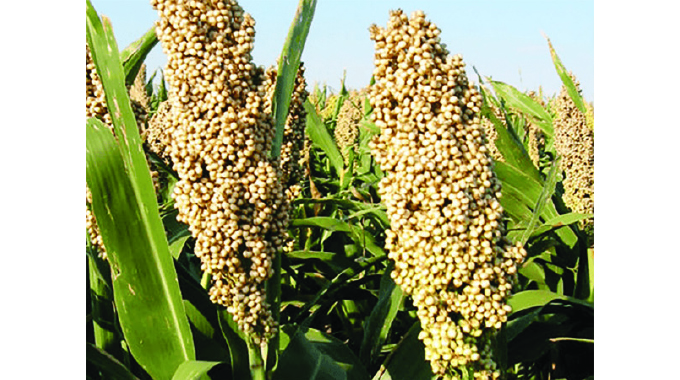
I took it upon myself to adopt these agro-ecological techniques making composted fertilisers that have assisted me in increasing my traditional grains yields of sorghum, cowpeas and pearl millet.”
She said she used to buy four to eight bags of fertiliser which was very expensive, but now she makes thermal compost, boccashi and liquid fertiliser which comes from locally available resources with low costs.
In terms of livestock, she said she has started producing fodder for her livestock. Mrs Ndlovu said before, to try and save their livestock, they had to move their cattle as far as 40 kilometres into Botswana’s border where the cattle would sometimes be shot and killed for trespassing.
“Through fodder production, there is no more loss of livestock through shooting in Botswana. The project interventions have not only reduced the costs of production but also increased my yields and eventually incomes. I harvested 0.7 tonnes on a 0.4 ha size plot of sorghum and 250 bales of lab lab and velvet bean for the livestock.”
She said this was a relief to her as livestock were her source of income as well as draught power.
Mrs Ndlovu said the surplus of the 200 bales will be sold to other cattle farmers in her community especially when the products are most profitable at US$2.50 per bale, giving her US$500, during the period August to November when cattle are stranded with feed.

“As the breadwinner for a family of three adults and four children, the money will assist to be able to pay school fees for the children and improve our livelihood. I am now able to meet my other family demands such as medical bills,” she added.
The Enhanced Resilience for Vulnerable Households in Zimbabwe project is funded by the European Union (EU) and managed by Food and Agriculture Organisation (FAO) and United Nations International Children’s Emergency Fund (UNICEF). The Sustainable Agriculture Technology (SAT) is the implementing partner in collaboration with the Government of Zimbabwe, as the project aims to address climate change shocks on vulnerable rural households in Matabeleland South Province.


 Online Reporter