

 admin
admin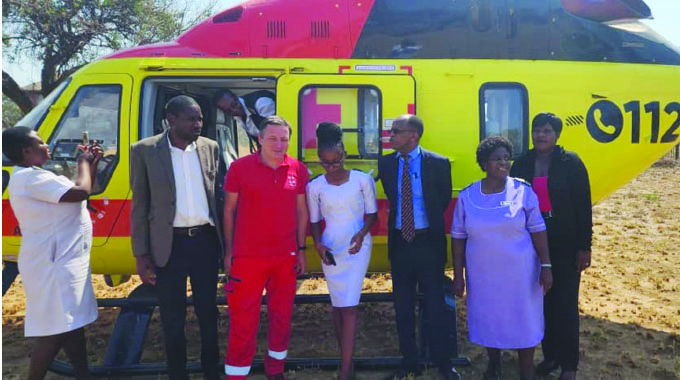
Raymond Jaravaza, Bulawayo Bureau
A CLOUD of dust blanketed a section of the United Bulawayo Hospitals (UBH) aerodrome as the rotor blades of an Ansat helicopter whirred in the air, announcing the arrival of a life-saving air ambulance at one of the city’s referral hospitals in Bulawayo yesterday.
The helicopter, a flying intensive care unit, is one of two air medical rescue service ambulances that will be stationed at UBH to offer swift medical responses for emergencies, such as victims critically injured in road accidents. The air ambulance will also be used to airlift patients from hard-to-reach places like rural areas, which would typically take hours to reach by road.
As soon as the rotor blades subsided and the helicopter’s engine switched off, two pilots, together with Dr Evgenii Kibakin, disembarked and signalled the waiting UBH team to come closer.
Dr Kibakin, a physician trained in Russia, explained some of the life-saving equipment that the air ambulance is equipped with to save lives while a patient is flown to a medical facility. The helicopter can carry a single patient and three medical staff in addition to two pilots.
“In the event of a medical emergency involving a mother and a child, the medical helicopter will carry both of them, including a doctor, two nurses, and two pilots. The air ambulance is equipped with breathing apparatus, pacemakers, monitoring systems, defibrillators, and blood transfusion equipment, among other equipment.
“The doctor and nurses should be able to stop excessive bleeding and stabilise a patient involved in a road accident until that patient is taken to a nearby hospital,” said Dr Kibakin.
It typically takes a motorist one and a half hours to drive from Bulawayo to Kezi, a 100km journey that takes long to complete due to the bad state of the road, which is infested with potholes. We asked Dr Kibakin to find out from one of the pilots, who are both not fluent in English, how long it will take to airlift a patient from Kezi. After some quick calculations in his head, the pilot replied, “About 30 minutes. The helicopter flies 190km per hour.”
Some work still needs to be done at the UBH aerodrome before the air ambulance services can go into full operation, as explained by the HeliZim accountable manager, Ellemencia Nyasha Makosa.
“The first stage is to get the helipad fixed because it’s not in a usable state for us to start full operations. We also need to erect a perimeter fence to secure our air ambulance helicopters. Once the helipad is approved by the Civil Aviation Authority of Zimbabwe, then full operations can start,” she said.
The HeliZim crew – doctors, pilots, technicians, and other personnel – will be housed in a building less than 200 metres from the UBH helipad. Makosa explained why it is important for the crew to reside within walking distance of the helipad.
“It’s very vital for the HeliZim crew to reside very close to the helipad and in close proximity to our equipment because they must meet the stipulated response time when a call is received that there is an emergency somewhere. They will be on standby 24 hours a day but do not work at night. We do not do night flights,” she said.
The ideal response time is 15 minutes from the time a call is received to the air ambulance taking off, said Makosa.
“When a call is received, say at UBH, we have to confirm if Mpilo Hospital has not received the same emergency call, then we file for a flight plan with the Civil Aviation Authority of Zimbabwe. Once we receive the flight plan, then we are ready to go,” she said.
In the event that the air ambulance is summoned to an area where there is no helipad, the pilots use their discretion to use an open space such as a sports field to land.
UBH acting clinical director Dr Trust Mushawarima said the medical institution was honoured to be chosen to host the air ambulance services.
“This service will transform our emergency services in terms of patient evacuations from accident scenes and reduce the time that accident victims are ferried to hospital for medical attention. The air ambulance services will benefit all Bulawayo hospitals as patients can be stabilised mid-air en-route to the respective hospitals where they will be treated,” said Dr Mushawarima.
President Mnangagwa and his Government are actively modernising the health sector as part of a strategic initiative to transform Zimbabwe into a prosperous, highly industrialised nation by 2030.
In June, the President travelled to Russia to seek investors for establishing air ambulance services for the public health sector.
Russian HeliDrive Air Ambulance Medical Services quickly responded, arriving in Zimbabwe to assist in developing an efficient air ambulance system staffed by highly skilled medical professionals, including doctors, nurses, engineers, dispatchers, and pilots. The recruitment and training of local personnel are underway, with the company hiring 40 local pilots, 50 doctors, 100 nurses, 100 dispatchers, and 10 engineers.
Air medical ambulances play a crucial role in healthcare by transporting patients, often in critical condition, from one location to another using aircraft specially equipped with medical equipment and staffed by trained medical professionals.
The importance of air medical transport lies in its ability to provide rapid and efficient transportation for patients who require immediate medical attention or specialised care that may not be available locally. The service allows for timely access to advanced medical facilities and specialised healthcare providers that may be located far away. This is particularly significant for individuals residing in remote areas or regions with limited healthcare resources. By bridging the geographical gap, air medical transport ensures that patients receive the necessary medical interventions promptly, potentially saving lives.



 Online Reporter