admin
admin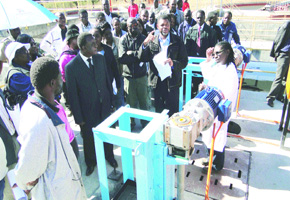
The $820 000 project was funded through an $800 000 loan from the International Development Bank of Zimbabwe (IDBZ) loan, with the remainder coming from council.
About $5,7 million is needed to rehabilitate all the city’s waste water treatment works.
The scope of the project entailed rehabilitating the Aisleby Number 3 and Thorngrove Sewage Treatment Works.
They have not been working properly in recent years, resulting in almost all the effluent that passed through them, getting discharged into the environment without being treated. Most of it went into Umguza River.
The Aisleby plant caters for waste that comes from the low-density areas, the Central Business District and the industrial areas, while the one at Thorngrove covers a number of the city’s high-density suburbs.
Speaking during a tour of the rehabilitated plants, the city’s director of engineering services, Engineer Simela Dube, said the plants would ensure that at least 25 percent of the city’s waste was treated to levels that were permissible before being discharged into the environment.
“Most of the waste that was going into Umguza was caused by the malfunction of the Aisleby plant. With the rehabilitation, we expect to reduce pollution of the river by about 50 percent. This is a big improvement which we want to continue working on until we reach 100 percent,” said Eng Dube.
He said the biggest challenge to treating waste to acceptable levels was Zesa power cuts.
“These plants are adversely affected by power cuts. Whenever there is load-shedding, everything comes to a standstill. Raw sewage collects in the ponds and overspills into the environment without being treated, thereby causing pollution,” said Eng Dube.
He said council would engage Zesa to have special lines that would not be subjected to load-shedding, to supply power to the plants.
Eng Dube said vulnerability to waterborne diseases would be reduced in the city, adding that ecosystems would be preserved, leading to increased bio-diversity and balanced life.
In a speech at the Aisleby plant, the Mayor, Councillor Thaba Moyo, said the project was the first phase of an ongoing process to resuscitate all the city’s wastewater treatment facilities.
He said the purified discharge from the plants would ensure increased agricultural productivity downstream in Umguza.
“The rehabilitation will enable a higher quality of effluent to be discharged into the river and hence reduce the mortality of aquatic life. The rehabilitated plants will drastically reduce discharge of raw sewage into the river thereby increasing agricultural productivity downstream,” said the Mayor.
Clr Moyo said a local company; Consolidated Merchants and Engineers (CEM) had carried out the rehabilitation.
In an interview during the tour, the Environmental Management Agency (EMA)’s provincial environmental manager for Bulawayo, Mr Decent Ndlovu, applauded the city council.
“This is a very pleasing and positive move. As EMA, we say council should keep it up and we invite them to share ideas with us as they work on reducing pollution to zero percent. Local authorities like Bulawayo should not wait to be fined for polluting the environment,” said Mr Ndlovu.
EMA has fined the Bulawayo City Council a total of $10 000 this year for polluting Umguza River.
Other companies in the city have also been fined varying amounts for the same offence.
Raw sewage, dangerous poisons like lead, mercury, cyanide and chromium 6 from companies in Bulawayo, have found their way into Umguza River.
Zinwa’s Gwayi Catchment area manager, Mr Fortune Musona, under whose jurisdiction the river falls, said crops irrigated with the water had elevated toxin levels and did not meet international standards for exports.
The Permanent Secretary in the Ministry of Health and Child Welfare, Dr Gerald Gwinji, once said if the concentration of the polluting chemicals increased to a certain level, drinking from the river could prove fatal.
A medical expert added that people who drank water from the river or ate animals that drank from it risked cumulative lead and mercury poisoning.
He said the effects that could manifest even after 20 years or in future generations, included babies born with deformities or children who are extremely dull.
The doctors said communities along the river could suffer from cancer or skin disorders because of the chemicals being dumped into the river.


 Online Reporter