Online Reporter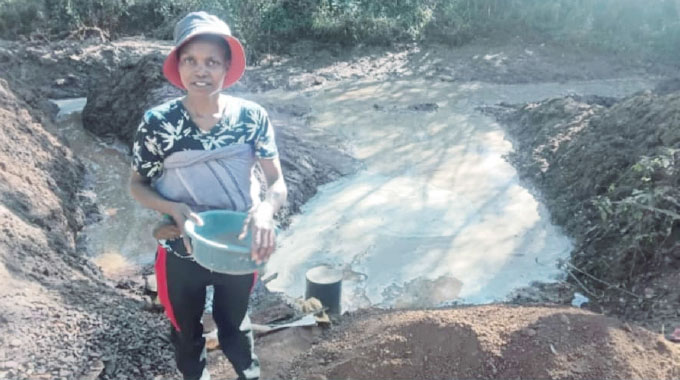
Gibson Mhaka, Senior Features Writer
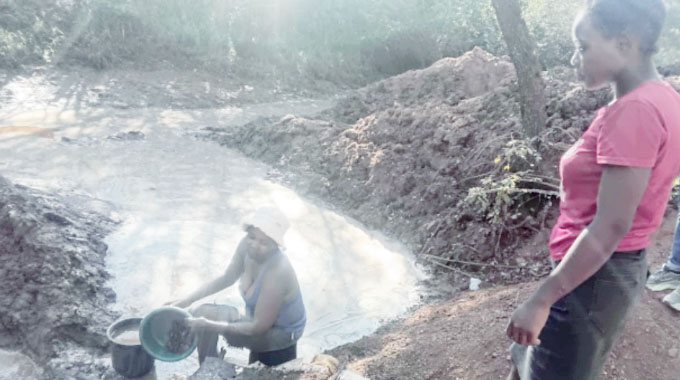
THE morning sun glitters on a stagnant pool of muddy water as a group of women descend the slippery banks of a riverbed in Village 10, under Chief Sibasa in Insiza District, Matabeleland South Province.
One grips a shovel worn smooth by years of use. Another clutches a battered plastic dish.
Nearby, a young mother adjusts the baby strapped to her back before crouching to sift through sludge in search of tiny specks of gold.
Their bare feet sink deep into the mud. Their hands, stained by soil, sweat and chemicals, move with the precision of people who have performed the same task countless times before.
By mid-morning, exhaustion is already etched across their faces. There are no gloves. No masks. No protective clothing. Only determination. And hope.
Hope that somewhere beneath the murky waters and heaps of crushed rock lies enough gold to buy mealie meal, pay school fees or keep hunger from the doorstep for another day.
Yet hidden beneath this daily struggle is a danger far deadlier than poverty itself.
It is odourless. Invisible. Slow-moving.
And for many of the women who come here every day, it is a threat they do not even know exists.
Mercury, the highly toxic metal used in artisanal gold mining, has become a silent killer in Zimbabwe’s informal mining communities, exposing thousands of women and children to serious health risks while they pursue one of the country’s most prized minerals.
In this corner of Zimbabwe’s mining belt, women risk their health and lives in pursuit of gold, a commodity that powers global markets but rarely transforms their own fortunes.
For many, artisanal mining is not a choice. It is survival.
The price of survival
This is the reality confronting 35-year-old Keitumetsi Ndlovu and 26-year-old Noleen Muleya of Village 10 under Chief Sibasa.
Every morning, they join scores of other women at the mining site, driven by the same objective: finding enough gold to sustain their families.
Traditionally, mining has been regarded as a male preserve. But recurring droughts, shrinking agricultural yields and economic challenges have pushed increasing numbers of women into artisanal and small-scale gold mining.
For Keitumetsi, a single mother, staying away from the mine is not an option.
She already suffers from recurring chest pains and severe skin irritation, yet she continues reporting for work each day.
“I am a single mother, and I carry the full burden of providing for my children,” she says in a low voice.
What she does not know is that the mercury she handles during gold processing could be contributing to the very ailments she is battling.
Like many women at the site, Keitumetsi has never received formal training on mercury exposure or its health consequences.
She continues touching and working around the toxic substance without protective equipment, unaware that prolonged exposure has been linked to respiratory illnesses, neurological disorders, kidney damage and skin conditions.
Her body is sending warning signals.
But poverty is louder.
The fear of failing to feed her children keeps her tied to the very work that may be slowly harming her.
Nearby, Noleen Muleya shares a similar story.
Gold mining, she says, has become the community’s economic lifeline.
“There are very few opportunities here. Most families depend on gold mining to survive,” she says.
Yet despite working in an environment where mercury is routinely used, Noleen admits she knows little about its dangers.
She is unaware that long-term exposure can damage the lungs, kidneys and nervous system or that mercury contamination can persist in the environment for decades.
Like countless women across Zimbabwe’s artisanal mining sector, she continues working in ignorance, unaware of the risks accumulating with every passing day.
A baby on her back, mercury in her hands
Perhaps no image better captures the vulnerability of women miners than that of Gugulethu Nare (25).
With her infant strapped securely to her back, she bends over muddy pools and heaps of crushed ore searching for gold.
The child sleeps as his mother works. The scene is both ordinary and heartbreaking.
Gugulethu says she has never been informed that mercury could be harmful to her health or that of her child.
“We do not know that mercury is a dangerous substance and we have never been sensitised about it,” she says.
Her words expose a troubling reality.
Across many artisanal mining communities, women and children are routinely exposed to hazardous chemicals without adequate information, training or protection.
As mothers process ore contaminated with mercury, their children remain within arm’s reach of the toxic environment.
What is particularly alarming is that many of these women have no idea they may be exposing themselves and their children to a substance known worldwide for causing serious health complications.
For Gugulethu and many others, the immediate challenge is not mercury.
It is survival. Finding the next meal, paying school fees and keeping a roof over their families’ heads.
The dangers of mercury remain invisible until they manifest as illness.
The toxic truth
The women’s stories emerged during a sensitisation campaign conducted under the planetGOLD Zimbabwe programme, an initiative seeking to reduce mercury use in artisanal and small-scale gold mining while promoting safer alternatives.
Supported by the Global Environment Facility (GEF) and led by the United Nations Environment Programme (UNEP), the programme is being implemented by IMPACT in partnership with the Ministry of Mines and Mining Development and the Environmental Management Agency (EMA).
The campaign targeted artisanal and small-scale gold miners, with particular focus on women miners, many of whom handle mercury regularly without fully understanding its dangers.
Mercury remains one of the most hazardous substances used in gold extraction.
When heated, it releases toxic vapours capable of contaminating air, water and soil.
During the visit, Environmental Management Agency official Mr Muchineripi Kuvuya took time to educate the women miners on the health and environmental dangers associated with mercury use.
He warned that the chemical’s impact extends far beyond mining sites.
“Mercury vapour does not simply disappear into the air. It can be carried by wind currents and rain, eventually contaminating the environment and affecting communities far beyond the mining site,” he said.
Mr Kuvuya explained that prolonged exposure can damage the lungs, kidneys and nervous system.
More disturbing, however, are the risks posed to unborn children.
“If a pregnant woman is exposed to high levels of mercury, it can negatively affect the developing baby and may lead to birth defects. The challenge with mercury is that it can remain in the body for a very long time, continuing to cause harm long after exposure,” he said.
For many women listening to the presentation, the information was shocking.
Several admitted it was the first time anyone had explained the dangers associated with mercury.
Reaching the unreachable
Zimbabwe became a signatory to the Minamata Convention on Mercury in 2013 before formally acceding to the treaty in 2021.
Yet despite global efforts to reduce mercury use, the chemical remains deeply embedded in artisanal gold production.
Experts estimate that approximately 96 percent of Zimbabwe’s artisanal gold output is still linked to mercury use.
Zimbabwe Artisanal and Small-Scale Women Miners Association (ZASWMA) chairperson Mrs Kundayi Chikonzo-Midzi says one of the greatest challenges is reaching women operating outside formal mining structures.
“We frequently sensitise women who work within cooperatives about the dangers of mercury and the importance of adopting safer mining practices. However, reaching those who operate illegally is often difficult because many of them fear that officials or visitors are coming to arrest them,” she said.
Technical advisor for the Insiza Women in Mining Association Ms Barbara Njanjari echoed similar concerns.
“Women in artisanal mining face numerous challenges, particularly those who are not formalised. Besides limited access to information on occupational health and safety, they also face gender-based violence, exploitation, discrimination, lack of financial support, inadequate mining equipment and difficulties in accessing markets and mining claims,” she said.
A safer future
For the organisation, planetGOLD Zimbabwe project manager Ms Nyaradzo Mutonhori says the programme aims to reduce mercury use by 4,85 tonnes over five years.
“PlanetGOLD Zimbabwe aims to promote a safe, clean and sustainable artisanal and small-scale gold mining sector in Zimbabwe by reducing mercury use by 4,85 tonnes over a five-year period,” she said.
Ms Mutonhori noted that women remain a key target because they are among the most vulnerable groups in the sector.
“We are deliberately targeting women miners because many of them are directly involved in gold processing activities where mercury is used.
“Those operating informally or illegally are often the hardest to reach, yet they are among the most vulnerable due to limited access to information, training and safer mining technologies,” she said.
The programme is also preparing miners to adopt mercury-free technologies capable of recovering gold without exposing communities to dangerous chemicals.
The hidden cost of gold
As the day draws to a close, Keitumetsi, Noleen and Gugulethu continue working.
They crush rocks. Wash sediment. Search for gold.
And hope.
Hope that today’s labour will bring enough reward to sustain their families.
Yet beyond the visible hardship lies a hidden danger they are only beginning to understand.
For years, these women have been fighting poverty with their bare hands.
What they did not know was that another battle was unfolding inside their bodies.
Mercury poisoning does not happen dramatically.
It creeps in silently. A persistent cough.
A skin rash. Fatigue. Numbness.
Complications during pregnancy.
Damage that often goes unnoticed until it is too late.
And that is what makes mercury such a formidable enemy.
It is not merely a toxic chemical.
For many of Zimbabwe’s forgotten women miners, it is a silent killer hiding beneath the glitter of gold.