


 Online Reporter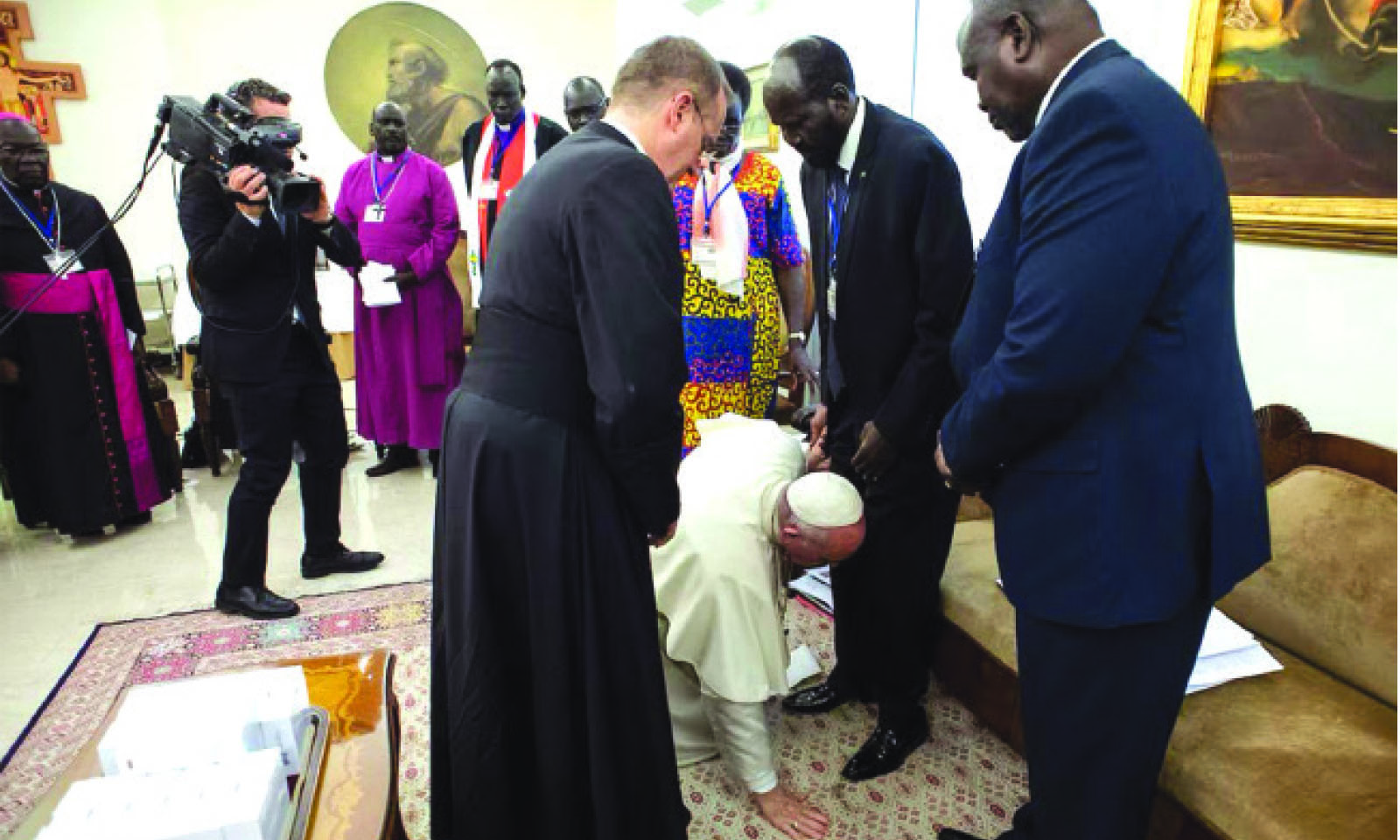
Communion with Bishop Lazarus
Only a higher calling can take a young man from the modest streets of Flores, Buenos Aires, Argentina, in Latin America, to the storied and hallowed halls of Rome as Pope of the Roman Catholic Church.
And this is no ordinary higher calling either.
Popes are considered successors of Saint Peter, upon whom Jesus Christ built his church, according to Matthew 16 verse 18: “And I tell you that you that you are Peter, and on this rock I will build my church, and the gates of Hades will not overcome it.”
So, in Catholic theology, the pope is God’s representative here on earth.
This is the story of Jorge Bergoglio — better known as Pope Francis — who fittingly finished his race as God’s athlete on Easter Monday after a long illness.
After stints in hospital, he recovered in time to bid his 1,3 billion flock farewell during Holy Week as he journeyed to the afterlife.
War and conflict
Just as during his time as Archbishop of Buenos Aires, his papacy mainly focused on the poor and marginalised, and he will be forever remembered as a crusader for peace and love, messages that resonate in the troubled and impoverished parts of the world.
And, as he endeavoured to signpost humanity towards the path of peace, Africa, which is now regarded as the future of the Church owing to the sheer and ever-growing number of Christians, became one of his preferred destinations.
From the time he was elected Pope on March 13, 2013 until he breathed his last on Monday, he visited 10 countries on the continent — including Kenya, the Central African Republic (CAR) and Uganda (2015), Mauritius, Madagascar and Mozambique (2017), as well as the Democratic Republic of Congo and South Sudan (2023).
In strife-torn CAR, which was in the throes of a bloody conflict pitting the Muslim Seleka and the Christian anti-Balaka militia at the time, Pope Francis took the bold and unprecedented decision to visit the Koudoukou mosque in the PK5 neighbourhood of the capital, Bangui, which was previously considered off-limits to Christians.
This gesture, followed by more assiduous efforts, marked the beginning of a peace agreement between the warring parties.
But the major plinth of Bishop Lazi’s instalment this week is Pope Francis’ visit to two particularly troubled countries in 2023 — the DRC and South Sudan.
These trips were not fortuitous but designed to quell simmering conflicts in these two countries.
At the time, the insurgency by the M23 rebels, which has now exploded into a full-blown conflict, had only just begun in the eastern DRC.
Back then, the pope could see through the third hand that was stirring up strife in a country that has the largest population of Catholics on the continent (45 million).
“Hands off the Democratic Republic of Congo! Hands off Africa! Stop choking Africa: It is not a mine to be stripped or a terrain to be plundered,” said Pope Francis while he was in Kinshasa at the end of January of the same year.
“We cannot grow accustomed to the bloodshed that has marked this country for decades, causing millions of deaths that remain mostly unknown elsewhere. What is happening here needs to be known.”
All told, the conflict has resulted in the displacement of millions and killing of more than 4 000 people, mostly civilians.
The following month, in February, the pope took the same message to Juba, South Sudan, where an easy peace between the country’s leaders — President Salva Kiir and Vice President Rick Machar — was proving tenuous.
Four years earlier, on April 11, 2011, in a gesture of utmost humility, Pope Francis had kissed the feet of both Kiir and Machar at the Vatican in supplication for peace in South Sudan. However, immediately after declaring independence on July 9, 2011, Africa’s youngest state had unfortunately plunged into conflict between factions loyal to the two leaders.
The pope, however, was determined.
“No more bloodshed, no more conflicts, no more violence and mutual recriminations about who is responsible for it, no more leaving your people a thirst for peace,” the pope said in a rebuke during his 2023 visit, speaking directly to Kiir and other leaders in the garden of the presidential palace.
“No more destruction: It is time to build . . . Leave the time of war behind and let a time of peace dawn.”
Despite this holy counsel, these two countries seem to have chosen conflict over peace, subjecting their war-weary citizens to the macabre cycle to death, misery, disillusionment and privation.
When tensions in South Sudan, an oil-rich country, began to rise again this year, the pontiff, even as he lay in his deathbed in March this year, wrote to the two leaders to choose peace.
Hardened hearts
In a television interview last year, Pope Francis, however, correctly diagnosed the problem that afflicts the world today, where people nonchalantly and heartlessly turn away from their suffering kith and kin, even when they can do something about it.
We see it in Gaza and most parts of the world as well.
“People wash their hands. There are so many Pontius Pilates on the loose out there. You see what is happening, the wars, the injustice, the crimes — that’s okay; that’s okay, and they wash their hands.
“Its indifference: that is what happens when the heart hardens and becomes indifferent.
“Please, we have to get our hearts to feel again. We cannot remain indifferent in the face of such human dramas.
The globalisation of indifference is a very ugly disease,” he said in an interview with 60 Minutes — an American television news magazine broadcast on the CBS television network — in May last year.
This is what Jesus warned about in Matthew 24:6-14.
“You will hear of wars and rumours of wars but see to it that you are not alarmed. Such things must happen, but the end is still to come,” it reads.
“Nation will rise against nation, and kingdom against kingdom. There will be famines and earthquakes in various places. All these are the beginning of birth pains Then you will be handed over to be persecuted and put to death, and you will be hated by all nations because of me.
At that time many will turn away from the faith and will betray and hate each other, and many false prophets will appear and deceive many people.
Because of the increase of wickedness, the love of most will grow cold, but the one who stands firm to the end will be saved. And this gospel of the kingdom will be preached in the whole world as a testimony to all nations, and then the end will come.”
Indeed, the love of most is growing cold.
But we need to have a heart again.
We need to begin to feel again.
Between good and evil, let us choose good. Between peace and war or conflict, we need to choose peace — over and over again — just like we did last week when we collectively ignored the irresponsible call for a stay-away from misguided and delusional elements in our midst.
Most importantly, we need to fight indifference and have the agency to change our circumstances.
Never should we be fence-sitters, but active participants in the development of our motherland, Zimbabwe.
This is one of the major lessons from Pope Francis.
Bishop out!



