admin
admin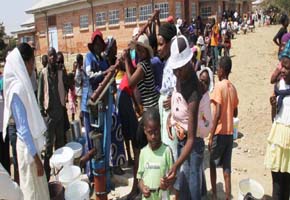
The situation has been steadily worsening in the past few years as the city’s population continues to increase, without additional supply dams being built.
The last supply dam for the city of Bulawayo was constructed in 1975 and 37 years later nothing has been done to enhance its water sources. In 1975 the population was estimated to be 263 000 residents but since then the city has continued to grow. With new settlements that have come up over the years the population is estimated to be over 1,5 million but still drawing from the same water sources that were meant to supply around 260 000 people.
This not the first time the city has embarked on water shedding. In 2008, regarded as one of the worst water shedding periods on record, residents went up to four days without water every week. Fear has gripped residents who believe another cholera outbreak is imminent if the water supply situation does not improve soon.
Magwegwe North residents are walking about six kilometres to fetch water from boreholes in neighbouring suburbs like Gwabalanda and Magwegwe West, as there is no functional borehole in their suburb.
Ms Soneni Ndlovu, a resident of Magwegwe North said: “We have to walk for over six kilometres to fetch water from Magwegwe west as the borehole that was near to us is not functioning. This is a very difficult situation because we have to share the borehole with other residents from Magwegwe. At times we have to queue for more than two hours to draw water from the borehole.”
The water shortage in the city has reached alarming proportions again this year, with some residents calling upon the Government to declare it a disaster situation. Water Resources Management and Development Minister Samuel Sipepa Nkomo however, said the situation is still far from critical as other cities have worse problems than Bulawayo.
“We have been told several times that something is being done to solve the water situation in the city but nothing has materialised. We will only believe when they start drawing water from the aquifer or when the projects are practically implemented,” said Mrs Sibongile Masuku of Nkulumane.
“Even if the council is shedding us, the problem is that we are still paying for water that we do not use as the council still estimates bills for us,” she said.
Mr Samuel Chikomo, of Burnside, said he feared for the worst as this situation may lead to the outbreak of water-borne diseases.
“With this water situation people are likely to get sick as water that is now coming out of taps is not clean and in most cases water is kept for long in drums.
“The council once said that borehole water in the city is not safe but they are not providing anything to supplement this and from the way things are going we are going back to 2008 where there was an outbreak of water-borne diseases like cholera” he said.
Some residents have challenged the city council to urgently start pumping more water from the Nyamandlovu Aquifer.
Mr Majaha Nkomo from Pumula South said: “Our situation is now similar to that in rural life. We have to get water from boreholes and store it in drums, which is not healthy. All we want to hear is that the aquifer is now working not just telling us their plans.
“Although we draw water from the boreholes we are made to pay $1 for some people who call themselves borehole owners as we have no choice as they sometimes lock the borehole if we refuse to pay,” he said.
Many projects have been proposed to ease the water crisis facing Bulawayo, but some of them have been failing to start or to be completed with stakeholders citing financial constraints as the major problem. At one point Minister Nkomo even proposed that the city should consider recycling water from Khami Dam for domestic use, a suggestion that was shot down by residents.
For example, the Mtshabezi project which is regarded as a short-term solution to Bulawayo’s perennial water woes has missed many deadlines of its completion with parties blaming each other on the delays of completing the project. The project seeks to bring water from Mtshabezi Dam to Bulawayo through the Umzingwane and Insiza dams. Once harnessed, it will be the city’s sixth supply dam and the third largest after Insiza and Inyankuni.
However, this project has had its own controversy as it has continually failed to meet its deadlines in terms of completion. At one point Minister Nkomo said the project would have been completed by March 2011 but this deadline was since deferred to October 2011 with the incessant rains being blamed for the delay. It was also announced that the project would be completed by June this year before it was pushed to July. Now the minister is non-committal on when the project will be completed but claims that the project is 99 percent complete.
Some 100 years since its proposal, the National Matabeleland Zambezi Water Project (NMZWP) has been marred by controversy and has failed to kick-start until fairly recently. Financial constraints have always thwarted the mammoth project, seen as the permanent solution to recurrent water shortage in Bulawayo. There is hope now, after the Government reached a deal with China for funding to continue the project which is currently stalling at the stop-go construction of Gwayi-Shangani Dam.
Delaying in rolling out the projects has a bearing on the water-shedding exercise adopted by the city in order to stretch supplies to around October to November.
Council introduced water shedding following the decommissioning of Upper Ncema Dam, leaving the city with four supply dams namely Insiza, Inyankuni, Lower Ncema and Umzingwane.
Inyankuni Dam has been left with eight months water supply, while Lower Ncema has four months supply left.
Bulawayo Progressive Residents’ Association coordinator Rodrick Fayayo said the water situation should be planned in advance.
“We know that there is a serious water crisis in Bulawayo but relevant stakeholders must plan in advance when there is still time not to just wait for the situation to be at a critical stage.
“Council is not complying with their timetable as some residents from Magwegwe, Entumbane and Gwabalanda have raised concern that at times the water is cut a day before from what the timetable says and at times it goes for more than the stipulated period.”
He also urged relevant stakeholders to be prepared as residents are likely to be affected from water-borne diseases.


 Online Reporter