Online Reporter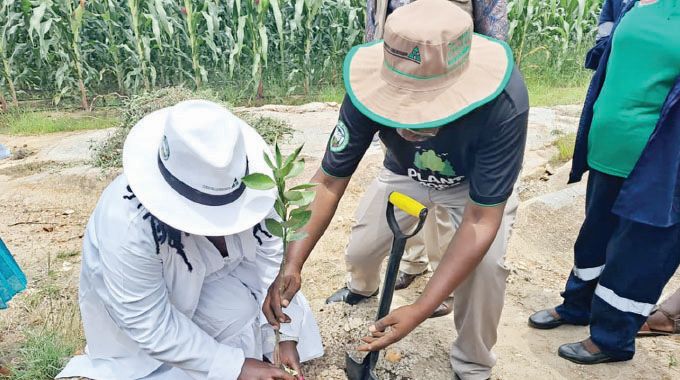
Sukulwenkosi Dube-Matutu, [email protected]
COMMUNITIES have been urged to take responsibility for preserving forests through tree planting and sustainable agricultural practices, in line with President Mnangagwa’s call for citizens to drive development in their own areas.
The call was made during a recent district tree-planting event held in the Ntepe area, Gwanda District, as part of this year’s National Tree Planting Day commemorations.
In a speech read on her behalf by an administrative officer, Mr Awakhiwe Moyo, Gwanda District Development Co-ordinator, Ms Nomathemba Ndlovu said forests and trees were critical to environmental sustainability, livelihoods and economic development.
She said the district event followed the national launch of National Tree Planting Day by President Mnangagwa at the 22nd National People’s Conference in Mutare, Manicaland Province.
“National Tree Planting Day is a pivotal occasion that highlights our collective commitment to environmental sustainability while addressing the urgent challenges facing our forests and natural resources,” said Ms Ndlovu.
“As a district, we are not merely planting trees, but reaffirming our dedication to preserving and restoring the aesthetic, ecological and economic value of our forests for generations to come.”
Ms Ndlovu said this year’s theme, “Trees and Forests for Ecosystem Restoration and Improved Livelihoods,” aligns with the National Development Strategy (NDS2), Vision 2030 and the United Nations Sustainable Development Goals.
“As we transition into the implementation of NDS2, forests will continue to play a pivotal role in achieving our national development agenda and the broader aspirations of Vision 2030, which seeks to transform Zimbabwe into an upper middle-income economy by 2030,” she said.
Ms Ndlovu said forests were central to ecological sustainability, climate change resilience and inclusive economic growth, adding that tree planting should begin at the household level and extend to schools, communities, wards and chiefdoms.
“Tree planting should not end with putting seedlings in the ground. Trees must be nurtured and protected so that they can deliver lasting benefits,” she said.
Ms Ndlovu said communities could improve food security and incomes by establishing orchards, forming co-operatives to market produce and using fruit trees to support school feeding programmes.
“Traditional leaders have a key role to play in mobilising their communities to protect and expand communal woodlands, while schools can instil environmental stewardship in learners from an early age,” she said.
Ms Ndlovu urged leaders across all sectors to lead by example in environmental conservation to strengthen community appreciation of forests and trees.
Forestry Commission board vice-chairperson, Commissioner Sefelipelo Bhebhe said the commission continues to promote tree planting through the distribution of seedlings, co-ordination of planting events and engagement with stakeholders to restore degraded landscapes.
“This initiative supports the Presidential Legacy Forests Programme, which seeks to reverse the degradation of our natural woodlands caused by agricultural expansion, unsustainable harvesting and climate change,” she said.
Commissioner Bhebhe said raising awareness about the importance of trees and promoting extensive tree planting were essential steps towards a greener and more sustainable future.
This year’s Tree of the Year is the Sausage Tree, known as Mumvee in Shona and Umvebe in IsiNdebele. Indigenous to Zimbabwe and Southern Africa, the tree is valued for its ecological, cultural and medicinal uses.
According to global statistics, between 2015 and 2020, about 10 million hectares of forests were lost annually, worldwide. Africa alone loses nearly four million hectares each year, almost double the global average.
Zimbabwe is also affected, losing an estimated 262 000 hectares of forest annually, underscoring the urgency of co-ordinated conservation efforts.