admin
admin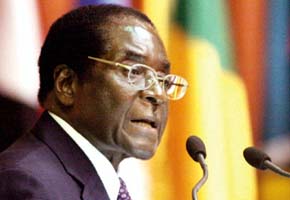
The President, who is also the Head of State and Government and Commander-in-Chief of the Zimbabwe Defence Forces, was speaking at the official launch of the 2012 Population Census in Harare.
Prime Minister Morgan Tsvangirai and his two deputies Professor Arthur Mutambara and Ms Thokozani Khupe attended the launch.
The counting of people will start from tomorrow midnight to Saturday midnight, with the collation of data taking up to 27 August.
“All persons who will spend the census night in Zimbabwe must be counted,” said President Mugabe.
“Thus, the catch-phrase for the census is ‘be sure to be counted’. My family and I will be counted and we must be sincerely counted and we also want sincere figures.
“There are some countries in Africa in which censuses are impossible to do because of ethnic differences or regional differences.
“You will find midway through the process, boxes disappear, disappear like they do on elections because one will say our region or province would be considered smaller or our ethnic group would be considered smaller.
“We want honest and objective facts, the data which will help us.”
President Mugabe urged Zimbabweans to be productive, saying he was disappointed by the 2002 census figures that showed the deadly effects of the HIV and Aids pandemic.
“I am sorry to say, but the figures of the census of 2002 were disappointing to me, the numbers were down and maybe they have not increased very much,” he said.
“The population (in 2002) had been decimated, decimated by the pandemic we all know, that of HIV and Aids.
“Perhaps we now need to establish whether the pandemic has the same effect of decimating our population or have we managed to control it in such a way that if it still affects us, we have managed to beat it with our death rate being lower than the birth rate.”
President Mugabe drew laughter from the audience when he said the reluctance by women to have many children was stagnating population growth.
“They now have two or three children when we had one mother producing 10 or 12 children, hanzi zvinouraya. Ko vanambuya havana kufa wani?” he said.
“We want more children, give us more children. You women murikurambirei navo. Mimba idzodzo makapiirwei, nhumbu idzodzo, aiwa aiwa musanyime.”
President Mugabe said the census was an important event to gauge various development statistics.
“A population census is an important periodic exercise in the life of any nation, for it gives us the capacity to better gauge our needs, in order to successfully chart and navigate our forward movement,” he said.
“There is, therefore, no greater single source of information about a nation than that which a population census is able to yield.”
President Mugabe said the population census would provide important data for the implementation of such programmes like the Mid-Term Plan.
“The 2012 population census will provide data for some indicators on each of the eight internationally agreed Millennium Development Goals,” he said.
“Further, information so gathered enables better comparisons with other nations, in such areas as literacy rates, average life expectancy, mortality and living conditions.”
Also speaking at the launch, PM Tsvangirai said statistics were an important tool in providing data for current and future planning for national development.
“The population census is a rich source of information that can be used for confronting and strategising the challenges we face,” he said.
“It also provides benchmark data on population characteristics and living conditions which are important for planning. Further, it provides a base for conducting subsequent statistical investigations by providing the sample frame.”
The census will be conducted at a cost of $40 million.
Government has provided the bigger portion of the money, with donors providing $12,6 million.
Bickering among civil servants over the recruitment process affected the census, which saw training of enume-rators failing to kick off as expected.
The training started only after two days following the intervention of Government.
The bulk of the enumerators are drawn from teachers, some of whom have the experience from previous censuses.
Zimbabwe holds a census after every 10 years, with the first in 1982 showing that the country had 7,6 million people.
There were 10,4 million people in 1992 and 11,6 million in 2002.
Meanwhile, in Bulawayo enumerators yesterday embarked on consistency checks to test the effectiveness of capturing data from households.
In a telephone interview, Zimbabwe National Statistics Agency director of pupulation census and surveys Mr Washington Mapeta said the consistency checks were when teams collected data from households and verified if the information collected was consistent with the actual information on the ground.
“The consistency checks are mainly to make sure that the counting of people is accurate. This will be done for example if the enumerators record that in a certain household there is a 30-year-old, the supervisors will then do a check by visiting the household to verify that,” said Mr Mapeta.
“After the consistency checks, the teams will then embark on a familiarisation exercise to familiarise themselves with the areas and households they will be visiting for the actual counting of people.
“This is expected to be done the day before the actual census.”
He said during this exercise, enumerators would interview real households to have a feel of the actual count.
“The familiarisation process is very critical because it will help enumerators gather confidence ahead of the actual census,” said Mr Mapeta.
“At the moment, we are in the process of procuring regalia for the census teams, after that we will be finalising delivering of census questionnaires to respective areas in time for the actual count of the people. — Harare Bureau-Chronicle Reporter



 Online Reporter