

 Online Reporter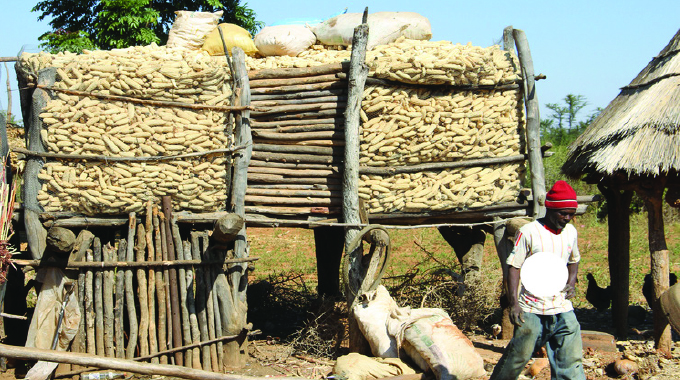
Tapiwanashe Mangwiro, Zimpapers Business Hub
ZIMBABWE’S 2024/25 post-harvest data show that the country’s cereal output slipped below earlier expectations but remained strong enough to ensure a modest surplus through mid-2026, according to the Zimbabwe National Statistics Agency (Zimstat).
Presenting the first ever Post-Harvest Survey Report for the 2024/25 season, Mr Nelson Mupfugami, Manager for Agriculture and Environment Statistics at Zimstat, said total cereal production reached 2,24 million tonnes, down from 2,93 million tonnes projected in April’s Crop, Livestock and Fisheries Assessment 2 (Clafa-2).
“The survey provides a comprehensive picture of what was actually harvested and kept in stock,” he said. “It enables policymakers to base decisions on verified production, not estimates.”
Of the total, maize accounted for 1,82 million tonnes, followed by sorghum at 288 344 tonnes, pearl millet 111 399 tonnes and finger millet 23 376 tonnes.
For maize, the official data point to a 23 percent variance from the earlier estimate of 2,29 million tonnes, which can be attributed to challenges crops could have faced between Clafa-2 and the Post Harvest Survey such as inadequate rains, excessive rains, pests and diseases outbreaks among others.
Even so, maize stocks were substantial, with about 1,06 million tonnes, or 58,5 percent, of all maize produced remaining in storage by early September, while 279 000 tonnes had already been consumed and 398 900 tonnes sold.
“We are observing a situation where household retention for consumption has increased, reflecting caution among farmers after a difficult climatic year,” Mr Mupfugami said.
The survey, however, did not account for what was consumed as fresh produce, which could also explain part of the difference between Clafa-2 and the actual harvest.
The data confirm that Zimbabwe’s communal areas remain the backbone of production.
Smallholders produced 794 000 tonnes of maize, or 44 percent of the total, far ahead of any other sector. A1 farms followed with 437 000 tonnes, and A2 commercial farms with 331 000 tonnes.
The findings feed directly into the Ministry of Lands, Agriculture, Fisheries, Water and Rural Development’s food-security projections for the 2025/26 consumption year.
At the prevailing food consumption rate of 7,5 kg per person per month, Zimbabwe will require about 1,39 million tonnes for human use and 400 000 tonnes for livestock, leaving an estimated surplus of 456 900 tonnes by May 2026.
Mr Mupfugami said, “This outlook provides a cushion for national cereal requirements, assuming stable post-harvest management and limited additional losses.”
Mashonaland West led provincial maize output at 393 000 tonnes, representing 21,6 percent of the national total.
Farmers reported mixed yields across provinces, with about 40 percent citing inadequate rains as the main factor affecting their harvest, while 17 percent pointed to pests and diseases. Still, most retained their cereal primarily for food.
“Roughly 72 percent of farmers with maize in stock said their main reason was consumption,” Mr Mupfugami noted, highlighting household food-security priorities ahead of market sales.
Sorghum and millet production underscored an emerging structural shift toward climate-resilient grains. Masvingo province accounted for a quarter of national sorghum output and 43 percent of pearl millet production.
“The data reinforces the importance of traditional grains in agro-ecological adaptation,” he added. “As rainfall patterns fluctuate, these crops are sustaining output where maize struggles.”
Oilseed performance was mixed but notable. Groundnut output reached 95 827 tonnes, with Mashonaland East and Manicaland each contributing about 22 percent. Midlands produced 27 percent of the country’s 38 800 tonnes of sunflower, while Mashonaland West delivered 42 percent of soybean output.
Communal farmers supplied 80 percent of groundnuts and nearly half of sunflower, but A2 commercial farms dominated soybeans, delivering 46 percent of the crop.
Seed sourcing patterns reveal continued reliance on formal markets as farmers used 31 000 tonnes of maize seed, of which 78 percent was purchased. For all cereal crops, purchased seed represented the largest share, evidence the agency says, of improving market linkages but also of cost pressure on smallholders.
Post-harvest handling remains a concern, as the report found that nearly 90 percent of maize and 85 percent of sorghum were stored in ordinary rooms, while the use of standard granaries and silos remained below two percent. Mr Mupfugami warned, “Traditional storage exposes grain to pests and moisture loss, contributing to the silent erosion of yields after harvest.”
Zimstat’s data cleaning and verification exercises, spanning 58 000 households across eight rural provinces, revealed a 93 percent response rate, one of the highest in the survey’s history.
Mr Mupfugami said, “This outlook provides a cushion for national cereal requirements, assuming stable post-harvest management and limited additional losses.”
To maintain the growth trajectory, the report recommends accelerating irrigation development, upgrading rural roads, and promoting hermetic storage technologies to cut post-harvest losses.
It also called for financial incentives and market linkages to stimulate private sector grain purchases and investments.
“The message is that agriculture remains the cornerstone of food and income security,” Mr Mupfugami concluded. “What we have now is sufficient for the short term, but sustainability depends on adaptive planning, investment in irrigation, and the continued mainstreaming of smallholder production.”
Commenting on the report, agriculture expert Dr Reneth Mano suggested a review and overhaul of the forecast methodology in order to get the variance between Clafa-2 and the Post Harvest Survey within the 10 percent boundary of acceptability in the profession.
He also called for monthly technical crop production updates between Clafa-2 and the final Post Harvest Crop Survey Report of September.
Dr Mano also called for a comprehensive review of maize demand in the economy, stating that the traditional focus on only mealie-meal and livestock feed is now insufficient. He believes that maize utilisation stretches far beyond these two traditional categories.
Dr Mano specifically notes that, in addition to the estimated demand for hupfu (mealie-meal) by the urban and rural population — estimated at 7.7 kg per person per year — and the demand from the stockfeed manufacturing industry, several other sectors now consume significant annual volumes of maize.
These include the beer brewing and beverages industry, the breakfast cereals and extruded corn snacks industry, and, perhaps most notably, the rapidly growing maize maputi (puffed corn) industry, which is expanding from urban centres into the village economy.
He further mentioned that Zimstats has recently completed an Economic Survey of formal businesses, which he anticipates will provide a detailed characterisation of Zimbabwe’s maize-based agro-processing industry, thereby supporting the need for this expanded review of national maize demand.




 Bongani Ndlovu