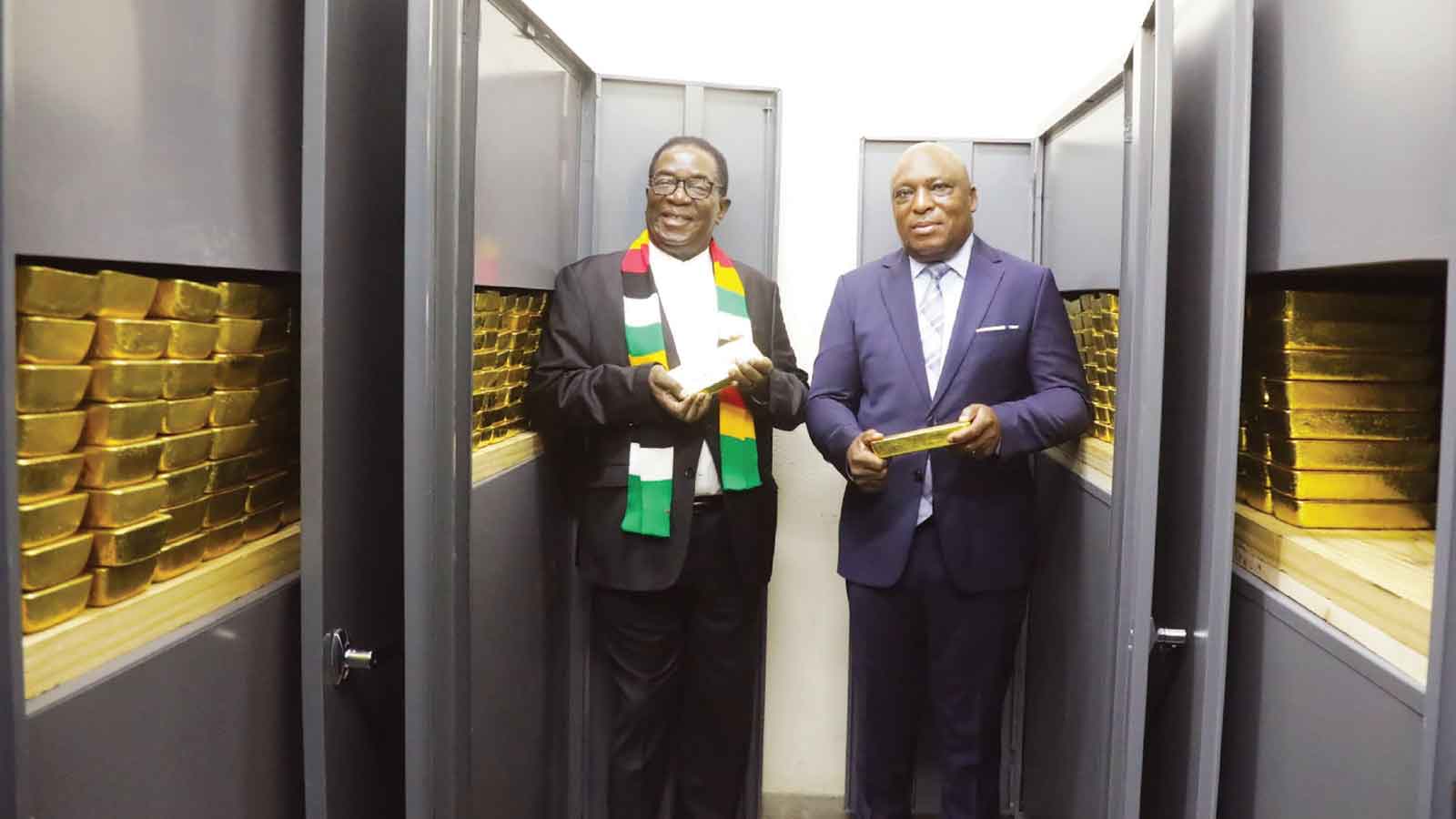
THE continuous rise in official Zimbabwean gold reserves has seen 4,48 tonnes of gold now accumulated in the deepest high-security vaults of the Reserve Bank of Zimbabwe with monthly additions coming in from the half of all mineral royalties that have to be paid in gold or, when authorised, acceptable foreign currency.
President Mnangagwa directed, about two years ago, that half of mineral royalties had to go into the reserves, initially by being paid in kind although with many minerals this would see sacks and ingots of fairly bulky material, hence the switch to allowing many miners the option of buying gold or sometimes transferring cash, all much easier to handle.
The important point is that half the royalties are to be used to build up the reserves, with a high proportion of these reserves kept in the tangible form of gold ingots.
This is something that can be seen and inspected and which retains value regardless of what happens to the value of even the strongest currencies in global money markets, or the regular but sustained devaluation that continual inflation, even if this is very low, imposes over the longer term on currency value stored in a database.
Gold prices fluctuate, but the trend is always maintaining real value over the longer term, and gold reserves are generally long-term reserves.
About once a year, the President likes to personally inspect the gold reserves, and journalists accompany him so they also see the stacks of ingots. This is largely an exercise to assure Zimbabweans that real gold physically exists in the reserves; a little over 4,48 tonnes comes to at least 360 bankers ingots of 12,4kg (400 troy ounces), the sort of ingot you see in pictures of bank vaults where gold is stored.
This build-up of gold reserves has now pushed Zimbabwe into third place in SADC and 11th place in Africa when it comes to counting gold ingots, so we are among the regional and continental leaders in building reserves.
With the foreign currency reserves also held by the Reserve Bank, there are now official reserves worth around US$1,4 billion, although the total can vary according to global prices and the continual addition from the half of all mining royalties.
That more than covers the ZiG22 billion local currency that exists in the economy in circulation and deposits at the present exchange rate of around ZiG26 to US$1. In fact, only about 60 percent of the reserves are needed to back all the ZiG in existence, giving an exceptionally healthy buffer of 40 percent.
This is again yet one more example of the strict conservative monetary policy of the Reserve Bank backed by the equally strict fiscal policy of the Government. We, and many others, would like to see that buffer maintained from royalty inflows even as ZiG use grows in the economy so we maintain the triple win of a stable local currency, a growing economy and more and more local currency used in all local transactions.
While the very strong backing of the ZiG is important, and helps build confidence, more and more we are going to see the measure of reserves against our import bills. At the moment, the reserves cover about 1,5 months of imports, way up from the near zero days of a few years ago. The Reserve Bank, again with Government backing, wants to see the reserves reach a minimum of 3 months cover and is quite happy to see this advance to six months cover.
But already that reserve buffer has helped to stabilise the foreign currency markets along with the now positive balance of trade, exports exceeding imports, and the larger current account surplus, foreign currency inflows exceeding outflows. Just knowing the reserves exist means that far more businesses and ordinary people trust the official markets.
Reserves have been rising significantly with those monthly royalty inflows, even as imports rise more gently; rising imports are a long-term trend even with our export-led industrial growth using local raw materials and are a result of the growing economy. The point is that we can now afford them, with change, rather than trying to scrape the bottom of a barrel. So pushing exports and adding value to exports will more and more drive economic growth.
Zimbabwe was built up in colonial times as a commodity exporter, like much of Africa. We are still somewhat over-reliant on commodity exports, but the percentage of product exports is rising sharply and that brings in the real money and creates the vast number of new jobs we have to create.
We all need to remember that a single economic indicator, such as reserve levels, do not tell the whole story.
We have to take into account the whole gamut of measures from GDP growth, to current account surpluses, to import and export figures and to how the new wealth is spread far more fairly. All these figures are now positive under the Second Republic, and that is why we are becoming better off as a country.