


 Chronicle Editor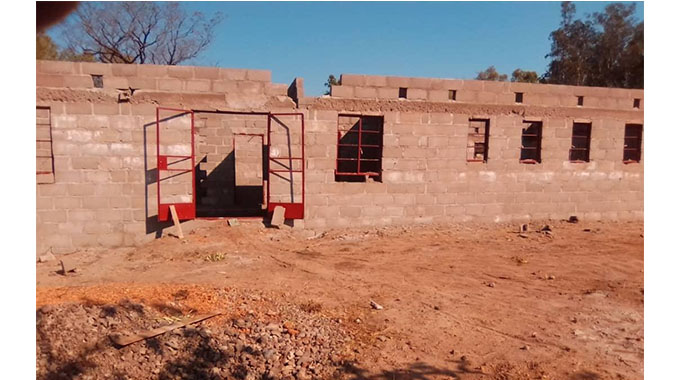
Leonard Ncube, Victoria Falls Reporter
LOCATED deep in rural Lupane is a 64-year-old primary school which has managed to produce some of the finest pupils in the country yet remained devoid of development until the community recently took the initiative to further develop it.
Gandangula Primary School which was built in 1956 and is located east of St Luke’s Hospital in Ward 19 under Chief Mabhikwa still had only two blocks until recently.
The community took it upon itself to upgrade the school and has since constructed two blocks with two classrooms each, they have also renovated an existing block, constructed a teachers’ cottage and two ablution facilities, drill a borehole and install a Jojo tank.
Currently the community is constructing an administration block and computer laboratory while the school authorities are mobilising resources to build an Early Childhood Development (ECD) block, a computer laboratory and to purchase solar equipment for digital learning.

All the projects are being done with the help of development partners namely Ubuntu Schales Trust, formerly Africa Project based at St Luke’s, Government, Kusile Rural District Council, World Vision and Profuture of Spain. Over the years, the school only had two classroom blocks and two teachers’ cottages shared among 337 learners and a staff complement of eight qualified and three relief teachers.
Lupane District Schools Inspector Mr Lovemore Ncube, himself a former teacher at the school said he was excited by the developments.
“Good things are happening at Gandangula Primary School. As a former teacher there I am excited by the developments. The school produced one of the well-known international architects, Engineer Ndaba Dube who is based in South Africa and is doing projects in Botswana, South Africa and Zimbabwe. The school is doing well academically including in the information communication technologies and has a booming garden,” said Mr Ncube.
Eng Dube studied engineering at the University of Zimbabwe (UZ).
Gandangula School authorities and villagers have been busy with construction work during the lockdown and learners will be forgiven for literally getting lost around the school premises because of the new structures when schools fully reopen tomorrow.
The School Development Committee chairperson, Mrs Patricia Mpala, said the school’s development is a product of multi-stakeholders’ efforts.
“Everyone is involved. Africa Project helped in the construction of classroom blocks and is paying school fees and buying uniforms for some of the pupils. World Vision provided ICT material in partnership with Profuture while Unicef supplied text books.
“Government on the other hand is also helping with feeding pupils and all this gives a complete set of what is needed for quality education,” said Mrs Mpala.
World vision donated 48 tablets for digital learning as part of an ongoing partnership with Government and Profuture to computerise all schools in the country.
The community is excited. Gandangula village head Mr Khumbula Mpala said villagers were proud to leave a lasting legacy for their children.
“Members of the community provided labour and dug the foundation, moulded bricks and provided building material such as gravel, pit sand, river sand and water for construction.
“The construction of these blocks is an inheritance we will leave for future generations. We wouldn’t have managed as a community without the help of donors which is why everyone took it as a responsibility to build our own school,” said Mr Mpala.
School authorities have also commended the community for paying up levies and fees, the money which was used to buy some of the materials.
The school is, however, still appealing for more partners who can assist to procure a solar system for a water project and digital learning.
While Gandangula is connected to electricity, the classrooms and garden are not hence the need for solar energy. -@ncubeleon


 Blessing Chizhande
 Online Reporter