admin
admin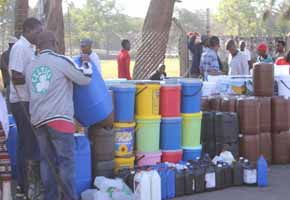
He said average consumption since the inception of the water shedding to date was 123 000 cubic metres per day.
Eng Mthunzi said recently installed air release valves were helping to reduce the frequency of pipe bursts.
“During the week shedding was introduced on 27 July we had 12 bursts. This peaked to 41 between 7 and 15 August. The figure has gone down to nine as of last week, following the installation of the valves,” he said.
In the ensuing discussion, council’s principal electro mechanical engineer, Eng Mente Rudolph Ndlovu, said some companies in the industrial sites were selling water to residents.
“Investigations have shown that companies are unscrupulously taking advantage of being excluded from shedding to collect treated water in bowsers for sale to residents. During the week that shedding was introduced, consumption actually jumped from133 000 cubic metres in a day to 143 000. We suspect this illegal practice is largely to blame for this increased consumption,” said Eng Ndlovu.
Stakeholders agreed that the rationing limit would never be met if the practice went unchecked.
Eng Mthunzi said it was necessary to identify registered water vendors so that those who were operating illegally could be arrested.
“The registered ones would also have to account for the source of the water that they sell to curb the abuse,” he said.
Bulawayo’s senior public relations officer Mrs Nesisa Mpofu said the premises of companies that closed down or relocated from the city would have to be checked as those who sell water could be drawing it from the closed companies.
The Town Clerk, Mr Middleton Nyoni, said owners of the numerous bowsers that have started selling water in the city had to be closely monitored.
Presenting the monitoring, consumption and compliance cluster report, Mr Thembelani Dube said there was concern over residents who were selling water for between R5 and $1 per 20 litres.
“We also found out that there are people who have put themselves in charge of community boreholes. They remove the pump handle and charge residents to use the boreholes. Residents in Pumula South have also expressed concern over raw sewage that flows near their borehole and fear the water might be contaminated,” said Mr Dube.
The Acting Mayor, Councillor Amen Mpofu, called for a full report on the issue to be availed to councillors so that policy could be crafted to deal with the problems.
Rounding up discussions, Mr Anglistone Sibanda of the advocacy cluster said his committee would be visiting Mtshabezi Dam on Thursday to assess the situation on the ground, regarding the pipeline.
“We are also arranging a meeting with the Parliamentary Portfolio Committees on water and public finance and the Ministry of Finance to get support and commitment for funding of water projects in Bulawayo, before the formulation of next year’s national budget,” said Mr Sibanda.
He said the committee would also engage stakeholder ministries in water issues that included the Ministries of Mines and Mining Development,
Water Resources Management and Development, Local Government, Rural and Urban Development and Environment and Natural Resources to synchronise efforts to permanently solve the perennial water problem in the city.
Two of the city’s five supply dams, Lower Ncema and Umzingwane have already been decommissioned.
Upper Ncema and Inyankuni are likely to follow in November and December leaving the city with just one supply dam, Insiza.



 Online Reporter