Chronicle Editor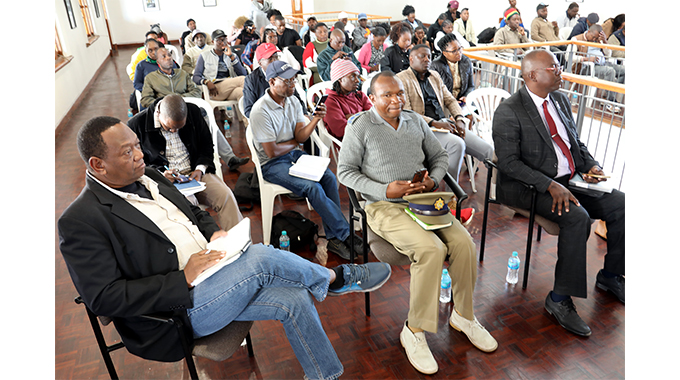
Melissa Mpofu and Natasha Mutsiba
Players in the cultural and creative industries (CCIs) in Matabeleland have stressed the need for Government to decentralise and consolidate services within the Zimbabwe Revenue Authority (Zimra), Department of Immigration, and Censorship and Entertainment Control Unit for the ease of doing business when clearing shows and foreign performing artistes.
This was said on Monday during a workshop that was organised by the National Arts Council of Zimbabwe (NACZ) for arts promoters and players in the CCIs with the aim of promoting the nexus between Government departments towards arts promotion and development.
The main goal was to create and promote a platform for dialogue and common understanding between NACZ, arts promoters, arts organisations, music managers and Government departments that included Zimra, Immigration, the Zimbabwe Republic Police (ZRP) and the Censorship & Entertainment unit.
The workshop that was well attended was held at the National Art Gallery of Zimbabwe in Bulawayo. It was a very educative and key event that commanded a full house as it gave creatives an opportunity to interact with people from the key departments in a relaxed environment.
They managed to share the challenges they face with the various departments and went on to give recommendations.
Among those in attendance were the NACZ director Nicholas Moyo, NACZ board member Jomo Mhone, and NACZ assistant director art promotions and development Barbara Gotore as well as the NACZ provincial arts manager for Bulawayo Cleopatra Dube and William Nyandoro. Creatives included playwright and arts promoter Raisedon Baya, Iyasa director Nkululeko Dube, film producer Priscilla Sithole Ncube, Thobela Arts Foundation director Oscar Siziba, arts promoter Saimon Mambazo Phiri, promoter and comedian MaForty, and arts promoter Nkululeko Nkala.
Following the various addresses, the workshop exposed the disconnection between promoters and authorities that deal with the clearance of artistes in the country.
Iyasa’s Dube said the workshop was a good start to bringing sanity to the arts promotions business.
“My concern, however, is that it (workshop) clearly showed us that there’s so much ignorance and disconnection among the promoters and authorities that deal with the clearance of artistes in the country. There’s so much bias to music shows because, in reality, they dominate the market, but using the same template for other genres like theatre and dance definitely hinders the progress of networking for artistes regionally and internationally,” Dube said.
When organising shows with foreign artistes, event organisers are expected to get clearance letters from NACZ, the Immigration, Zimra and the Censorship unit.
However, some creatives said they feel that the amounts required to host shows are a bit too steep, especially for genres other than music.
When clearing a show with the NACZ, according to them, the minimum show clearance fee is US$1 000. “The calculation of show clearance fees is five percent venue capacity x price of tickets. The money charged is payable as cash or bank transfer into NACZ official Nostro account,” said NACZ programmes officer (head office) Terrence Vuta.
After paying NACZ, promoters are required to pay tax to Zimra for the clearance of artistes.
“It’s a requirement that a foreign artiste or entertainer gets a tax clearance for performing in Zimbabwe. For calculations for withholding tax and payment to Zimra, Zimra computes a 15 percent withholding tax payable by the foreign artiste/entertainer based on the fees on the contract regardless of whether the promoter has paid the foreign artiste the full amount or not.
“Everything has to be stated in your contract so that we’ll be able to calculate the tax to be paid for us to issue promoters with a clearance letter,” said Zimra revenue officer, Gratuence Mutsogoro.
In response to this, Dube said: “Not all artists that we bring to the country are high profile and as such, not all shows and programmes make a lot of money to be able to afford promotion fees for each and every Government department that requires them to pay.”
He said the services of the Government departments (immigration, NACZ, Censorship unit and Zimra) need to be consolidated as it is taxing to have to go to “all those departments instead of just having a one-stop shop”.
“It’s also important to consolidate all those services into a one-stop shop because the various departments operating differently and at their own timelines is also detrimental to the efficiency of clearing artistes. The system is too bureaucratic and if one office handling that on behalf of promoters is established, then we’re likely to see more compliance from promoters,” Dube said.
Filmmaker Sithole pleaded with Zimra to improve their systems as she said artistes are failing to register with them online when they want to apply for tax clearance letters.
“I’m failing to get a tax clearance letter despite having tried to do so on many occasions. I’ve resorted to using a consultant to do this for me. I’m requesting that you work on your systems.”
The Zimra official responded by encouraging artistes to physically visit their offices or call on their landlines if they have challenges on the online platform.
However, artistes were quick to highlight that some of the officials tend to look down on artistes, thereby discouraging them from visiting the Zimra offices.
“Do the people at Zimra Mhlahlandlela offices know what they’re doing? I went there wanting to get the paperwork to clear an artiste that I wanted to bring into the country and I was in for a rude awakening. No one there knew what to do. I was told to go to their ZITF stand and no one again knew what to do.
“Eventually, one of the officers made a call to Harare to make calculations. Should we have to go to Harare each time we want to clear shows?” asked a disgruntled comedian, MaForty.
“The arrogance of the officers is uncalled for. When we come to your offices, it’s because we want help, please help us so that we work well together,” he said.
Nkala, who is one of the organisers of the Intwasa Arts Festival said the event exposed the lack of dissemination of information.
“The event was good. There were too many take-homes regards information. It also exposed the lack of dissemination of information and the need to decentralise Government offices. It was a necessity,” said Nkala.
Following a presentation by Oscar Mugomeri, the Censorship and Entertainments Control Unit operations director, most players realised that they were not ignorant of many things and highlighted the need to have this key department decentralised.
Mugomeri, in his address, constantly told creatives of the importance of protecting the image of the country and encouraged them to tell the Zimbabwean story.
“We censor both local and international films. We also regulate theatre houses in the interest of public safety and morality. We regulate live shows for both local and international artistes and censor music material,” he said.
In determining what is indecent, Mugomeri said: “When we say this thing is indecent, obscene, or harmful to public morals, we consider quite a number of varying issues. Some of them are improper behaviour like suggestive dancing, scenes that are suggestive of immorality, child abuse and cruelty to women, nudity, and too much kissing. Such films, we don’t approve them.”
He expressed concern over the music that is being produced nowadays citing Jah Signal’s Stonyeni and Baba Harare’s Haubvire hits.
“I don’t know what’s happening in Zimbabwe. Maybe it’s because of the new generation, they love songs which are full of indecency. Back then, we used to have the likes of Oliver Mtukudzi, Thomas Mapfumo and Leonard Dembo who sang songs that were culturally accepted by the society. But now, the youths are singing about “kudonhedza musika” (Boom Beto’s Munodonhedza Musika song), ‘ndinehombe’ (from Baba Harare’s Haubvire song and stonyeni (from Jah Signal’s Stonyeni song). “We’d like to warn the artistes not to go beyond that. Every song has to go through the process of censorship and through that, we’ll be able to hear songs which are acceptable by the society.”
Following Mugomeri’s address, Saimon Mambazo Phiri said this department was stifling their creativity more than anything.
“I’m not saying censorship should be done away with but, there’s a certain level of respect to this sector. This sector revolves around things we think about and see. The same community that you keep complaining about projecting things to has accepted a lot of stuff that they consume from regional TV stations and networks.
“They don’t like consuming our content thinking we aren’t able to deliver that content to them yet it’s the censorship laws that stifle us,” said Mambazo.
Filmmaker Sithole supported him saying: “It seems all the narratives that we’re creating are being censored. Now, we no longer know what a Zimbabwean story should look like. We no longer know what to create as Zimbabweans because we are censored even if we talk about realities.”
On behalf of the ZRP, Inspector Ndlovu from the Bulawayo Central Police District urged promoters to work closely with them when organising shows for their own security and that of the public.
“When organising events, you (promoters) should approach the local regulating authority (officer commanding district) and request officers for your event. Our role is to protect you and your fans (showgoers). That’s why we need you to notify us when hosting shows so that we provide security to ensure everyone including their belongings, are safe,” said Inspector Ndlovu.
Creatives were quick to highlight that it is not so simple working with the police as their presence can intimidate show-goers.
“The presence of police intimidates our audiences. I’ll rather have private security and not ZRP because of this. I’m suggesting that you work on your image,” commented MaForty.
Responding to MaForty, Inspector Ndlovu said: “It’s prudent that you involve the police at your function. There shall be a day when you’ll need the police so just involve them and let them be aware of your event.”
Also raising concern on the police was Mhone, an arts promoter.
“The cops, when you rope them in, don’t come on time and when they do, some will be drunk. They spoil our shows as you find some of them allowing people into places they shouldn’t be. It’s possible for police to change their attitude so that we enjoy having them at our events,” Mhone said.
At the end of the event, MaForty said it was good that they interacted with the relevant Government departments that deal with event promotion.
“However, I think, if the Government of Zimbabwe is committed to creating a vibrant entertainment industry that will make a valuable contribution to the GDP, some of these rules and regulations need to be updated to the 21st century with consultation with us the players in the industry,” he suggested.
NACZ director, Moyo said they decided to host the workshop in Bulawayo after realising that most meetings are held in Harare, disadvantaging those outside the capital city.
“The NACZ board decided to reach out to all its stakeholders deliberately,” he said.
On the issue of decentralising Government departments, Moyo said: “The issue has been scaled up to find ways to better coordinate operations. We’re looking for ways to do things better and I can assure you, it is a work in progress.”


 Online Reporter