Chronicle Editor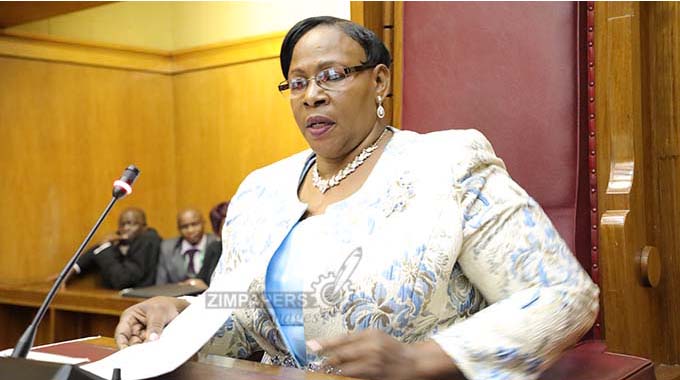
Peter Matika, [email protected]
SENATE president Cde Mabel Chinomona has reiterated the need to uphold the rights of workers and enhancing decent working conditions, which improves the welfare of employees across sectors as key indicators towards achieving the country’s vision of an upper middle-income economy by 2030.
She noted the significance of incentivising the labour force and promoting gender equality as part of the key targets under the Second Republic, as she challenged Parliamentarians to play their part in creating a supportive legislative framework.
Senator Chinomona, who was in Bulawayo over the weekend attending a three-day workshop for the Portfolio Committee on Public Service, Labour and Social Welfare and Thematic Committee on Sustainable Development Goals, said there was a need to strike a delicate balance between the needs of workers and the demands of employers while promoting a fair and just working environment for all.
The aim of the workshop was to drive the national agenda towards achieving Sustainable Development Goals (SDGs) by 2030.
“One of the key result areas of the Portfolio Committee on Public Service, Labour and Social Welfare is effective oversight of the labour market, which is critical in achieving NDS1,” said Sen Chinomona.
“In all its forms, labour is essential to economic activity, a driving force behind innovation and the foundation of prosperity. In light of this, Section 65 of the Constitution guarantees every Zimbabwean the right to fair and equitable wages and safe and ethical labour practices and standards.”
The enactment of the Labour Act during the 9th Parliament in order to align the Act to the Constitution and the International Labour Organisation (ILO) Standards ratified by Zimbabwe, is significant as it establishes the legal foundation necessary to guarantee ethical labour practices.

To that end, Sen Chinomona said Parliament plays a pivotal role in ensuring implementation of the provisions in the Labour Act guided by international best practices, in particular, the value of labour.
Thus, Parliamentarians must draw their expertise and experience in crafting legislation that will not only protect workers’ rights but also foster a culture of respect and inclusivity in the workplace, she said.
Quoting Adam Smith, rightly known as the father of modern economics who captures the value of labour in the economy, she said labour was the first and most critical force in wealth creation across the world.
“True to Adam Smith’s wisdom, skilled human capital available reflects the economy’s total value,” Sen Chinomona said.
She said the value and vibrancy of the national economy are reflected by and anchored on the availability of appropriate human capital with requisite modern skills capable of creating value, growth and development for the country.
She urged close collaboration between the Portfolio Committee on Public Service, Labour and Social Welfare and the Ministry of Skills Audit in creating a knowledge-driven economy for sustained growth guided by Vision 2030. Simultaneously, Sen Chinomona said the Thematic Committee on SDGs, guided by SDG 8, should preside over the application of effective measures and policies to eradicate indolent labour, thereby curtailing public service lethargy in the public sector.
In order to achieve Vision 2030 and implementation of NDS1, policies and legislations in Zimbabwe require a sound, committed and innovative civil service.
“The Public Service Commission has the mandate to steer the creation of an efficient and capable public service that meets the expectations of all the citizens of Zimbabwe,” she said.
“Your role is to have a telescopic analysis of the commission’s strategic plan, which is a key document towards realising its objectives.”
Sen Chinomona urged the Commission to also ensure that public service employees have the right skills, knowledge, values and attitude for efficient service delivery.
Sen Chinomona went on to address the issue of brain drain and the impact it has on the development of the country and pledged that during the 10th Parliament would advocate for policies that harness human capital and curb brain drain, which hinders the country’s development.
“Brain drain bears a huge cost to Zimbabwe than the benefits. For instance, the then Minister of Health, Vice President Chiwenga hinted that training a single doctor cost over US$75 000 annually translating to US$490 000 for seven years.
“After completion, they are offered better remuneration elsewhere outside Zimbabwe. We need to address that anomaly urgently,” said Sen Chinomona.
“More importantly, the National Social Protection Policy Framework launched in 2016 gave the guiding framework for all social protection interventions by the Government or development partners.
“The NDS1 targets the availability of social protection for all by 2025. This entails undertaking measures that improve access to inclusive social protection to reduce extreme poverty and improve access to basic social services.”



 Online Reporter