Chronicle Editor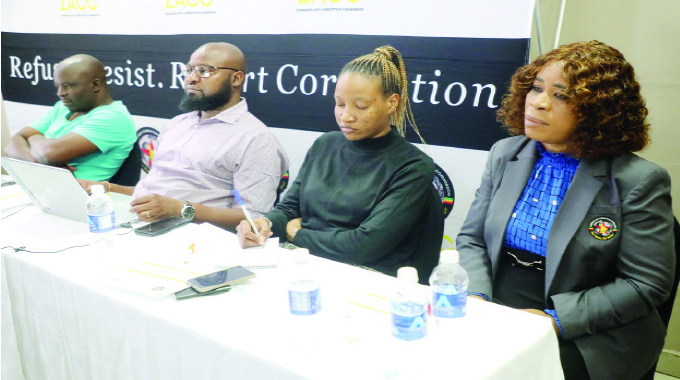
Ashley Phiri, [email protected]
THE Zimbabwe Anti-Corruption Commission (Zacc) has called on the media fraternity to complement Government efforts in the fight against corruption, by continuing to play the watchdog role with the highest integrity.
Speaking during an engagement meeting and training workshop for journalists in Bulawayo yesterday, Zacc deputy chairperson, Commissioner Kuziva Murapa implored the media to be bold and report corruption without fear or favour, including highlighting success stories by the anti-corruption body in the fight against the scourge.
“Zacc has a 70 percent success rate and that is a pretty high figure when we compare it to regional standards, but most of it goes unnoticed because our media does not report about it and I don’t know why,” he said.

“I want to encourage journalists to take part in investigative journalism because that also helps us as an organisation in combatting crime. As an organisation, we understand that to effectively report and carry out investigations, journalists should first have an appreciation of what exactly is corruption hence this workshop.”
Mr Murapa said police and Zacc have upped their investigative efforts and a lot of documents have been sent to the National Prosecuting Authority for prosecution.
The two-day workshop, which Zacc is holding in conjunction with Transparency International Zimbabwe, is aimed at equipping media practitioners with an understanding of corruption issues including some provisions of the Constitution.
Speaking during the same event, Zacc manager for legal representation, Ms Spiwe Chafungamoyo said adequate policy knowledge and integrity upholding are key in anti-corruption reporting.
“As a country, we are governed by the Constitution and we are also signatories of various conventions. Therefore, what this means, is that one needs to be adequately conversant with the constitutions of bodies we are signatories to as that is where we notice breaches in conduct, which translates to corruption,” she said

“Journalists cannot fully report with an impartiality if they do not have a deep understanding of the law and policies governing anti-corruption and that is why we are here conducting this workshop so we can get the best out of media practitioners.”
During plenary discussions on the recommendations to Zacc and reporting on corruption, participants said there was a need to re-look at the policy on whistle-blower protection as it is not fully clear.
“Sometimes whistle-blower is left in danger from a corruption perpetrator as they are not fully protected by the law as the Whistle-blower Protection Bill is still in its infant stage,” said one participant.
The principles of the Public Interest Disclosure (Protection of Whistle Blowers) Bill, which seeks to protect individuals who give out information regarding illicit activities within organisations they are employed in, are part of efforts by the Second Republic to fight corruption. Zimbabwe does not have specific legislation that provides for the protection of individuals that point out (whistle-blow) against illicit activities within the organisations they are employed in.
The gap is affecting the fight against corruption and exposing whistle-blowers to retaliation. The Bill will promote a Whole-of-Society Approach in the fight against corruption by protecting genuine witnesses who raise issues of public interest.
The Bill will among other provisions, provide for disclosure of conduct averse to public interest in the public and private sectors, protection of whistle-blowers by prohibiting detrimental treatment of any whistle-blower because of his or her whistle-blowing and a framework within which public interest disclosures shall be dealt with.
The enactment of the Bill is in line with international best practices as Zimbabwe is a signatory to several conventions aimed at combating the scourge of corruption within the public and private sector, among these being the Sadc Protocol against Corruption; the African Union Convention on Prevention and Combating Corruption and the United Nations Convention against Corruption.
It is hoped that the trial of corruption cases will be stepped up once legislation to protect whistle-blowers and witnesses for them to freely testify in corruption cases is in place. Over 100 corruption cases have been set down and are at various stages of prosecution.
The lack of a clear system to protect whistle-blowers and insulate witnesses from victimisation had slowed the movement of corruption cases in the courts.
This also meant that anti-corruption institutions in the country ended up focusing on low-level corruption involving small sums of money, while the big fish continued to accumulate ill-gotten wealth.


 Online Reporter