

 admin
admin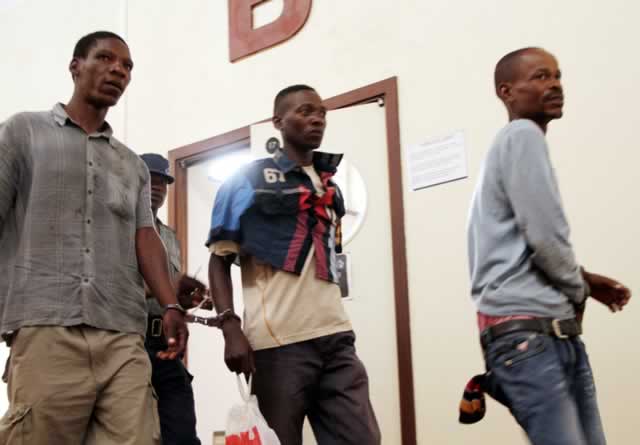

Yoliswa Dube
HARDLY a day after release from Khami Maximum Prison in Bulawayo through the Presidential amnesty, Mandi Mabhena, 31, Elvis Kalima Banda, 33, and Nomthandazo Mzingaye Moyo, 25, were once again found wanting.
They allegedly broke into a house in Nketa 7 suburb and stole a plasma television set and three cellphones all valued at $865. The trio was serving jail sentences for unlawful entry and theft before their pardon.
Another pardoned criminal through this benign offer, Cloud Phiri, who was released from Bulawayo Prison after serving part of a sentence for unlawful entry, was back in the courts for allegedly raping a minor.
Phiri, 20, of Tshabalala, who had barely spent a week out of prison, pounced on a 15-year-old girl from Highmount suburb as she and her young brother collected firewood in the bush.
He tore off her clothes and raped her, ignoring her screams and pleas after overpowering her younger brother who dashed off to seek help, a court heard.
Following these incidents, many have wondered whether or not these delinquents deserved this unstinting gesture to begin with.
Lawyer Collins Rungwandi said amnesty was necessary for some people, especially women and juveniles adding that in as much as prisons were meant for rehabilitation; they are not the only way through which people could be changed.
Turning to these prisoners’ victims in instances of fraud and rape, Rungwandi said: “When someone is convicted of a crime, there are instances where some years from the sentence are suspended on condition of good behaviour. When they receive amnesty, that sentence is completely dissolved and they are free to go.
“However, there is the issue of restitution especially in cases of fraud. Whoever was defrauded would have to take up the matter with the civil courts where one can claim their money.
“It becomes a civil matter in which the ex-prisoner might have to pay back what they owe in the form of property or money but that can only happen if the case is taken to the civil courts.”
Restitution refers to returning to the proper owner of property or the monetary value of loss. Sometimes restitution is made part of a judgment in negligence and or contract cases. In criminal cases, one of the penalties imposed is the return of stolen goods to the victim or payment to the victim for the harm caused.
Rungwandi said it was essential to place a mechanism through which ex-prisoners can be followed up.
“There is no guarantee that once one has been released from prison they would not commit another offence therefore there is a need to make follow ups on them. In the United States for example there is a parole office through which ex-prisoners are monitored closely.
“In Zimbabwe, it is just done sporadically, that is why you find some people going back to prison after a very short space of time. Thorough research and reconciliation with the outside world should be done on each prisoner prior to their release,” he said.
Rungwandi added that it was important for these ex-prisoners to undergo counselling after they have been released.
“In order to protect victims of some of these perpetrators, parole officers should be assigned to ex-prisoners so that they can be monitored closely. Government should have individuals that will do this, be it social workers or those from Zimbabwe Prison Services.
“However, President Mugabe should be commended for the move,” he said.
Others have said the reason why some prisoners cannot be rehabilitated is because they are caught up in certain spiritual warfare.
Traditional healer David Muhabhinyana Ngwenya said the reason why some prisoners are repeat offenders is because certain “spirits” follow them.
“Bayabe belemimoya emibi ebahlezi emahlombe,” he said.
Ngwenya said there was need for such people to seek help from capable traditional healers.
“The parents and relatives of these people should come together and find a lasting solution. Kumele badinge umuntu ozaxhotsha leyo mimoya njalo adingisise imbangela yalolodubo,” he said.
Ngwenya added that various means of earning a living should be availed to ex-prisoners on release so that they are able to sustain themselves and not repeat similar offences.
Police warned released prisoners who benefited from the Presidential pardon to stay away from crime and strive to integrate well into society.
National police spokesperson Senior Assistant Commissioner Charity Charamba said police would be monitoring these ex-prisoners.
“Police would like to applaud President Mugabe for the recent amnesty. We are however, appealing to those granted this freedom to go back into society and lead a crime free life,” she said.
“The freedom they have been granted is not a licence to commit crime but to repent and engage in meaningful economic activities as law abiding citizens.
“The police will be monitoring those released and anyone with a propensity to engage in any criminal conduct will be dealt with in terms of the law.”
Culturist Pathisa Nyathi said prisons were a retributive institution, which is alien to African culture.
“As Africans, we seek restitution and not retribution. We seek to restore damaged relationships. For example, if somebody steals my goats, our relationship is destabilised therefore that person needs to give me back my goats in order for our relationship to be restored.
“If that person does not return the goats, how does it become useful to society for them to be jailed; what l want are my goats. If that person is sent to prison for stealing the goats, while they have not given me back my goats — the system has done nothing.
“You have simply punished that person but done nothing to compensate me. I will still want my goats even after that person has served their sentence,” he said.
Nyathi said culturally, even if someone is sent to prison, at the end of the day that does not restitute the other party.
“Even if you are jailed for 10 or even 20 years, at the end of that sentence I will still want my goats back because it is a personal relationship that has been damaged.
“In African culture, we are concerned about fixing that relationship. If I am given back my goats then we can continue with our lives. Taking someone to prison does not mend any of our relationships.
“When someone is taken to prison, it is totally irrelevant to us. It is now a matter between him and the State but the goats never belonged to the State. It is like someone who serves a sentence for killing another man’s daughter, no matter how many years they are jailed, that man will still want his daughter,” he said.
Nyathi said it was important to distinguish between the western way of law enforcement which takes offenders to prison and the cultural way which emphasises the importance of restoration.
However, Nyathi said there was a need to pardon prisoners now and again for various reasons.
“It may be a decision based on financial constraint such that it becomes useless to keep prisoners if the State cannot feed them or if they are overcrowded giving rise to the spread of diseases.
“It is also good for those that are not hard core criminals and those that have served a portion of their sentences,” he said.
President Mugabe recently pardoned 2,000 prisoners, mostly females and juveniles. The country’s 42 prisons had 18,980 inmates, which was 12 percent above their combined holding capacity of 17,000.
Under the Clemency Order No 1 of 2014, the President granted remission of the remainder of the periods of imprisonment to female prisoners regardless of the offence committed, save for those sentenced to life imprisonment or death.
This meant that all female prisoners at Chikurubi Female Prison were set free save for two who were sentenced to death and one who was sentenced to life.
President Mugabe also granted a full remission of the remaining period of imprisonment to all juvenile prisoners under the age of 18 years serving imprisonment irrespective of the offences they committed.
Prisoners sentenced to 36 months and below and have already served a quarter of their sentences are also set to benefit from the presidential pardon.



 Online Reporter