

 admin
admin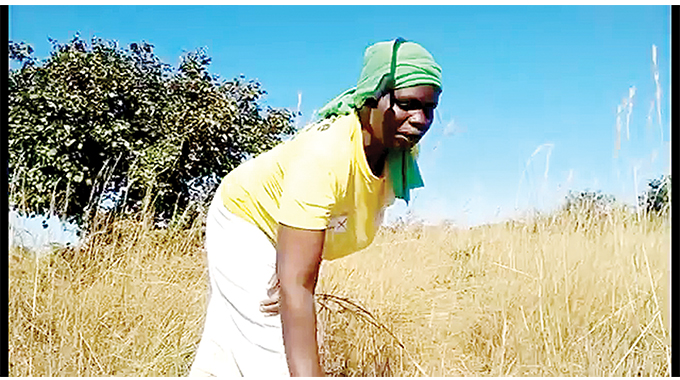
Hazel Marimbiza
At a certain time of the year, when the grass grows dry and long – you’ll see mounds of grass neatly tied in bundles and stacked in the yards of the homes all over Wilfred Hope Farm in Mangwe District.
The women of Wilfred Hope Farm spend weeks in the forest cutting thatch grass. When they’re done cutting grass for the season, the women then load up their share of thatch grass and transport it to their homes where they keep it until they can find a buyer for the grass.
Women farmers in Mangwe have turned to selling thatching grass to eke a living.
Sifiso Sebele said she has been in the grass business for years and has managed to send her children to school from that venture.
“My husband died in 2007 so I survive on cutting grass. There is no other job that I do. Selling helps me to buy sugar, soap and to pay school fees,” said Sebele.
Apart from providing revenue to farmers, these women are also mitigating veld fires, following many years of losing properties to uncontrolled fires by rural communities. Despite massive education campaigns by Environmental Management Agency (EMA), fires continue to cause havoc in communities and various fire hotspots dotted around the country.
In a statement by (EMA) national spokesperson Amkela Sidange, said the country recorded a total of 298 fire incidents and lost 165 352, 94 hectares to veld fires since the onset of the 2020 fire season on July 31.
During the same period last year, 1 050 veld fire incidents were recorded while 315 763, 08ha of prime land was destroyed.
Sidange said veld fires remained a major driver of land degradation in Zimbabwe, with the country losing over one million hectares of valuable land each year.
The fire season stretches from July 31 up to October 31 each year.
“During this period, the risk of runaway fires is high due to the availability of dry biomass, heat and wind, which are the necessary conditions for the spread of veld fires; and only ending on the onset of the rainy season. However, with climate change at hand, characterised by shifts in seasons, the country now records veld fire incidents before the onset, and after the end of the fire season.
“Already the country has recorded a total of 298 fire incidents and lost 165 352, 94ha to veld fires before the commencement of the fire season on 31 July 2020. Mashonaland West lost most land with over 80 171, 75ha, followed by Manicaland, Matabeleland North and Mashonaland Central with 25 962, 96 ha, 23 741, 22ha and 13 039, 7ha respectively. Over 80 percent of the veld fires recorded were as a result of early burning by property owners in preparation for the fire season and about 20 percent was associated with negligence in handling fire during a time when the veld is susceptible to veld fires,” said Sidange.
According to EMA frequent burning has implication on carbon stocks and emissions, wildlife habitat, human health and life, as well as livelihoods.
Veld fires lead to severe environmental degradation by reducing land cover thus exposing the land to agents of accelerated soil erosion due to increase in overland flow or surface run-off and modifications in various ecological processes. Soil erosion leads to the siltation of rivers and dams which reduces their water carrying capacity, inducing floods in low-lying areas and changes in the hydrological cycle.
In Zimbabwe, it is now commonly agreed that veld fires are a single significant threat to national economic recovery plans as they are destroying not only pastures necessary for the restocking exercise, but also destroying vast crop plantations, negatively impacting the country’s food security.
Instead of moaning, women in Mangwe are seeing a silver lining on the dark cloud brought by the raging fires. Their efforts to combat the fires have turned out to be a money spinning venture.
Many Mangwe widows are also involved in fireguard construction projects which are fulfilling one of the objectives of the country’s gender policy which seeks to support efforts to “transform informal livelihood income generation into viable economic activities and broaden agro-entrepreneurship in disadvantaged rural, resettlement and urban areas”.
Belinda Kazuru, who ventured into the business when the fire season started in July said during the short space of time, she had managed to buy fertiliser in preparation for the planting season.
“I cut grass around my farm to construct fireguards and sell it to people in the city who now love grass-thatched properties. I managed to buy bags of fertiliser and every day I put food on the table for children.
“We are reaping double rewards from cutting grass – we are protecting our compounds and lives from uncontrolled fires while making money out of the grass,” she said.
The gender policy’s objectives is derived from the United Nations Sustainable Development Goals (SDGs). Mangwe women’s money spinning grass project seeks to realise objective number one of the goals – that is ending poverty.
They have managed to turn the tide and see economic opportunities.
For women in Mangwe empowerment has come through the need to conserve the environment.
Nomagugu Moyo said they can do better if they can have a ready market for their product.
“We have benefited but the market is still subdued because as we speak I still have thatch bundles which still need buyers. We still need help from the authorities so that we can have a ready market for our grass.”
Community leaders said the women should now come together because there is power in numbers.
They can form their group and brand themselves and it becomes easier for them to look for a market and meet the big orders especially by those in the hospitality sector.
“What it therefore means is that they will now have to be quality conscious which will further push their brand and create a niche market for themselves. It means they sell their product at the prevailing market rates,” said Councillor Kevin Ncube.
The thatching grass project has thus killed two birds with one stone by economically empowering women in the community while also reducing environmental degradation through combating veld fires.
This is one of the key SDGs which seeks to ‘sustainably manage forests, combat desertification, and halt and reverse land degradation, halt biodiversity loss’.



 Bongani Ndlovu
 Online Reporter