admin
admin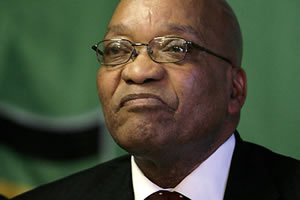

IN his book, “The politician” Robert Welch remarks that “explanations are like government. Nobody loves them, but a minimum amount of both is a necessary evil”. South African President Jacob Zuma must be feeling the same. He never realised the depth and implication of his Monday utterances.
Such is the power of the tongue. As the Bible says, it is small but it can boast about great things and it is also a fire that can set alight the entire course of human existence.
The utterances that have put President Zuma under spotlight since Monday when he spoke at the Gauteng Manifesto Forum at the University of the Witwatersrand in Johannesburg on e-tolls where he said in part: “We can’t think like Africans, in Africa, generally. We are in Johannesburg, this is Johannesburg. It’s not some national road in Malawi.”
The South African Presidency has tried to douse the flames but for now, it’s an exercise in futility. Judging by the online comments, it is quite evident that people are hurt by what Cde Zuma said.
Not only that, they feel insulted and belittled because they never thought that someone at his level would make such utterances. Indeed, he is human, but people feel that the president failed to exercise discretion in his choice of words and examples, which would be used as an excuse by South African citizens to look down upon people from other parts of the African continent.
To put it simply; it was in bad taste and also politically incorrect. It was also a remark that is so full of neo-colonial thinking about Africa and its people. The road from being called “niggers” and “kaffirs” was long and arduous. We thought we had arrived, but it seems as if there is still a lot to be done.
As Africans, we are people that should be proud to be who they are. They might have labelled Africa as a “Dark Continent”, but it is now the last frontier to true civilisation, that is if we show respect and tolerance to each other irrespective of social standing. All the 54 countries that make up this continent are important.
By saying “we can’t think like Africans, in Africa”, Cde Zuma was buttressing the long-held view outside Africa that South Africa is not part of Africa, but would only choose to be when it is to its advantage. Just like Arab countries in North Africa, which cannot choose which continent they belong despite being on the African continent.
People in the Diaspora can testify how difficult it is to tell someone that they are from Africa, but they are not from South Africa. This is probably a credit to how South Africans have marketed their country, although in most cases what we have seen is how this marketing drive has taken aspects of South Africa out of historical context.
The story of former president Nelson Mandela is a case in point. So too the super-rich and poor divide that is a reality of the so-called rainbow nation.
What President Zuma did was to use those very stereotypical elements that the people of Africa have been fighting against. As a former freedom fighter these very tags used by Boers and other colonialists is what made him join the struggle. However, 19 years after gaining democracy, it is as if the struggle was for naught for President Zuma says black South Africans continue to “think like Africans, in Africa”.
This is very sad for Africa, considering South Africa’s status on the continent. When South Africa represents the continent on various international forums such as the BRICS or G20, we now wonder how Africa is presented, if the African way of thinking is not acceptable on the continent?
President Zuma also said, “We are in Johannesburg, this is Johannesburg. It’s not some national road in Malawi.” No amount of explaining can take away what some commentators have termed as arrogance. If Johannesburg is being presented as some super city on the continent, how come it has the highest crime rate on the continent? Why are more women and children raped every few seconds, if Johannesburg is Johannesburg? Why has Johannesburg also fuelled most of the xenophobia against people from other parts of Africa, but never touched migrants from Western countries?
Why should history be so inconvenient when it is common knowledge that this city of gold and a lot of the infrastructure and wealth in South Africa were built on the sweat and blood of migrants from most African countries including Malawi?
However, the tipping point was when President Zuma said, “It’s not some national road in Malawi.” Malawi is not just an African country, but also a sister country in the region and current chair of the regional bloc Sadc. It is small, but it has contributed immensely to the well-being of the region. The journey of migrant workers from the then Nyasaland to neighbouring countries such as Southern Rhodesia (Zimbabwe) and South Africa was a journey where people sought better opportunities as the region was industrialising.
The labour force provided by Malawians then and now for Sadc’s development is beyond measure. They worked on farms and in mines. They did all the dirty work to get most countries where they are now. Today, when neighbouring countries are prospering, Malawi still has to get returns on its human resource investment that spans over a century.
The demeaning remarks against Malawi, especially Malawian immigrants spanning various generations are not unique to President Zuma’s Monday utterances. It was rampant even in Zimbabwe.
However, as unfortunate as this incident might be for President Zuma and South Africans, it has allowed people to express their views openly, but more critically to introspect. We are learning from this, and more specifically we are learning that careless talk costs.
Diplomacy will do its part, but since the issue is now in the court of public opinion, we have to find out how best we move on without necessarily causing more angst. Constructive criticism is the way forward.
Let’s also learn that forgiveness is the hallmark of integrity.
This is an incident that should not divide Africa and South Africa and Malawi in particular.


 Online Reporter