admin
admin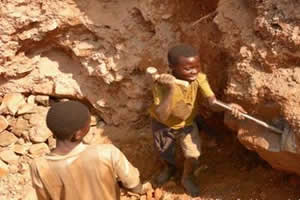
non-discrimination.
However, despite the large social reform movement that has been generated around this issue, more than 200 million children worldwide are still in child labour, and a staggering 115 million are subject to its worst forms.
The global campaign to end child labour is at a critical juncture. As the new Global Report under the follow-up to the ILO Declaration on fundamental Principles and Rights at Work shows, child labour continues to decline worldwide.
However, this is at a slower pace than before. The report entitled “Accelerating action against Child Labour” says there are clear signs of progress but also disconcerting gaps in the global response.
The new trends point to a major shift in the international fight against child labour compared to previous years. In 2006 when encouraged by the positive results of the second Global Report, the ILO set the target of 2016 for eliminating the worst forms of child labour.
Halfway towards that date, the report shows that in some critical parts of the world, the fight is in danger of being lost. It warns that if current trends continue, the 2016 target will not be reached.
There have been a number of leadership initiatives over the past years and important achievements in advocacy, enhanced partnerships, support of corporate social responsibility, data collection and research.
Perhaps the most important step forward has been the overwhelming global consensus in support of the Education for All movement.
However, a renewed sense of commitment is needed. Governments have options when it comes to policy choices and budgetary allocations. The current global economic crisis cannot serve as an excuse to shift our priorities. A world free of child labour is possible.
Among the key reports findings as highlighted earlier is the fact that child labour continues to decline, but only modestly — a three percent reduction in the four year period covered by the new estimates (2004-2008).
In the previous report (covering the period 2000-2004), there had been a 10 percent decrease. It is with great anticipation that we await the 2008-2012 report.
The global number of child labourers stands at 215 million, only seven million less than in 2004. Among the ages between five and 14 years, the number of children in child labour has declined by 10 percent and the number of children in hazardous work by 31 percent.
Whilst the number of children in hazardous work — often used as a proxy for the worst forms of child labour — is declining, the overall rate of reduction has slowed, and there are still 115 million children in hazardous work. There has been a welcome 15 percent decrease in the number of girls in child labour and a 24 percent decline in the number of girls in hazardous work. However, boys saw their work increase, both in terms of incidence rates and in absolute numbers.
Extend of hazardous work among boys remained relatively stable. There has been an alarming 20 percent increase in child labour in the 15-17 years age group — from 52 million to 62 million.
With regard to children aged 5-14 in economic activity, the Asian-Pacific region, Latin America and the Caribbean experienced a decrease. In contrast, for the same age group, the number of children in economic activity is increasing in sub-Saharan Africa.
The situation is particularly alarming in this region where one in four children aged 5-17 are child labourers, compared to one in eight in Asia-Pacific, and one in ten in Latin America and the Caribbean.
Most child labourers continue to work in agriculture (60 percent). Only one in five working children is in paid employment. The overwhelming majority is unpaid family workers. There has been considerable progress in the ratification of ILO standards concerning child labour, namely of Convention 182 (on worst forms of child labour) and Convention 138 (on minimum age). One third of the children in the world live in countries that have not ratified these conventions.
Eliminating child labour is an essential element in the ILO’s goal of “Decent Work for All.”
The ILO tackles child labour not as an isolated issue but as an integral part of national efforts for economic and social development. According to the timeline in the fight against child labour, in 1919 the first International Labour Conference adopted the first international Convention against child labour — the Minimum Age (Industry) Convention (No. 5).
The year 1930 saw adoption of the first Forced Labour Convention (No. 29), while the Minimum Age Convention (No. 138) was adopted in 1973.
In 1992, the ILO established the International Programme on the Elimination of Child Labour.
The Amsterdam and Oslo International Conferences took place in 1997, and these events helped raise international awareness of the child labour problem and the need for a forward looking strategy.
The year 1998 saw adoption of the ILO Declaration on Fundamental Principles and Rights at Work.
This focused on freedom of association, abolition of forced labour, end of discrimination in the workplace, and the elimination of child labour.
All ILO member States pledged to uphold and promote these principles. In 1999, the ILO’s Worst Forms of Child Labour Convention (No. 182) was adopted. It focused the world’s attention on the need to take immediate action to eradicate those forms of child labour that are hazardous and damaging on children’s physical, mental and moral well-being.
The year 2002 saw the ILO publish its first global report on child labour and established June 12 as World Day Against Child Labour. The ILO supports more than 80 countries in formulating their own programmes to combat child labour. The first ILO global study on the costs and benefits of eliminating child labour was carried out in 2004 and said that benefits would outweigh costs by nearly six to one.
In 2008, the ILO adopted the Declaration on Social Justice for a Fair Globalisation, which recognises the particular significance of the fundamental rights, including the effective abolition of child labour.



 Online Reporter