

 Chronicle Editor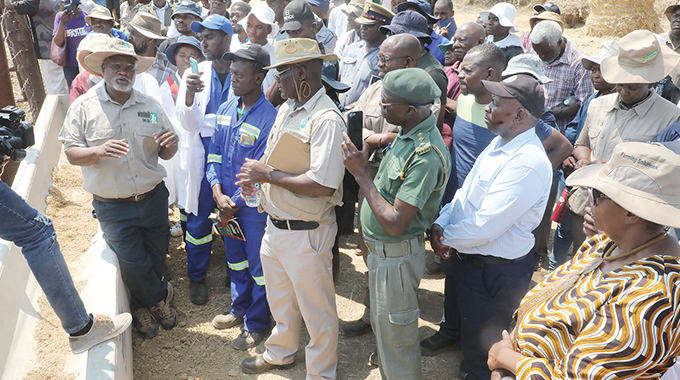
Peter Matika, [email protected]
LIVESTOCK farmers should always be ready for drought and adopt proactive mitigation measures such as destocking, fodder production and other supplementary feed interventions to save their animals from starvation.
Prominent cattle breeder and Esigodini farmer, Mr Obert Chinhamo, said this on Monday during an annual livestock field day at Biano Farm in Umzingwane District, Matabeleland South Province, where farmers gathered to exchange notes on how to grow their herd and boost farming output despite droughts.
The livestock sector contributes significantly to the inclusive growth and development of the Matabeleland South and the country as a whole. Government is already focused on increasing the national herd to six million by 2025 in line with the country’s Agricultural Growth Recovery Plan to meet national demand for meat and dairy products with surplus exports.
Intense breeding of cattle, enhanced feeding, livestock disease control and drought mitigation are key focus areas. With the national herd hovering around 5, 5 million, various measures have been put in place to improve the quality of livestock including artificial insemination, which involves cross-breeding with semen from selected quality bulls and vaccination programmes.

Under the Livestock Recovery and Growth Plan, the Government is concerned with the level of performance of the livestock sector hence it promulgated the blueprint to address all areas that are limiting growth.
In his remarks, Mr Chinhamo said by producing fodder, farmers are in a position to cushion themselves from buying huge amounts of stock feed. Silage is one of the technologies used to preserve fodder, especially during the dry season. It helps to preserve nutrients in stock feed.
“There are methods such as silage that can be used by any farmer in the world. This is a process where forage plants such as maize, legumes and grasses are cut and stored in silage pits for use as animal feed,” said Mr Chinhamo.
“Since protein content decreases and fibre content increases as the crop matures, fodder should be harvested in early maturity. The feed harvested from the silage pits can last and feed livestock until the next season.
“Whether there is below-to-normal rainfall, you can still harvest the grass or maize,” he added.
Following the drought induced season to the El Nino phenomenon, most provinces have recorded alarming deaths in livestock, due to starvation.
Mr Chinhamo said the early weather prediction that most parts of the country would receive normal to below-normal rainfall due to the El Nino effects, should have been warning enough for cattle farmers to prepare and adopt drought mitigation measures to save their livestock.
During the event dubbed: “Weathering the Drought; Innovative Approaches to Livestock Management” Mr Chinhamo showcased various methods of how to feed his livestock during drought seasons. The event was attended by farmers from across the country, as well as agricultural students from the province.
Mr Chinhamo, who exclusively breeds Simmentals said the success of livestock farming is based on yoking and keeping good genetics in animals.
“Farmers can make silage and package it into smaller bags. This is ideal for small scale farmers. Farmers should always expect drought and must always be prepared,” he said.
“All farmers should adopt silage, as it is less costly and can be done at the ease of your farm. Let’s not act because of a situation but let’s make it a habit and a need for us to always be ahead,” said Mr Chinhamo.
He said the process of breeding livestock is essential while harnessing and producing fodder was a much more reliable and sustainable method for monitoring his livestock’s health and diet, particularly in times of drought.

Mr Chinhamo said the livestock sector has great potential to record huge success if farmers focused on improving their animals through cross-breeding.
“It’s good to have a lot of cattle, but they must bring value to the farmer in producing more beef or milk. This can be realised with the right breed of cattle without having too many animals,” said Mr Chinhamo.
Permanent Secretary for Matabeleland South Provincial Affairs and Devolution, Mrs Latiso Dlamini-Maseko, said it is important to have strategies for dry season feeding, as the country battles the worst drought, especially in Matabeleland South province.
“Being a drought year, this year’s dry season was longer than usual meaning that farmers had to supplement livestock feed for a longer period and this has cost implications,” she said.
“It has called for farmers to get the cheapest ways of supplementing their cattle using locally available materials. That’s why we saw roughage ammonification of hay to improve its protein content to survive,” said Mrs Dlamini-Maseko.
She said the process can also be applied by small scale farmers who can use plastic bags to make silage instead of digging pits. Farmers were also urged to improve access to water at their farms to establish pastures that will provide protein, vitamins and other essential minerals to livestock, especially in drought seasons.
“Let us all guard jealously our herd as we build it. Vision 2030 is achievable if every farmer takes it upon himself to fight poverty. I urge farmers to diversify where possible. It is also necessary to avoid some everyday farm costs. Farmers can practice poultry and aqua farming,” Mrs Dlamini-Maseko said.
She commended Mr Chinhamo’s farm as a fulfilment of President Mnangagwa’s philosophy “ilizwe lakhiwa ngabanikazi balo.”


 Online Reporter
 Bongani Ndlovu