Online Reporter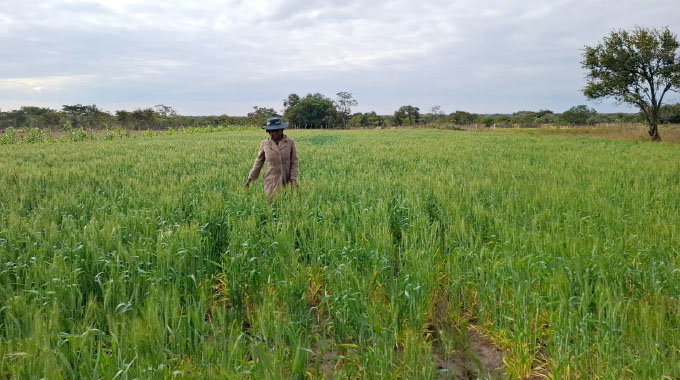
Patrick Chitumba, Midlands Bureau
FARMERS in Midlands Province have surpassed the 12 000-hectare winter wheat planting target, reaching 12 020 hectares, with the majority of the crop already germinated.
This momentum signals a positive outlook for wheat production in the province and the country at large.
Winter wheat planting typically runs from mid-April to late May, with the first two weeks of May considered the ideal window for planting in the highveld. While planting can extend into mid-June, this is generally discouraged due to the diminishing yield potential. In the lowveld, planting may commence earlier.
The province largely matched last year’s achievement of 12 081 hectares bolstered by Government initiatives such as the Presidential Inputs Programme (PIP) and increasing participation by both commercial and smallholder farmers.
Midlands Provincial Director for Agricultural Rural Development and Advisory Services, Ms Busiso Mavankeni commended farmers for reaching the 12 000-hectare target, noting that the province continues to play a key role in national wheat production.
Production is primarily concentrated in Kwekwe District, which accounts for 85 percent of the province’s winter wheat output.
Leading producers include Douglas Kwande of DCK Investments (DCK Farm), who planted 600 hectares, and the First Family’s Pricabe Farm, which planted over 500 hectares.
Farmers in Mberengwa, Lower Gweru and Shurugwi have also contributed significantly, benefitting from access to irrigation systems.
Farmers collected seeds and fertilisers from Grain Marketing Board depots in key production zones, supported by Government programmes and agricultural development initiatives such as the Arda Presidential Irrigation Schemes and the Arda Joint Venture projects.
“We commend farmers, who worked tirelessly to ensure we reached or surpassed the 12 000-hectare winter wheat target. By the end of the planting season, we had reached 12 020 hectares, which is very commendable,” said Ms Mavankeni.
“The early crop, which was planted in mid to late April, is now at the flowering stage, ten weeks from germination.
This represents 10 percent of the total planted area, equating to 1 027 hectares,” she said.
Ms Mavankeni added that the area planted between May 1 and 15 is now at the stem elongation stage.
“It’s seven weeks from germination, and the second node of the stem is visible. This accounts for 30 percent of the planted area, or 3 084 hectares,” she said.
“The area planted between 16 and 30 May is at the hardening stage, which now represents 40 percent of the crop, or 4 110 hectares.”
Lastly, Ms Mavankeni noted that 20 percent of the crop was planted between June 1 and 15 and is at the tillering stage, covering 2 060 hectares.
“Generally, the crop is in good condition, and if these conditions continue, we expect a bumper wheat harvest,” she said.
Ms Mavankeni emphasised the importance of pest control, urging farmers to scout for quelea birds, identify roosting sites and report them to Agritex extension officers or the Migratory Pests Department to ensure swift action.