admin
admin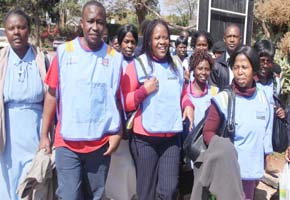
This year’s exercise required enumerators to collect ample information from respondents when compared to the last exercise as the questions did not only require the number of individuals per household but also needed enumerators to probe more into the personal lives of individuals.
Some enumerators involved in the exercise were willing to share with Chronicle their experiences and the observations they made during the course of the exercise.
An enumerator who was conducting the exercise in Nyamandlovu area under Umguza district, Matabeleland North said people in her enumeration area willingly responded to all questions despite the enormous paperwork that was involved.
“Respondents in my enumeration area were willing to co-operate despite the huge paperwork I had to collect during the exercise.
“This year’s census exercise was not only concerned with inquiring on the number of individuals per household but it also had questions that probed more into personal issues like the health of respondents, their education level, employment and details about their families.
The enumerator said although respondents were forthcoming with information, conducting the exercise in a peri-urban set-up was a challenge as there was no transport for the enumerators to use to move from one household to another.
“The households in my enumeration area were located far apart. I had to travel on foot moving from house to house because we did not have any form of transportation. This was a huge challenge because I had to walk long distances under the scorching sun,” said the enumerator.
She said she also had to walk from her home to the enumeration area everyday and the more she moved further into the area the greater the distance she had to walk.
“We had no transport to take us from our homes to the enumeration areas. We had to use our own means of transport and the only option I had was to walk in order to get to my area.
“I had a target of about 100 households throughout the whole census exercise. As a result I sometimes had to walk over 20 kilometres per day in order to meet my target which compelled me to walk such long distances,” she said.
The enumerator said walking such long distances on foot was huge setback as it slowed progress when covering the enumeration area.
“Eventually I was forced to spend a lot of time walking long distances which slowed my progress in a great way. Other enumerators who found it impossible to walk to their enumeration areas had to use rail transport,” said the enumerator.
She said three wards under Nyamandlovu area were given only one car to share which made it impossible for some enumerators to gain access to the vehicle for transportation purposes during the exercise.
The census exercise was conducted by Zimbabwe National Statistics Agency (Zimstat). The just ended census is the fourth to be conducted in the country. It began at midnight on 17 August and was expected to run up to 27 August. However, due to several setbacks the exercise was extended by two days. Preliminary results are expected by December, with the final results due out a few months later.
An enumerator, who worked in Ward 28 in Umguza, said the exercise began with a training exercise that became handy during the actual exercise.
“We first had a census training exercise at Eveline High School where we were equipped with skills that we used during the actual exercise.
“During the training we were equipped with skills on how to feed information onto the questionnaires that we were using to collect information during the exercise. We also received training on how to conduct interviews, probe for answers and how to handle interviews in various situations,” she said.
The enumerator said the training that she received came in handy for her as she recalls a few instances where respondents were reluctant in co-operating and had to apply some of the skills she had learnt.
“I recall an incident when I visited a house in my enumeration area. I knocked on the door and a middle aged woman walked up to the door. She immediately realised that I was a enumerator when she saw my uniform.
“Before I could talk to her she told me that they were six people in her family, after saying that she turned her back and returned into the house,” said the enumerator.
She said she had no option but to try and convince the woman to talk to her.
“I finally managed to tell the woman that I needed more information but I struggled in getting her to answer some of the sensitive questions. When I asked her about the whereabouts of the father of her children she seemed intimidated and she questioned the relevance of that information in a census exercise.
“Other respondents were not willing to respond to questions related to their health, level of education, employment and families. They were questioning the relevance of that information in a census exercise,” she said.
An enumerator in Cowdray Park, Bulawayo said one major challenge she recalls is that of call-backs, where she had to re-visit particular households either because the parents were not around or they were reluctant to co-operate.
She recalls an incident where she had to visit a household three times because the parents were not willing to talk to her.
“I remember visiting a particular home within my enumeration area. The parents of the household were present but they referred me to a 19 year-old boy and they left the house, leaving him to attend to me. The boy did not have most of the answers I needed and I had to schedule an appointment for the following day.
“On my return a small girl came up to the door and told me the parents were absent. I was persistent about talking to the parents and the father finally came out of the house and he told me he was in a hurry and he just walked past me,” she said.
The enumerator said she was compelled to involve her superiors into the matter. She said despite their involvement they were still unable to talk to the father and they only used the information they received from the boy.
Another enumerator who was conducting the exercise in Magwegwe, also in Bulawayo said although some respondents were questioning the relevance of some of the questions that were involved in the census exercise others were co-operative.
“I realised that most of the respondents I questioned were either unemployed or self-employed. The questions I was asking which are concerned with employment and housing seemed to raise certain expectations among the respondents.
“Some of them were asking whether the Government aimed to improve the housing facilities or create jobs after compiling the information. Despite all these pestering questions we were advised not to answer questions that did not concern us as enumerators,” said the enumerator.
The enumerator in Nyamandlovu said the respondents in her area also had high hopes that the census exercise would result in development in their area.
“Respondents expressed high hopes that the census exercise might be linked with intentions from the Government to develop infrastructure, rehabilitate dams, improve water supplies and build more schools,” said the enumerator.


 Online Reporter