


 admin
admin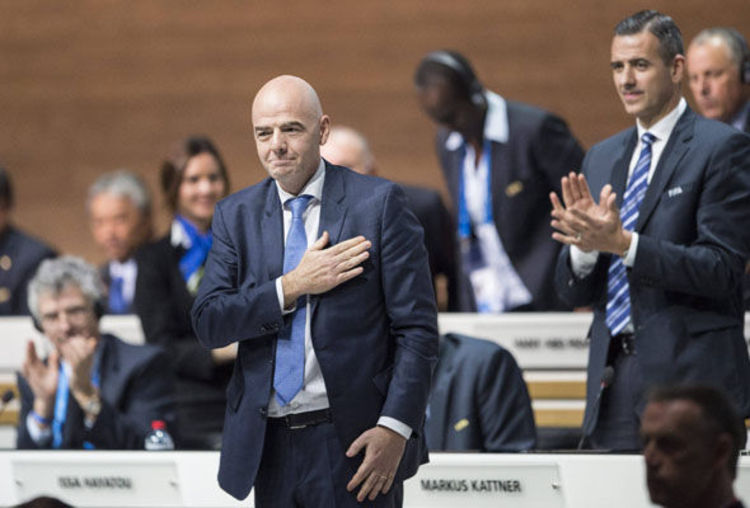
Clearly competent, professional, bristling more evidently with ambition than personality, Gianni Infantino is an archetype, a polished product of Switzerland’s time-served machinery for servicing international sports governing bodies.
General secretary of European football’s governing body, Uefa, by Lake Geneva, Infantino was the substitute candidate to stand for the presidency of Fifa, the game’s tattered global governing body, sited in its bunker-like headquaters on a hill above Zurich.
His boss, the Uefa president and former great as a footballer, Michel Platini, was the favourite to succeed Sepp Blatter after declaring his candidacy in the summer, until his gilded career crashed into a devastating ban from all football activities, reduced this week from eight years to six.
Uefa had positioned itself at a dignified, clean distance fromthe multiple arrests and US and Swiss criminal investigations into Fifa officials, until the revelation that Platini was in 2011 paid 1.35m by Blatter, which both men claimed was for work Platini did at Fifa nine years previously.
Infantino, 45, a Swiss lawyer and career sports administrator rather than a committee-clambering football politician, seemed an unlikely replacement for the grand, world famous Platini, but he briskly stepped up to the challenge.
In his campaign, flying the equivalent air miles of five times round the globe to meet Fifa’s vote-wielders in person, Infantino has shown himself to be not just a technocrat, but shrewdly aware of football’s political heart: self-interest.
His slick manifesto promises all the correct themes: transparency, good governance, support for the reforms proposed as Fifa’s life raft from its sea of disgrace.
But large dollar signs are – literally – at the centre of it.
Highlighting the “very significant increase” in money he is promising to the voting football associations, two pages are devoted to spelling out the cash on the table.
Each of Fifa’s football associations in 209 countries is promised $5m over four years, while the confederations – the six continental blocs including Uefa – will be paid $40m.
There is another $4m regionally for youth tournaments and – personally very important to the delegates gathered in Zurich to vote – $1m for travel costs.
The cash Fifa distributes from the billions made selling TV rights and sponsorship for the four-yearly World Cup has under Blatter’s 17-year presidency been a constant focus of suspicion.
It was considered prey to corruption in the receiving country, and a way for the president to buy support.
The reforms promise closer auditing and a separation of the president from personal involvement in where the money goes, but still, Infantino has shown he knows what moves Fifa’s constituents.
He pointedly noted that he began his campaign in Cairo and ended it in Cape Town – Africa’s 54 associations are grateful recipients of Fifa investment, and usually decisive in a Fifa vote.
Other attractions Infantino has offered include giving each country’s association, however tiny or huge, an equal vote; expanding the World Cup from 32 to 40 countries; and engaging more with clubs, the wealthy engines of world football who have long objected to their exclusion from Fifa.
So Infantino is a mixture peculiarly formed by Switzerland’s officer class of sports administrators: an accomplished executive who has has pledged a clean-up of football’s corrupt culture, but who understands how its world works.
Born in Brig, a Swiss-German speaking Alpine town close to the border with Italy, he studied law at Fribourg university, then worked as the secretary general of the International Centre for Sports Studies at the University of Neuchâtel.
He joined Uefa in 2000, worked his way carefully up to become director of the legal affairs and club licensing division in 2004, before becoming general secretary, effectively the chief executive, in 2009.
He can justifiably cite genuine achievements during that time in Uefa’s HQ, besides longevity of survival, itself a feat in a highly rivalrous environment.
The increased commercialisation and lucrative sales of TV rights for the European Championships – for national teams – and Champions League – for clubs – has been balanced by improved social programmes and backing for supporter ownership of clubs.
“Financial fair play”, a somewhat toe-curling soubriquet, and not one associated with Fifa, was introduced in 2010, requiring top European clubs to staunch their losses from paying excessive players wages.
Uefa argues it has turned the game’s finances around, cutting losses by 70% in its first three years.
Criticism of Infantino at Uefa has centred around him keeping close to his boss as Platini grew increasingly presidential while eyeing the accession to football’s top job in Zurich.
Now Infantino has nipped in himself. If he really is to make good on his manifesto, feed football’s barons while cleaning up the game, he has an enormous task. — Guardian
What they said
“Infantino, he was the brain of UEFA, a computer. He’s a guy who can speak six or seven languages, a lawyer who is familiar with all the little details. He sorted out UEFA he can sort out FIFA also.”
– Michal Listkiewicz, former president of the Polish football federation.
“Infantino elected president of FIFA, the pill must be hard to swallow for Michel Platini.”
– Former French coach Raymond Domenech on Twitter.
“This is what was needed to help advance football again. This is what FIFA needed . Infantino’s campaign was amazing .. but now the real work begins.”
– Dutch football federation (KNVB) director of football Bert van Oostveen.
“This is magnificent. It’s quite emotional when in four months you have managed to get most of the world behind you.
I expect a lot from Gianni. We should welcome him as the new president of FIFA.”
– KNVB president Michael van Praag.
“I am sure FIFA under the able leadership of Mr. Infantino will continue to give India its due importance and cooperation for the development and promotion of football.”
– All-India Football Federation (AIFF) vice-president Subrata Dutta to AFP.
“I am happy as this is the best solution for FIFA. I liked that the campaign was conducted very correctly, very democratically with mutual respect.”
– Belgian FIFA executive committee member Michel D’Hooghe to AFP.
“I don’t even know who is running.”
– Disgraced Trinidad and Tobago football boss Jack Warner, claiming he had no interest in Friday’s election.
“The South African Football Association (SAFA) now looks forward to the practical implementation of the promises to increase the number of African teams in the World Cup and increase the number of African members on the executive of FIFA.” – SAFA president Danny Jordaan
The Zimbabwe Football president Dr Phillip Chiyangwa, the Zifa Executive Committee, the Zifa assembly, the dedicated Zifa secretariat and the entire football family wish to congratulate Gianni Infantino the newly elected Fifa president on his resounding victory.
Zifa is confident that your experience and excellent leadership skills will greatly benefit football in Zimbabwe and the world at large. – Philip Chiyangwa


 Online Reporter