Online Reporter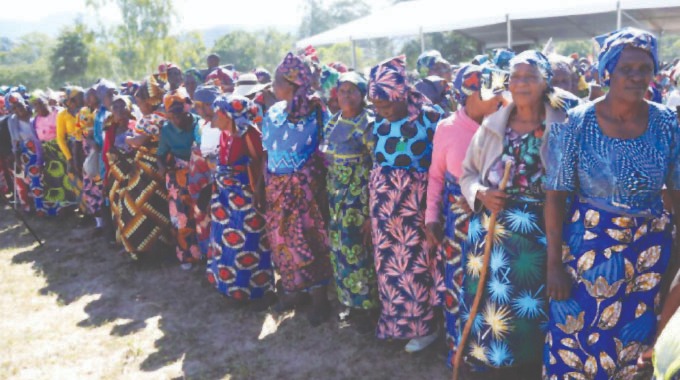
Cuthbert Mavheko, [email protected]
IN a unique and unprecedented move, the First Lady, Dr Auxillia Mnangagwa, recently launched the ground breaking “Doek Drive”, which is aimed at restoring and promoting cultural values among women.
The Doek Drive places the traditional “doek” and “Zambia” (wrapper) at the centre of womanhood, by promoting modesty and ensuring that women dress in a dignified manner.
The key point to note here is that the “doek” and “zambia” are not merely garments.
They are, in fact, perfectly valid expressions of our African identity.
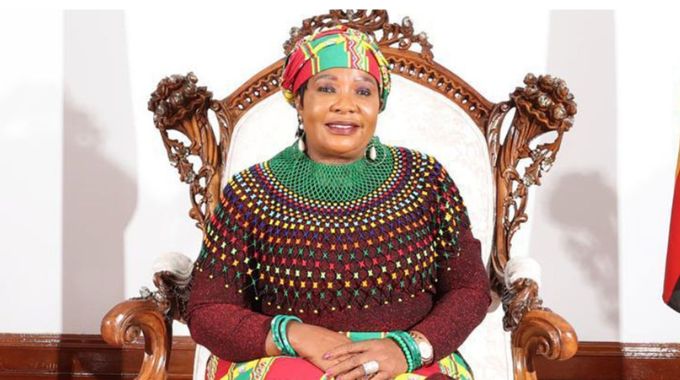
Addressing multitudes of people who attended the launch of the Doek Drive in Shamva, Mashonaland Central province, the First Lady, described the “doek” and “zambia” as symbols of honour, identity and pride, adding that a mother’s dressing should be exemplary.
“Women, you are leaders. The way a mother dresses shows what kind of person she is. As mothers, we teach our children how to dress and how to behave. A woman is the one who holds the family together so that the home has dignity,” the First Lady said.
The fact that “a woman is the one who holds the family together” is buttressed by an ancient Shona adage, which says “musha mukadzi”. Literally translated, this means a home is built on the solid foundation of a woman.
The “Doek Drive” was launched at the appropriate time, because a significant number of young women in the country are dressing in ways that downgrade our cultural norms and values as Africans. In light of this, with all due respect, it is the considered opinion of this scribe that the First Lady, Dr Mnangagwa, deserves kudos for launching the Doek Drive, which is aimed at promoting cultural values among women.
It is common knowledge that today we are living in a society that is very different from the society of a few decades back — a society which held in high esteem our cultural norms and values. Be that as it may, the way many young women are dressing in these youth-oriented modern times is undoubtedly not only antithetical to our cultural norms and values as Africans, but is actually corroding our moral fabric as a nation.
One does not need to be well-versed in rocket science to understand that some women misuse dressing purposely to try to entice men by constantly dressing in a very physical, seductive and sensual way. They do this, no doubt, in order to satisfy their vanity and enjoy the luxury of having men finding them sexually appealing.
By contrast, the Holy Bible, which is God’s Instruction Manual to mankind, admonishes women to “adorn themselves in modest apparel, with propriety and moderation, not with braided hair or gold or pearls or costly clothing” (I Timothy 2 verse 9).
In other words, the way a woman dresses should be appropriate for the occasion and should exemplify discretion, balance and moderation, whether it be evening wear, casual dress or whatever.
The key point to note here is that God abhors women who wear men’s clothing, and men who put on women’s clothing. Deuteronomy 22 verse 5 says: “A woman shall not wear anything that pertains to a man, nor shall a man put on a woman’s garment, for all who do so are an abomination to the Lord your God.”
Many elderly people in the country are in agreement that only men, and not women, should wear trousers. Mrs Sharon Ndiweni, (84) a retired high school teacher from Old Magwegwe, who is a member of the United Methodist Church, said: “In the past, ubuntu/hunhu reigned supreme in our motherland.
We (women) did not wear trousers. As far as we were concerned then, trousers were only to be worn by men, and not women. In those bygone days, we also avoided wearing mini-skirts or see- through dresses that are being worn by many young women today. Women wore dresses, covering the body down to the knees or ankles. These dresses were covered with ‘zambias’ (wrappers). But look at how things have changed these days!”
She said some women, especially teenagers in urban areas, are now dressing in shameless ways. “Daily, we see them walking up and down the streets, wearing mini- skirts, see-through dresses and tight-fitting shorts. This kind of dressing vitiates our cultural norms and values as Africans.
In my 30 years’ experience as a teacher, I came to the unpleasant conclusion that mothers are responsible for all this. Mothers have no choice but to shoulder the blame because they set the example.
If mothers wear trousers, mini-skirts or see-through dresses, they must not be surprised to see their daughters wearing the same type of clothes when they mature into adulthood. But, on the other hand, if mothers dress modestly, their children will do the same thing.
As mothers, we owe it to ourselves and to our precious children to set a good example, and the bottom line is that our children will follow the example we set at home. It is essential to understand that the family is ordained by God. Children are entitled to be reared by a father and mother who honour marital vows with complete fidelity.”
Psychologists are in agreement that the personality and temperament of a child is firmly established in the first few years of life, and lays the foundation for the child’s future. In light of this, parents have a moral and spiritual responsibility to take an active role in the affairs of their children, and guardians entrusted with looking after children whose parents are in the diaspora, should carry out their supervisory role with the utmost seriousness and dedication.
In rearing children, parents and guardians must stick to high moral standards of behaviour and not practice double standards. They should live by example because children are natural mimics – they learn more from actions than from words. “Action speaks louder than words,” says an ancient English adage.
Indeed, it is so sad and disturbing to note that many parents are no longer fulfilling their duties and responsibilities of rearing children. They no longer have time for their children; their hope is that their children will be taught manners and discipline at school. The sad reality, however, is that some of today’s educators have earned themselves a really bad reputation as child molesters, who are not even capable of imparting their knowledge to learners.
In these days of rapid change in world affairs, in technology and in social patterns, many youngsters are now being guided and socialised by decadent television movies, Tik Tok, Facebook, WhatsApp and music. This has not only changed the way they think, dress and behave, but it has turned many of them into wayward youths.
What adds salt to the wound is that many youths today find themselves entangled in the web of alcoholism, drug and substance abuse, sexual immorality and many other vile activities. I rest my pen.
l Cuthbert Mavheko is a freelance journalist and theologian. He can be contacted on 0773963448/0775522095.