Online Reporter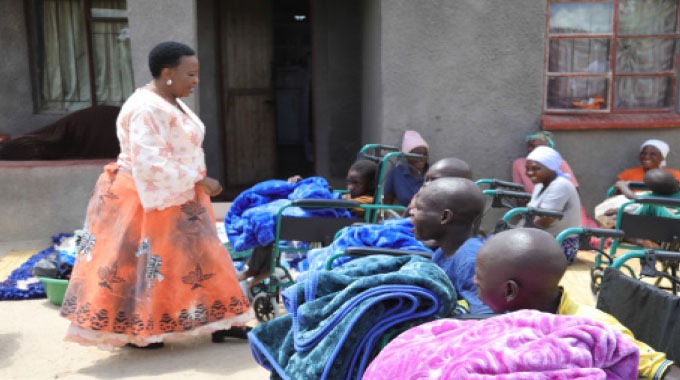
NOTHING beats a mother’s love.
This was evident when the caring First Lady, Dr Auxillia Mnangagwa, visited a family in Epworth where four blood sisters are devotedly caring for nine children living with cerebral palsy.
It has been a long and demanding journey for the four Gogo Petronella Muzvidzwa’s (née Mutasa) daughters, Abigail, Christine, Tsitsi and Modesta, whose commitment to caring for the children has tested them in ways few can imagine.
For years, they have shared the responsibility of looking after the children, aged between 11 and 22, often carrying them on their backs due to a lack of wheelchairs, which made it difficult for the family to move around and access basic amenities.
Cerebral palsy is a neurological condition that affects movement, muscle tone and posture.

Their daily lives have been defined by endurance rather than convenience, as every step beyond their doorstep requires physical strength, patience and unwavering devotion.
Three of the sisters were divorced by their spouses due to the challenges brought by the condition, but despite remarrying other men, they continue to face the same challenge of having children born with cerebral palsy.
Before their father’s death, the family tried all sorts of assistance to no avail. Even after his passing, efforts are still ongoing, although they claim that some of their paternal relatives are reluctant to help.
Their father had two wives, but there have been no issues concerning the children of the other wife.
The four women shared their harrowing experiences of raising children with disabilities, such that some community members in the densely populated peri-urban settlement sometimes fail to fully understand the family’s situation.
Recently, a quiet and gentle knock at the Muzvidzwa family’s gate brought unexpected relief.
The visitor was the First Lady, Dr Mnangagwa, who had learnt about the family’s situation and decided to personally visit them to offer both moral and material support.
Moved by their circumstances, Mother Zimbabwe brought wheelchairs, blankets, clothes and food hampers to assist the family that has long carried its burden largely on its own.
For the Muzvidzwa sisters, leaving home with the children had always required careful planning and difficult choices.
They often had to decide who to carry first, who to leave behind, and how to navigate uneven paths with children whose muscles struggled even with the gentlest shift in position.
On rainy days, the paths turn muddy, while on dry days, dust clings to clothes and skin. Transport money is rarely guaranteed.
For families managing chronic conditions such as cerebral palsy, the strain can be constant both financially and emotionally.
During the handover, the First Lady presented each of the nine children with a wheelchair, clothes and a blanket to improve their mobility while easing the physical burden on their caregivers.
One by one, the children were gently placed into chairs designed to support their posture and comfort. The practical intervention immediately changed the dynamics of the family’s daily life.
For the first time in years, movement no longer depended entirely on someone’s back.
The food hampers provided by the First Lady served a great deal in complementing their food supplies.
Handing over the items, Dr Mnangagwa emphasised that children with disabilities deserve equal opportunities and support from society.
“As a mother myself, I was deeply touched when I heard about your situation. No one chooses such a condition, but children are a gift from God. I personally came so that I could see for myself how you are living and how you are managing, because it is rare in our families to see such a situation coming from one household,” she said.
“You wrote a letter asking for assistance, and when I later called and spoke with you, that is what touched my heart and motivated me to come here today. I have come so that each child can now have their own wheelchair. Let us continue supporting one another as we move forward together.”
The First Lady also comforted the family, encouraging them to accept the situation and continue caring for the children with love.
“You have already given birth and played your part as parents, so you should not abandon them. Continue taking good care of them because they are a blessing from God,” she said.
Dr Mnangagwa also took time to interact with the family, learning how they are managing their daily lives and how neighbours and the community are responding.
Mother Zimbabwe shared a lighter moment with the children, whose smiles reflected their gratitude and joy.
The four sisters, together with their mother, expressed heartfelt gratitude for the intervention, saying the wheelchairs would greatly improve the children’s quality of life and restore a sense of dignity.
What was once a physically exhausting routine of lifting and carrying will now require far less strain.
Cerebral palsy requires long-term management and consistent care, placing significant financial and emotional strain on families, particularly in low-income communities.
One of the sisters, Tsitsi, expressed her gratitude to Mother Zimbabwe, describing her as a true Angel of Hope.
“I would like to thank our First Lady for what she has done for us and for the kindness she has shown. Life with the children has been very difficult because they cannot walk.
“Sometimes rain would fall while they were just sitting there, unable to move. But now they are able to move around. Carrying them or moving around with them had become a challenge because they are now grown,” she said.
One of the sisters, Christine, narrated their ordeal.
“We are sisters, and this is what our family situation is like today. Our mother, the First Lady, who is loving and compassionate, came into our home. She comforted us and encouraged us to remain strong as we continue caring for our children, whom we regard as a gift,” she said.
For Modesta, indeed, Dr Mnangagwa is a listening and humble mother.
“We sent our plea for assistance, and she responded immediately and came. I am very thankful.
“I never imagined that she would come and help us. We received wheelchairs, blankets and food. May God continue to protect and bless our dear First Lady,” she said.
For Abigail, spending a day with a listening First Lady was more than a blessing.
“She came to our home and saw the challenges we are facing. She also gave us words of encouragement. Her visit comforted us and strengthened us through her encouraging words,” she said.
Their mother, Gogo Muzvidzwa, was on cloud nine over the donation.
“I would like to thank our mother, the First Lady, for what she has done for my grandchildren. I am truly grateful that our mother comforted us and managed to come here after we presented our plea for assistance,” she said.
In places like Epworth, where resources are often stretched, disability can deepen vulnerability.
Dr Mnangagwa’s intervention forms part of her broader outreach initiatives aimed at supporting vulnerable groups, including children, women and people living with disabilities across the country.
For the Muzvidzwa family, however, the visit meant more than assistance.
It meant relief, recognition and the comforting knowledge that their struggles had not gone unnoticed.
It left a moment in which the weight of care felt, if only slightly, shared.