Online Reporter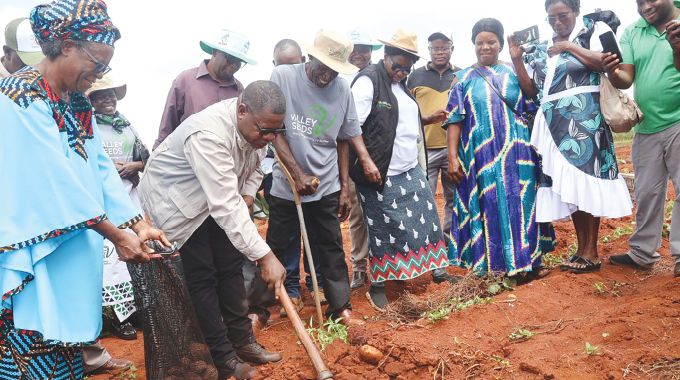
Theseus Shambare, [email protected]
THE morning at Nkunzani Farm begins with the steady rhythm of steel striking soil.
Bent slightly forward, Mr Godfrey Nkunzani drives his hoe into the rich red earth, loosening a ridge before reaching down to pull up a cluster of potatoes — firm, plump and dusted with fresh soil.
Around him, workers move in measured steps along the rows, lifting, sorting and filling sacks in a rhythm honed by experience.
Visitors move along the rows, taking in the harvest during a field day held recently at this farm within Komani Estates.
Among them is Professor Obert Jiri, Permanent Secretary in the Ministry of Lands, Agriculture, Fisheries, Water and Rural Development, observing the farm’s methods up close.
A few paces away, a visiting farmer holds up a single potato — unusually large — drawing murmurs of admiration from those gathered along the field.
It is a small gesture, but it hints at the scale of the harvest taking shape.
Each line of the field yields an average of 45 pockets, and with 120 lines planted, success here is measured as much by precision as by productivity.
Beyond the potato rows, maize rises in uniform, deep-green columns — a quiet testament to a farm that has not only survived, but thrived.
It does not end there.
This potato field is kept alive by six solar-powered boreholes that supply water to a 10m by 20m reservoir, which also serves as a fishpond.
The potatoes are watered through drip irrigation.
Despite water limitations for the rest of the farm, Mr Nkunzani has planted 26 hectares of maize and nine hectares of soya beans this season, while also renting additional land from neighbouring farms.
Two decades ago, that certainty did not exist.
A beneficiary of Zimbabwe’s Land Reform Programme, Mr Nkunzani got into farming at a time when ownership came faster than capacity.
Like many new farmers in the early 2000s, he had land — but limited access to capital, infrastructure and technical expertise.
“The land was there, but production was not where it needed to be.
“You had to learn everything, often through trial and error,” he said.
That gap — between access and productivity — defined the early years of land reform, as large tracts of farmland struggled to reach full potential.
Early phases of the Comprehensive National Agricultural Land Audit showed that of the approximately 300 000 land units targeted for review, only about 18 646 (6 percent) had been audited in the first phase, revealing 255 abandoned units and 112 vacant ones that the Government moved to re-allocate, as well as concerns over farm sizes and multiple ownerships exceeding gazetted limits.
Historical analyses also pointed to deep underlying underutilisation: studies of Zimbabwe’s agricultural structure suggested that as much as 65 percent of large-scale commercial farmland remained underutilised, highlighting just how much productive land was lying idle or only partially used before the reforms and productivity interventions of recent years.
To bridge this divide, in 2020, the Government introduced joint ventures (JVs) — a model pairing landowners with investors who brought capital, technical know-how, and modern farming methods.
The initiative targeted underutilised A1 and A2 farms, encouraging partnerships that modernised infrastructure, expanded irrigation and introduced mechanisation and precision farming practices.
By late 2025, over 2 500 Government-approved joint ventures covered more than 217 000 hectares, transforming idle land into productive operations focused on strategic crops like maize, wheat and tobacco.
All agreements were formalised and regularised by the ministry to protect both landowners and investors, ensuring that partnerships were fair, legally binding and aimed at building lasting capacity.
It is within that framework that Mr Nkunzani’s farm found new purpose.
In 2020, he partnered with agricultural investor Mr Allan York, combining his land with capital and technical expertise.
The results were immediate — maize yields climbed to an average of 12 tonnes per hectare under dryland conditions, soybeans reached 3,4 tonnes per hectare and under drip irrigation, potato yields peaked at 67 tonnes per hectare.
But the real shift, he said, was not in the numbers.
“It changed how I thought about farming. Planning, timing, reinvestment — understanding that this is a business,” he said.
Across Zimbabwe, nearly 4 000 such partnerships have quietly reshaped the agricultural landscape, unlocking production on land that had remained underutilised for years.
Professor Jiri described the model as both corrective and catalytic.
“These joint ventures are addressing a critical gap. We are bringing together farmers who have land with investors who have capital and technical expertise to ensure that land is fully utilised.
“The expectation is that farmers build capacity, reinvest and eventually become independent,” he said.
At Nkunzani Farm, that transition is already visible.
Having absorbed both skills and systems, Mr Nkunzani now operates independently, expanding his hectarage while diversifying into fish farming as a hedge against climate risk.
His farm employs 11 workers, four permanently and hosts students on agricultural attachment — transforming it into a site of both production and knowledge transfer.
For Agriculture and Rural Development Advisory Services chief director, Mrs Medlinah Magwenzi, this represents the long-term impact of the JV model.
“We are beginning to see a different kind of farmer emerging,” she said.
“Not just someone with land, but someone who understands production, markets and sustainability.”
Nationally, that shift is reflected in recent output trends.
The 2024/2025 summer cropping season saw maize production rebound dramatically, wheat yields reach record highs, and tobacco volumes approach historic peaks.
Analysts credit a combination of improved rainfall, expanded hectarage and adoption of productivity-enhancing practices.
“Commercial agriculture in Zimbabwe was built over decades, with strong institutional support,” said agricultural economist Dr Blessing Moyo.
“What we are seeing now is a newer group of farmers building capacity within a much shorter timeframe, often under more constrained conditions.”
Joint ventures, he added, are transitional — a bridge that allows farmers to move from access to independence.
Mr Nkunzani appears to have crossed that bridge.
His operations are structured, his investments deliberate, and his risks calculated.
The farm now supports livelihoods beyond his own, producing output, creating jobs and transferring knowledge.
As Zimbabwe approaches Independence Day, the story unfolding here offers a grounded interpretation of independence in practice: not just ownership, but productivity.
Not just a moment, but a process.
“It takes time. You have to learn, adapt, and keep improving,” Mr Nkunzani said.
As the day advances, trucks carry produce out of the fields while irrigation systems continue their steady work — feeding into the next cycle, the next season, the next decision.
Across Zimbabwe, thousands of similar journeys are underway.
Some are still at the beginning; others, like Mr Nkunzani’s, are transitioning towards independence — not as a slogan, but as a lived reality.
The transformation is uneven, ongoing and at times fragile.
But it is also real.
And in farms like this one, it is measurable — in yields, in jobs, in knowledge and in the quiet confidence of a farmer who now stands not just as a beneficiary of land, but as a producer in full control of it.
Independence is no longer something marked on a calendar.
It is something being built — season by season, decision by decision — in fields like these.