Online Reporter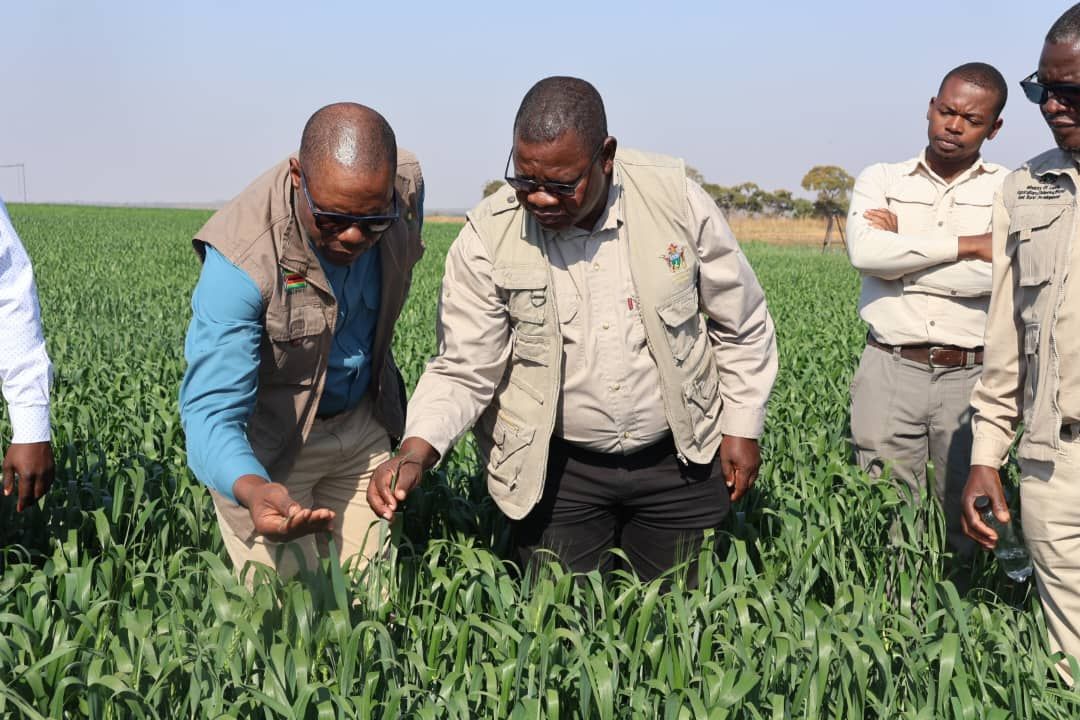
Theseus Mauruki Shambare Features Writer
THE convoy slows to a stop at Barwick L Farm under Pula Estates, where a sea of emerald-green wheat stretches towards the horizon.
Centre pivots sweep gracefully across the landscape, sprinkling life onto fields that, only a few seasons ago, were producing little.
Young agricultural students gather around notebooks in hand.
Experienced commercial farmers exchange observations on crop stands and irrigation schedules.
Government officials inspect the fields while trucks wait for another season that promises to replenish the Strategic Grain Reserve.
Standing among them is a man whose office once stretched across Africa.Not long ago, Mr Phibeon Mutibura spent his days travelling between Johannesburg, Gaborone, Maputo and other regional capitals, discussing investments, balance sheets and corporate strategy as a senior banking executive.
Today, at Barwick L Farm under Pula Estates, he is just as comfortable talking about soil moisture, fertiliser application, wheat yields and grain deliveries.
His story is more than one man’s career change.
It is part of a quiet but significant movement taking shape across Zimbabwe—one in which professionals, entrepreneurs and members of the diaspora are returning home, bringing with them capital, management skills, global experience and a renewed belief that agriculture can become the country’s next engine of economic transformation.
The timing is symbolic.
Next month, Zimbabwe commemorates Heroes Day, remembering men and women who crossed borders decades ago to organise and wage the liberation struggle that secured the country’s independence.
Many of those heroes were themselves members of the diaspora.
Some were studying at foreign universities.
Others had fled persecution under the Rhodesian regime.
Many abandoned careers and comfortable lives because they believed Zimbabwe’s future was worth building.
Today’s returnees are answering a different national call.
Their battlefield is not the liberation war.
Their mission is to help build food security, create jobs and contribute to an agricultural revolution that seeks to transform Zimbabwe into a regional agricultural powerhouse once again.
For Mr Mutibura, the decision to return home was never driven by nostalgia alone.
Born in Murambinda, Buhera, and raised partly in Chitungwiza, his childhood was shaped by rural life even as his professional ambitions led him into banking.
Inspired by a cousin who worked in the financial sector, he studied Banking and Finance at the National University of Science and Technology before furthering his education at the University of
Pretoria and undertaking several professional qualifications.
His corporate journey took him through Barclays before later joining ABSA, where he rose to become a regional executive overseeing operations in 12 African countries.
By every conventional measure, he had reached the pinnacle of corporate success.
Yet something kept pulling him back.
“Despite foreign countries having been viewed as greener pastures, to me, I never forgot my roots,” he said.
His perspective on agriculture deepened further after attending the Chitepo School of Ideology, where discussions on nation-building reinforced his conviction that food production is more than an economic activity.
For him, allowing foreign markets to dominate local food systems carries risks that go beyond commerce.
Food security, he believes, is inseparable from national resilience.
That conviction eventually outweighed the comfort of a multinational corporate career.
Returning home, however, was far from easy.
His first attempt at farming in Rafingora involved only five hectares of marginal land.
“Getting a farm seemed to be a herculean task,” he recalled.
Many people would have walked away.
Instead, Mr Mutibura embraced one of the models increasingly reshaping Zimbabwean agriculture.
Through Government-supported joint ventures, he partnered with landowners in Mashonaland Central, combining investment capital, business planning and technical expertise with land that had previously remained underutilised.
The results have been remarkable.
In only three years, his irrigated land expanded from virtually nothing to around 300 hectares.
During the 2025/26 summer season, he cultivated 250 hectares of irrigated maize and 400 hectares of sorghum before delivering grain to the Grain Marketing Board.
This winter, another 250 hectares are under wheat.
Next summer cropping season he plans to increase production to 300 hectares of irrigated maize and 700 hectares of sorghum, with his overall farming footprint expected to reach way above 1 000 hectares.
The spreadsheets have not disappeared from his life.
They have simply found a different purpose.
Financial modelling now guides irrigation investment.
Corporate governance now strengthens farm management.
Regional executive experience now helps coordinate large-scale commercial production.
Today, Barwick L Farm under Pula Estates has become more than a commercial grain enterprise.
It has evolved into a centre of learning where experienced farmers mentor diaspora returnees, aspiring commercial producers and agricultural students, demonstrating how knowledge-sharing is becoming as important as grain production itself.
But perhaps the greatest harvest emerging from the farm is neither maize nor wheat.
It is people.
The Strategic Grain Reserve (SGR) 200ha Plus Club, through which Mr Mutibura was mentored, is steadily becoming more than an association of successful grain farmers.
It is evolving into a practical academy where experienced producers nurture the next generation of commercial farmers.
Knowledge is shared from farmer to farmer – mistakes become lessons, success becomes transferable.
Having benefited from that mentorship, Mr Mutibura is now paying it forward.
One of those inspired by the movement is Ms Abigail Zaranyika.
At first glance, many would mistake her for a fashion model rather than someone preparing to establish commercial maize fields.
She laughs at the stereotype.
“I actually make agriculture look attractive,” she said with infectious confidence.
Recently returned from Scotland, Ms Zaranyika said she closely followed the emergence of young commercial farmers in Zimbabwe before deciding to return and revive her family’s farm in Marondera, Mashonaland East.
She has joined the SGR 200ha Plus Club and will begin by producing 50 hectares of maize under mentorship from experienced farmers.
For her, agriculture is not dirty work.
It is modern business.
“So many people think commercial farming is difficult,” she said.
“But once you have the knowledge and the right mentors, it becomes a business that can sustain you and your family while making our country flourish.”
Then comes a statement that captures the spirit of many returnees.
“There is nothing called greener pastures than home.”
Her words arrive at a moment when thousands of Zimbabweans continue returning from neighbouring South Africa following recurring episodes of xenophobic tension and uncertainty.
Not every returning Zimbabwean will become a commercial farmer.
Yet agriculture is increasingly presenting itself as one of the country’s most accessible investment opportunities, particularly for professionals and members of the diaspora bringing home skills, savings and international exposure.
Instead of viewing return as defeat, many are beginning to see it as reinvestment.
Another generation is already preparing to carry the torch.
Walking through the wheat fields at Barwick L Farm is Ms Alicia Bharu, a student on industrial attachment from Gwebi College of Agriculture.
For her, the farm is more than a workplace.
It is a living classroom.
“Being attached at this farm has been an eye-opener,” she said.
“Getting hands-on experience is helping me transfer the theory we learnt at college into commercial farming practice.”
That simple observation reveals something profound.
Zimbabwe’s agricultural transformation will not be sustained by infrastructure alone.
It will depend on transferring practical knowledge from one generation to the next.
Every experienced farmer becomes a teacher.
Every commercial farm becomes a training ground.
Every successful season becomes an investment in future production.
The movement is receiving institutional backing.
During a field tour by officials recently, Agricultural and Rural Development Authority (ARDA) chief executive officer Mr Tinotenda Mhiko said Zimbabwe’s production strategy now integrates several complementary models designed to maximise land utilisation and productivity.
These include ARDA estates, A1 and A2 joint ventures, irrigation scheme business units and clustered smallholder farmers.
Beyond financing inputs, farmers receive soil testing, agronomic support, land-use planning, logistical coordination and marketing assistance.
Preparations are already underway to establish about 110 000 hectares during the coming season, including 75 000 hectares under irrigated maize, with between 350 000 and 450 000 metric tonnes targeted for delivery into the Strategic Grain Reserve.
Permanent Secretary for Lands, Agriculture, Fisheries, Water and Rural Development Professor Obert Jiri said organised farmer groups and joint ventures have become one of the country’s most effective production models.
More than 4 000 joint ventures have already been established.
The concept is straightforward.
Some Zimbabweans possess productive land but lack capital.
Others possess capital, business expertise and a passion for farming but require access to land.
When those strengths are combined, productivity rises.
Professor Jiri said the partnerships are also creating an important graduation pathway, allowing landowners and emerging farmers to acquire commercial farming skills before eventually operating independently.
Equally significant is the mentorship taking place within organised farmer groups.
Established farmers are introducing newcomers to financiers, input suppliers, mechanisation services and modern production systems.
For SGR 200ha Plus Club vice chairperson Mr Simba Mugariri, that mentorship model is central to Zimbabwe’s agricultural future.
“Rather than simply increasing hectarage, the organisation seeks to multiply successful commercial farmers capable of consistently producing grain at scale.
“The ambition is to expand from more than 500 large-scale producers today to over 1 000 by 2030, making a substantial contribution to national grain production,” he said.
As Heroes Day approaches, history offers an interesting reflection.

The liberation struggle and today’s agricultural transformation belong to different chapters of Zimbabwe’s national story.
One secured political independence.
The other seeks to strengthen economic resilience through food security.
They should not be confused, both are linked by a common thread.
In each era, Zimbabweans have been called upon to invest their skills, their courage and their belief in the country’s future.
Some answered that call decades ago from foreign capitals, refugee camps and university campuses.
Today, another generation is returning from corporate offices, boardrooms and overseas communities carrying different tools but driven by a similar desire to help build the nation.
As the afternoon sun settles over Barwick L Farm under Pula Estates, the centre pivots continue their slow circles across the wheat.
Nearby, Ms Bharu follows closely behind experienced agronomists, absorbing lessons that no classroom alone could provide.
Across another section of the farm, Ms Zaranyika is admiring what she is witnessing, convinced that agriculture offers young Zimbabweans opportunities many have overlooked.
Mr Mutibura watches quietly.
Years ago, he managed financial portfolios spread across a continent.
Today, he is cultivating something arguably more enduring than profit.
He is helping grow a generation of commercial farmers who believe Zimbabwe’s greatest opportunities may not lie beyond its borders, but beneath its own fertile soil.
And perhaps that is the quiet revolution unfolding at Barwick L Farm under Pula Estates—and across Zimbabwe’s countryside—not simply the return of people to farms, but the return of confidence in Zimbabwe itself.