Online Reporter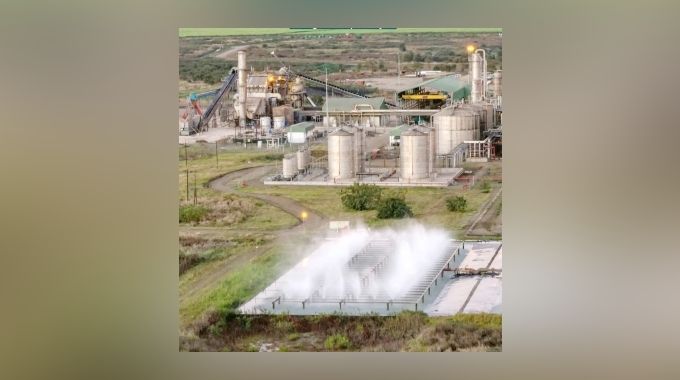
Theseus Shambare Features Writer
AT dawn in Chisumbanje, the Lowveld is already awake before the sun clears the cane fields.
A convoy of diesel trucks rumbles out of the GreenFuel ethanol complex, their cargo no longer destined for sugar refineries or export warehouses, but for fuel blending depots feeding Zimbabwe’s national energy system.
Behind the wheel of one of them is *Tafadzwa, a 46-year-old driver employed under the Green Fuel logistics network.
“Before this, we were seasonal,” he said, checking fuel seals on his tanker.
“Now ethanol runs all year. The plant never sleeps.”
The Chisumbanje ethanol plant — operated under Green Fuel Zimbabwe (Private) Limited, a joint venture involving
Rating International (Mauritius) and local stakeholders — is now one of the largest biofuel facilities in Southern
Africa, with an installed capacity estimated at over 150 million litres per year, forming the backbone of Zimbabwe’s blending programme.
But what is emerging here is no longer just an industrial success story.
It is a contested transformation of land, labour and energy.
In nearby Chinyamukwakwa Village, sugarcane outgrower Ms Ruth Mlambo stands at the edge of her contracted plot, reviewing a new pricing sheet from millers.
For years, her income depended on sugar supply agreements.
Now, she has been absorbed into an expanded cane-to-ethanol supply system. “The money is better in some seasons,” she said. “But we are not sure what happens if sugar disappears completely.”
Her concern reflects a growing tension in Zimbabwe’s Lowveld: the reallocation of cane from food-grade sugar production towards ethanol blending under the national fuel strategy.
Agricultural economist Dr Prosper Zindi said the shift is economically rational but socially complex.
“Biofuels improve energy security, yes,” he explained.
“But they also restructure land use, pricing systems and farmer bargaining power. Without safeguards, smallholders can be squeezed.”
The concern is not theoretical.
Zimbabwe currently blends ethanol into petrol at ratios ranging from E10 to E20, depending on supply conditions and regulatory adjustments by the Ministry of Energy and Power Development.
But each percentage increase in blending raises a policy question: How much agricultural land should serve fuel rather than food?
Inside the ethanol engine room
At the Chisumbanje processing facility, workers move between fermentation dashboards and control screens tracking real-time ethanol output.
The plant converts sugarcane molasses and juice into fuel-grade ethanol supplied to national blending depots operated under the National Oil Infrastructure Company of Zimbabwe (NOIC).
Vice-President Dr Constantino Chiwenga visited GreenFuel’s Chisumbanje plant recently to assess mitigation measures amid recent price hikes due to global conflicts.
During the visit, GreenFuel general manager Mr Conrad Rautenbach said the Chisumbanje expansion supports national resilience as well as business growth.
“As a company, we have been upscaling and upgrading throughout the years. Obviously, like everyone, we didn’t predict a crisis in the Middle East, but we tried to be prepared and to be self-reliant as a company and as a country,” Mr Rautenbach said.
“We have been expanding our sugarcane development, and we have been expanding on the factory side, the production side and on the storage side.
“We are going as fast as we can to develop. This year, the plan is to produce 120 million litres of ethanol and now, with our upgraded storage facility, we should be able to have E20 throughout the year instead of dropping to E5,” he said.
The shift aligns with Government targets announced by the Ministry of Agriculture, Mechanisation and Water
Resources Development: increasing national ethanol output from approximately 155 million litres to 600 million litres annually by 2035.
According to official policy briefs, the goal is to reduce fuel import dependency, which consumes a significant portion of Zimbabwe’s foreign currency earnings each year.
But industry insiders admit the expansion is constrained by infrastructure bottlenecks — particularly storage capacity, blending logistics and transport corridor inefficiencies linking the Lowveld to Harare and Bulawayo.
The policy room in Victoria Falls
Inside the SADC Joint Meeting of Ministers Responsible for Agriculture, Food Security, Fisheries and Aquaculture in
Victoria Falls, the tone was different — but the urgency was the same.
Zimbabwe’s Minister of Agriculture, Dr Anxious Masuka, positioned ethanol as part of a broader structural shift.
“We are deliberately reorienting the sugar industry from food sugar production towards ethanol production,” he said.
“This is about cushioning the economy from global fuel shocks.”
He pointed to global instability — particularly the Russia–Ukraine conflict and Middle East tensions — as drivers of fertiliser and fuel price volatility.
Official data from regional trade briefings show fertiliser prices have increased by up to 300 to 400 percent over recent years, severely affecting production costs across Southern Africa.
South African Agriculture Minister John Steenhuisen confirmed the regional pressure.
“Input costs are now one of the biggest threats to food security in the region,” he said.
“We must localise production of strategic agricultural inputs, including energy-linked systems like ethanol.”
The border that now moves energy
At Chirundu One-Stop Border Post, customs officer Mr Moses Kunda observes a shift in cargo composition.
“Before, we mostly processed tobacco, maize, general imports,” he said.
“Now we are seeing more industrial agricultural inputs and fuel-linked logistics systems.”
Tanker movements linked to ethanol blending supply chains are increasing, according to border management officials, reflecting the integration of agriculture and energy logistics across the region.
This is no longer just trade in crops. It is trade in energy systems.
Regional alignment: Tanzania, Zimbabwe and the new trade logic
In Victoria Falls, Zimbabwe and Tanzania deepened discussions on agricultural trade diversification.
Tanzania’s Minister of Agriculture Daniel Godfrey Chongolo emphasised structured intra-African trade.
“We cannot continue exporting raw commodities and importing processed goods,” he said.
“Regional value chains must be strengthened.”
Zimbabwe is currently a net importer of rice, while Tanzania holds surplus production capacity, creating immediate trade complementarity.
At the same time, both countries face declining global tobacco prices, raising questions about the long-term viability of traditional export crops.
Despite optimism, structural gaps remain unresolved.
A senior official within Zimbabwe’s agricultural planning structures, who requested anonymity due to ongoing negotiations, highlighted key constraints.
Key challenges include limited rail logistics linking Lowveld production zones to major markets, inadequate ethanol storage capacity at urban depots, inconsistent enforcement of fuel blending regulations across retailers and delayed private sector investment in downstream infrastructure critical for scaling the industry.
“These are not policy problems anymore,” the official said. “They are execution problems.”
The human cost of transition
Back in Chinyamukwakwa, Ms Mlambo walks past an irrigation pipeline trench marking expansion of ethanol-oriented cane production zones.
She pauses.
“If this works,” she said quietly, “my children might not need to leave Zimbabwe.”
But she added a warning that echoes across the Lowveld:
“We just do not want to become suppliers who cannot decide our own prices.”
The last shift
As evening settles over Chisumbanje, the ethanol plant does not slow.
Steam rises from processing towers.
Trucks queue under floodlights. Control room screens flicker with output metrics.
Inside the facility, engineers review daily production figures showing stable ethanol output, rising national blending demand and mounting pressure on transport and logistics systems supporting distribution.
Outside, Tafadzwa starts his engine for a night run towards the NOIC blending depot.
“This is not sugar anymore,” he said.
“This is fuel for the country.”
Night falls over Zimbabwe’s Lowveld, but the landscape remains in motion — illuminated by industrial lights cutting through cane fields that once existed only as agricultural space.
Now they are something else.
They are energy fields. They are transport corridors. They are trade assets in a regional system being quietly rewired.
And as tanker trucks move north towards Harare and policy debates continue in regional capitals from Pretoria to Lusaka to Dar es Salaam, a new reality is becoming visible:
Southern Africa’s agriculture is no longer defined only by what it grows.
It is defined by what it powers.
And in that shift — from sugar to strategic fuel — lies one of the most consequential industrial transformations the region has ever attempted.