


 admin
admin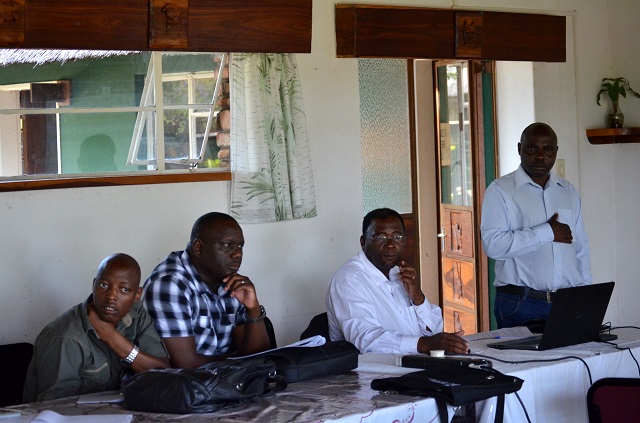

Dumisani Nsingo, Senior Business Reporter
THE Ministry of Environment, Water and Climate Change has expressed satisfaction at the role played by the Hwange Sanyati Biological Corridor Project (HSBCP) in ensuring effective wildlife species management.
Speaking at an HSBCP stakeholders meeting at the Hwange Main Camp recently, the Ministry of Environment, Water and Climate Change principal natural resources officer, Mr Kundishora Mpandaguta, said the project has played a significant part in protecting biodiversity at the Hwange National Park, Sikumi and Ngamo forests.
HSBC project covers an area of 5,7 million hectares in north-western Zimbabwe and falls within the Kavango-Zambezi (Kaza) Trans-frontier Conservation Area. It is a $6,4 million project being funded by the Global Environment Facility and is running from 2014-2019.
World Bank is the implementing agency for the project, World Wildlife Fund the activities implementing entity while the Ministry of Environment, Water and Climate Change is the co-ordinating authority. Key project partners are Parks and Wildlife Management Authority; Communal Areas Management Programme for Indigenous Resources Association, Zimbabwe Environmental Management Agency and the Forestry Commission.
“Since the beginning of the project we have managed to set ourselves to improve game water supply. We managed to drill several boreholes which are operated by solar and some by diesel and repaired some which were broken down.
“We wanted to improve the anti-poaching efforts within the areas, so we bought vehicles for transportation and moving rangers from one place to the other. We bought radio communication equipment so that they can communicate better,” said Mr Mpandaguta.
He said the project also saw the capacitation of the Zimbabwe Parks and Wildlife Management Authority’s Information and Communication Technology systems.
“We bought computers and installed what we called smart system where they collect data on what is happening on the field such as recording or getting minute information from rangers on the ground.
“We did manage to buy equipment such as tractors and trucks to manage veld fires. Prior to the procurement of this equipment, we did a study on fire ecology, how fires affect biodiversity and we try to do interventions that are informed on study,” said Mr Mpandaguta.
Hwange National Park forms a bigger component of the Kaza area.
“Whatever action we do at Hwange National Park has an impact on regional success in terms of conservation because you will note that most of our elephants travel to Botswana, they go to Namibia, they go to Zambia. So whatever efforts we do has an impact in terms of how we succeed on a regional scale particularly the Kaza landscape,” said Mr Mpandaguta.
He said Hwange National Park plays an integral part in the country’s tourism industry.
“We continue to improve the performance of the Park so that the tourism industry also has an opportunity to grow and tourists have confidence knowing that tourism efforts in Zimbabwe make sure all endangered or protected species are really protected,” said Mr Mpandaguta.
Under the biodiversity focal area, the project is supporting the conservation and sustainable use of biodiversity by strengthening the management of Hwange National Park and its buffer area. Under land degradation, the project contributes to developing tools for arresting and reversing current trends in land degradation in the Sanyati catchment area and piloting land rehabilitation projects. Under climate change, the project supports small mitigation measures to reduce greenhouse gas emissions, management of land and longer-term adaptation measures.
“The project has three main components, biodiversity conservation, land degradation management and then we have climate change. The integration of all these three aspects in this one single biological corridor is an indication of how we want conservation to be integrated. We cannot look at these issues separately because they are intertwined within the environment.
“So going forward we are hoping to improve or upscale what we are doing here and we finish the project. Our hope is that it doesn’t end here, but we take the lessons we have leant from the project and try to find more funding and try to fill the gaps where we think we need a bit of assistance. This project has given us good lessons so far that we can upscale in other areas of Zimbabwe, not only just in this north-western landscape,” said Mr Mpandaguta.


 Online Reporter