admin
admin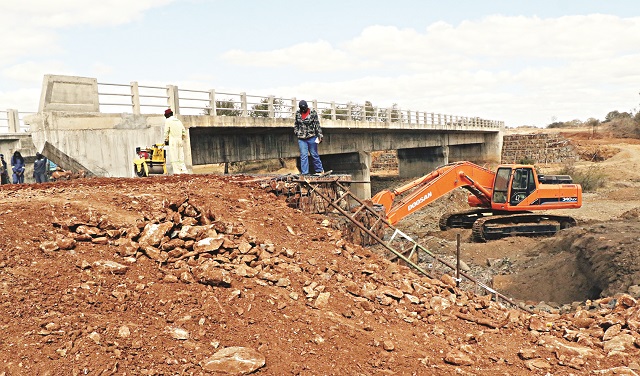

Melissa Mpofu recently in Nkayi
THE ongoing Emergency Road Rehabilitation Programme (ERRP) being spearheaded by Government through the Zimbabwe National Roads Administration (Zinara) has brought smiles to travellers and motorists across the country.
Most damaged roads that had been abandoned for years are being repaired as part of the countrywide road networks improvement by the new dispensation.
Speaking during a media familiarisation tour of completed and on-going road and bridges rehabilitation projects in Matabeleland North on Friday, Joseph Makokove, the provincial road engineer, said they were happy with progress made so far and paid tribute to the new dispensation for availing funds.
“It is the new political dispensation’s thrust for Zimbabwe to have a well-developed, trafficable and safe trunk, rural and urban road network. The general condition of most roads in the country had deteriorated due to inadequate funding for routine maintenance, but through the Emergency Road Rehabilitation Programme, the roads are now being rehabilitated,” said Eng Makokove.
The ERRP is a Government programme that was initiated in order to rehabilitate the country’s road network that had been extensively damaged during the last rain season. Phase one of the ERRP, which commenced on March 12 last year, prioritised preservation of the road infrastructure from further deterioration and safe passage for travellers.
“For phase one, we targeted critical roads in each and every district in Matabeleland North. We repaired several damaged road sections and rehabilitated drainage systems targeting structures especially culverts and other roads that were completely cut off by the rains,” said Eng Makokove.
On-going phase two of the programme is focusing on major rehabilitation works, reconstruction of damaged bridges including preventive periodic maintenance works and rehabilitation of failed sections of the road network.
“In terms of our road network Matabeleland North, which has seven districts covers approximately 3 000km. Of our major roads, we have Bulawayo to Victoria Falls, which is the longest road and is earmarked for dualisation,” he said.
The programme has brought smiles as people in Binga, who had a bridge that links them to the biggest hospital in their district that was washed away, had been reconstructed.
“The Gwayi-Binga road, which links to the major hospital in Binga-Kariangwe Mission had a bridge on Lubu River that was washed away making it hard for people there to access the hospital. This has been addressed so the people in Binga can now access the major hospital in the district.
“Currently, there’s a failed section in Gwayi area, which we’re going to do 3km of road rehabilitation. We’ve already recruited people and we’re moving machinery to the site,” said Eng Makokove.
For people in Binga, where fishing is a major economic activity, he said Siabuwa Mujere Road, which links people to Jere fisheries was also being re-gravelled in order to make the road trafficable.
But, it has not been smooth sailing as some of the projects had to be suspended last year when prices escalated.
“For phase two, we did Kamativi-Binga but unfortunately towards the end of last year when prices escalated, some projects failed to take off and ended up spilling into 2018. Kamativi-Binga resealing was however completed this year,” he said.
The engineer revealed plans to shorten the distance between Harare and Victoria Falls by about 200kms through the ERRP.
“Nkayi-Lupane Road is an ongoing project that was suspended due to funding sometime back. It is, however, earmarked to be constructed as it will shorten the distance from Harare to Victoria Falls by 200km via Kwekwe to Lupane. So, there’ll be no need for motorists to pass through Bulawayo when travelling to Victoria Falls.”
During a tour of Nkayi Road, Eng Makokove said Bulawayo-Nkayi Road that had been neglected for a very long time had been given top priority. The Bulawayo-Nkayi Road that had become too old because of increased volume of traffic and was now expensive to continue maintaining last had works done in 2011. Now the road is set to be widened with an abandoned high level bridge on the Ngwigwisi River along the road set to be complete.
“Fortunately, this year under the road development programme, we have disbursed $5 million for Bulawayo-Tsholotsho Road, which is enough to do 10km and are already upgrading the road. On Bulawayo-Nkayi Road, another $5 million has been availed for 10km,” he said.
“The high level Ngwigwisi River Bridge along the Bulawayo-Nkayi Road that was constructed in 2000 and suspended due to funding challenges is work in progress now. This was after a visit of the bridge by President Emmerson Mnangagwa. Funds were availed after and we commenced work on that bridge.
“The structure was complete but backfilling and approaches to the bridge were not done so the bridge was just in isolation of the road. We are now trying to link it to the road so that people can access the high level bridge.”
Eng Makokove said the high level bridge would really be a major relief for motorists who use the Bulawayo-Nkayi route as the low-level bridge had become a hazard.
“During the rainy season, the low level bridge, which is a single lane sometimes gets over-flooded then people get stranded and spend several hours waiting for the river to subside. With the high level bridge in operation, we expect that this coming rain season, it will all be a thing of the past as it will be a two-lane carriageway,” he said.
The stretch supported by the $3,5 million by Treasury is hoped to be complete by end of September. Eng Makokove said they hoped to get about $50 million annually for the province for the next three to four years to complete all roads and bridge rehabilitation projects. So far for this year, under the new dispensation, he said the department has received $21 million from the Ministry of Finance and Economic Planning compared to the $3 million they received last year.
“In the history of the department, we have never received such an amount. Actually our personnel are still overwhelmed with the money because last year we got $3 million for the whole year. So this is quite remarkable,” he said.
The ERRP’s implementation is being co-ordinated through a Project Steering Committee (PSC), which provides policy guidance. The Project Steering Committee is chaired by the Ministry of Finance and Economic Planning and involves sister ministries, the Ministry of Transport and Infrastructural Development, Ministry of Local Government, Public Works and National Housing; and the District Development Fund (DDF).


 Online Reporter