Chronicle Editor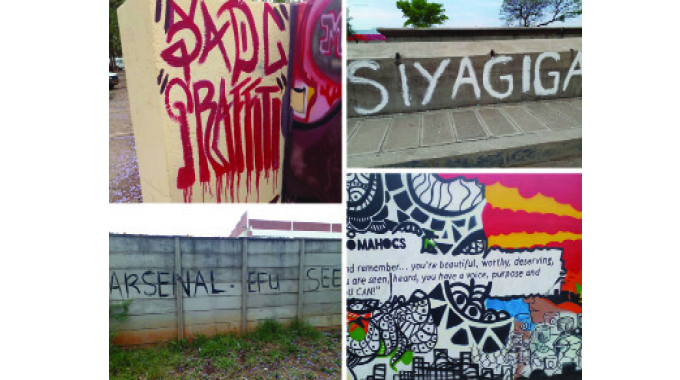
Mbulelo Mpofu, Showbiz Reporter
TAKING a walk in the streets of Bulawayo presents one with an opportunity to feast upon some remarkable visual experience.
Bulawayo residents are people of art, culture and colour. Irrespective of the surface at their disposal, they do not pass the chance to paint the city red.
Last month, we discussed the customisation of sneakers, slides and apparel in general and the ball keeps rolling. This week, we will focus on ink and paint.
Ink, in its universality, seems to stick on any surface and people cannot help but fall in love with it.
Everyone wants to live a “colourful” life and it doesn’t get more literal than that.
From mere letters to logos and cultic figures, melanin is dressed with ink and paint to better express themselves and for some, to send a message.
Tattoos have for long been used as identifiers to gang and religious affiliations among other things across the globe.
In its infancy, the tattoo culture used to be just about the black ink.
With the advent and advancement of technology, vast colours have emerged and the end-result has been iconic.
Equipped with sterile and skin surfer pens, tattoo artists are ready to alter the outer look of the body and give it a fresh look even though one might be unfortunate to get a botched job and live to regret ever trying out the process.
From small tattoos to those that cover most of the body, the frame is subjected to ink.
So, to what lengths do people go to in pursuit of beauty, peculiarity and greatness?
There are many myths surrounding tattoos and among the most-common is them seen as a radical way of expressing oneself. Is it?
Tattoos come in different types and these include Watercolor Tattoo, Geometric Tattoo, Traditional Tattoo, Text-
Based Tattoo, Tribal Tattoo, Realism Tattoos and Cosmetic Tattoos just to name a few.
Owing its origins to mainstream personalities, especially in the film, music and sports entertainment, the culture has even permeated our society and the numbers of people who have them is growing.
One can stumble upon tattoos in different parts of the body and with this kind of daredevilry, humankind has ramped the culture up a notch, from painting bodies and house walls, to painting basically anything that paint can stick on to.
Now, let’s go back to my allusion of graffiti affording one a remarkable visual experience of our city, the opposite is also true. Sometimes, these giant words and logos plastered all over our walls give a sorry sight, thanks to obscenities and for lack of a better term, badly-done paintings.
This custom has Italian roots wherein the word graffiti is derived from the Italian word graffio which translates to scratch or incised inscriptions.
Graffiti is usually understood as the unauthorised marking of public space by an individual or group but nowadays, it is a viable and entrepreneurially-sound endeavour.
This custom, sometimes classified as antisocial behaviour performed in order to gain attention or seek thrill, can also be understood as an expressive art form.
Most of the time, graffitists tend to be nocturnal when embarking on their graffiti. When the city goes to sleep, the boys come out to play and bring spray paint as their toys.
Is graffiti a sign of unruly behaviour from rowdy elements, bent on denting the walls of the city?
Sometimes, in the court of public opinion, graffitists are slain.
Saturday Leisure engaged with lovers of art and members of the public so as to pick their brain on what they think about tattoos and graffiti and how they feel about them.
“This culture of writing walls is despicable and is a product of an uncultured being. Sometimes, you even see obscenities drawn on our durawalls and I think it is high time law-enforcers look into this. Our walls are an eyesore now because of this and we know these boys. Their nicknames are even written on the roads. We need help,” complained one irate woman from Iminyela suburb who preferred anonymity.
One man thanked the heavens and “whoever invented graffiti.” Thamsanqa Ncube from Njube said he enjoys seeing graffiti on walls as this serves as a window to how creative people from Bulawayo can be.
“Don’t not get me wrong. We do have bad graffitists who paint bad stuff on our city walls, but this only goes to show to which length people go to in their quest to beautify their city,” communicated Ncube.
Along Old Khami Road, on the train fly over, one is greeted with giant words coated on the bridge wall and this paints the city in bad light if aesthetics is anything to go by.
One wonders whether it was an Arsenal fan or just a troll job, but clearly that giant “Arsenalee” was badly engraved against the bridge, a sign that whoever wrote that is clueless as to how blend and contrast colours.
But it’s not all doom and gloom for the city since not all graffitists have nefarious agendas.
Other graffitists are vehicles of change, educational change that is, and a good example of that is Buhle Bemvelo Signs who drew animals and people partaking in various sporting disciplines on the precast wall of Mpumelelo Primary School.
“Our job is to paint walls and when presented with a chance to work with schools, we do not pass that chance. It’s always great to get to paint educational content since this also serves as our way of giving back to the community because we were once school children as well,” said Buhle Bemvelo Signs founder Sipho Khumalo.
Another graffiti artist, Munashe Chitsa, director of WeCanPaintings said that he sees graffiti as a form of expression and to them, it’s not just about walls, but any surface is good for painting and vouched for its continuity.
“Graffiti is a commercial endeavour for us and as a lover of art, doing it for a fee makes it all worthwhile,” said Chitsa.
What’s your take on tattoos and graffiti? Let’s keep the conversation going. — @eMKlass_49


 Online Reporter