Online Reporter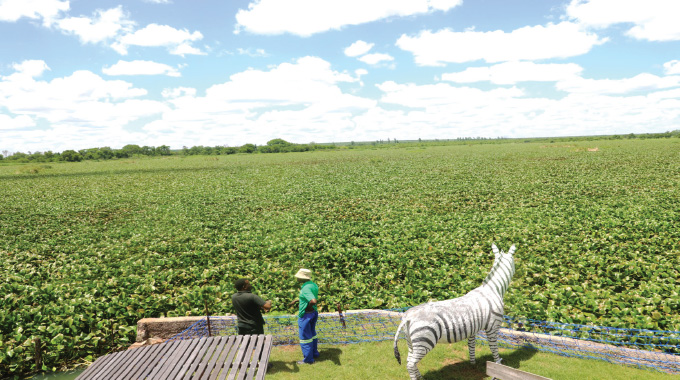
Raymond Jaravaza, [email protected]
UMGUZA Dam on the outskirts of Bulawayo, once a hive of leisure and economic activity, has been transformed into a lifeless green carpet after an aggressive invasion by water hyacinth, a highly destructive aquatic plant that is suffocating the water body and crippling local livelihoods.
The dam, managed by the Zimbabwe National Water Authority (Zinwa) and located on Bulawayo City Council-owned Aisleby Farm, is now almost entirely covered by water hyacinth, one of the world’s most aggressive aquatic weeds. Thick mats of fleshy green leaves blanket the water surface, blocking sunlight, depleting oxygen and drastically reducing biodiversity.
Water hyacinth spreads rapidly, forming thick layers of fleshy green leaves that choke water bodies, kill fish and render water unsafe for domestic, recreational and productive use.
Umguza Dam used to attract day trippers for speedboat rides, canoeing, fishing, birdwatching and picnics.
Today, it stands as a stark symbol of the growing ecological crisis affecting rivers, streams and dams across the country.
Beyond its recreational value, Umguza Dam is a critical lifeline for surrounding communities, supporting agriculture and providing water for livestock. However, today, that lifeline is under threat.
Mr John Makoni, who runs a leisure and entertainment business at the dam, said the infestation has virtually brought operations to a standstill.
“We have speedboats and regular boats that should be operating on the dam, but that is no longer possible because the water hyacinth has completely taken over,” he said.
“We are in the business of water sports, and a dam that looks like a green field instead of a water body is not attractive to clients. People want to see water, not weeds.”
In a desperate bid to keep the business afloat, Mr Makoni’s employees physically remove the weed from a small section of the dam to create a viewing area for customers.
“We even erected a floating fence to prevent the hyacinth from spreading into that section. It’s the only way clients can at least glimpse some clear water while relaxing,” he said.
“The plant has literally swallowed the dam. You cannot see a single drop of water as far as the eye can see.”
The infestation has also disrupted livestock farming, with cattle and goats from nearby communities unable to drink from the dam.
“This dam should be a lifeline for the surrounding communities, but livestock can no longer access the water,” said Mr Makoni.
He said officials from the Environmental Management Agency (EMA) visit the site regularly to assess water quality.
He said the problem dates back several years. “I took over this place in 2023, but I understand that the dam had already been covered by hyacinth as far back as 2017,” said Mr Makoni.
Farming communities downstream have not been spared either.
Beneficiaries of the land reform programme in Umguza District said the invasive plant has wiped out a key source of food and income.
“We used to fish in the Umguza River, but now the water is completely covered. All we see is a green carpet. Fishing has become impossible,” said Mr Mthandazo Mguni.
Mrs Primrose Ntuli said the decline of the Umguza Dam has also resulted in job losses.
“Before 2015, especially during the festive season, we used to get casual jobs here because many visitors came. The boats are gone, the visitors are gone, and our jobs are gone,” she said.
EMA national spokesperson Ms Amkela Sidange acknowledged the scale of the challenge, saying efforts were underway to find sustainable and environmentally friendly ways of controlling the spread of water hyacinth.
She said the authority is working with local universities to find sustainable and environmentally friendly ways to control the spread of water hyacinth.
“There is a lot of research that is being conducted to find ways of using biological methods to get rid of or control the spread of hyacinth. As EMA, we are working together with universities around the country in that regard,” said Ms Sidange.
She said EMA also conducts monthly ambient water quality monitoring in affected rivers, dams and streams to assess ecosystem health, detect pollution and ensure safety for human use, recreation and aquatic life.
Elsewhere in the region, innovative solutions are emerging. In South Africa, scientists have introduced a tiny insect, Megamelus scutellaris, a natural predator of water hyacinth. Released in large numbers, the bug feeds on the plant’s nutrient transport tissues, weakening and eventually killing the weed. Both the insect and the plant originate from the Amazon basin in South America.
As Umguza Dam continues to choke under the weight of the invasive weed, local communities and businesses alike are hoping that similar long-term solutions can be implemented before one of Bulawayo’s once-thriving recreational and economic hubs is lost completely.