Online Reporter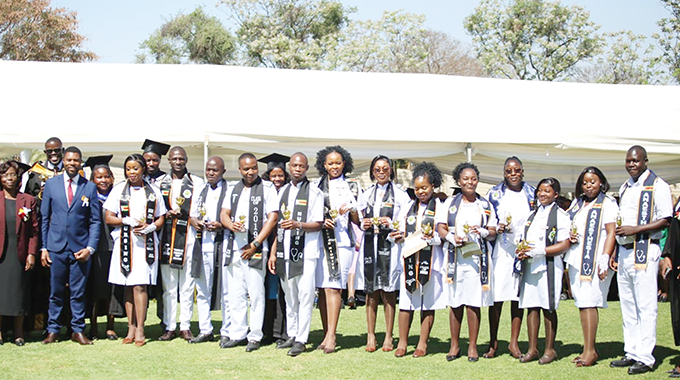
Patrick Chitumba, Midlands Bureau
GWERU Provincial Hospital (GPH) has become the first provincial hospital in Zimbabwe to train nurse anaesthetists, marking a major breakthrough in the Second Republic’s drive to decentralise specialist healthcare training and services beyond Harare.
The hospital yesterday graduated its first cohort of 10 nurse anaesthetists following the launch of the specialised programme in 2024, becoming only the second Government institution in the country to offer the training after Parirenyatwa Group of Hospitals.

The development is expected to strengthen access to surgical and emergency services, particularly in rural and hard-to-reach communities, where shortages of specialised health personnel remain a major challenge.
Health Service Commission (HSC) deputy chairperson Dr Rugare Abigail Kangwende hailed the achievement as a milestone in human-capital development and devolution.
“Central hospitals are six, but there is only one central hospital that trains nurse anaesthetists and it is Parirenyatwa Group of Hospitals. Gweru Provincial Hospital becomes the first one among provincial hospitals in the country to offer such training,” she said.

“Congratulations to Gweru Provincial Hospital for breaking new ground and making history.”
Nurse anaesthetists play a critical role in surgical teams, administering anaesthesia and monitoring patients during operations, including caesarean sections and other major procedures.
Kangwende said expanding specialist training to provincial institutions was in line with the Government’s de-centralisation thrust, devolution agenda and Vision 2030.
The move, she said, would help address both the shortage and uneven distribution of health professionals in the country.
“The challenge is not only the number of health workers but also their distribution. Only one-third of healthcare professionals are working in the rural or hard-to-reach areas yet two-thirds of the population of Zimbabwe live in rural areas,” said Kangwende.
She said the imbalance was inconsistent with the country’s devolution thrust and required urgent intervention.
The HSC is targeting the creation and funding of at least 32 000 additional health-worker posts by 2030, with Treasury having approved 14 000 posts during the second half of 2025 and in 2026.
“So far, in 2025 and 2026, just the second half of 2025 and 2026, Treasury has granted the Ministry of Health and Child Care a total of 14 000 posts for health workers. That is a listening Government,” she said.
“The HSC is now working to fill the approved posts, although specialist positions remain difficult to fill because of a shortage of suitably qualified personnel.”
Kangwende said Government was working with the Ministry of Higher and Tertiary Education, Innovation, Science and Technology Development and other agencies to increase the number of health professionals produced by training institutions.
To improve the distribution and retention of health workers, the HSC is developing a data-driven classification system that will place rural and hard-to-reach health institutions into red, amber and green categories according to their level of hardship.
The classification will be used to design targeted incentives to attract and retain health professionals in under-served communities.
“Our aim is to have this rural health workforce retention fully functional in early 2027, so that we can truly and confidently say we are leaving no one and no place behind,” said Kangwende.
Government is also preparing to take over funding of health-worker retention incentives currently supported by development partners, whose funding is expected to end in December.
Kangwende said GPH had demonstrated that provincial institutions could produce high-quality specialist health personnel despite resource constraints.
“The Nurses Training School has consistently recorded pass rates of between 99 and 100 percent, while the hospital’s School of Environmental Health Technicians produced the best Hexco examination results among training schools in the southern region,” she said.
A total of 54 individual awards were won by graduates in the current cohort.
“This is excellent human capital development done right here at Gweru Provincial Hospital,” said Kangwende.
She commended tutors, instructors and mentors for continuing to train health workers despite shortages of teaching personnel, inadequate classroom and office space and limited access to computers and other digital learning resources.
Kangwende said the HSC was working with the Ministry of Health and Child Care and other Government departments and agencies to address the challenges.
Addressing the graduates, she said their qualification came at a critical time as Zimbabwe works towards achieving Universal Health Coverage by 2030.
She urged them to uphold professionalism, compassion and ethical conduct, drawing lessons from health workers who served on the frontline during the Covid-19 pandemic.
“You are the heartbeat of the health system. You are right there on the frontline to assist us, human beings, during our most vulnerable state,” said Kangwende.