


 Online Reporter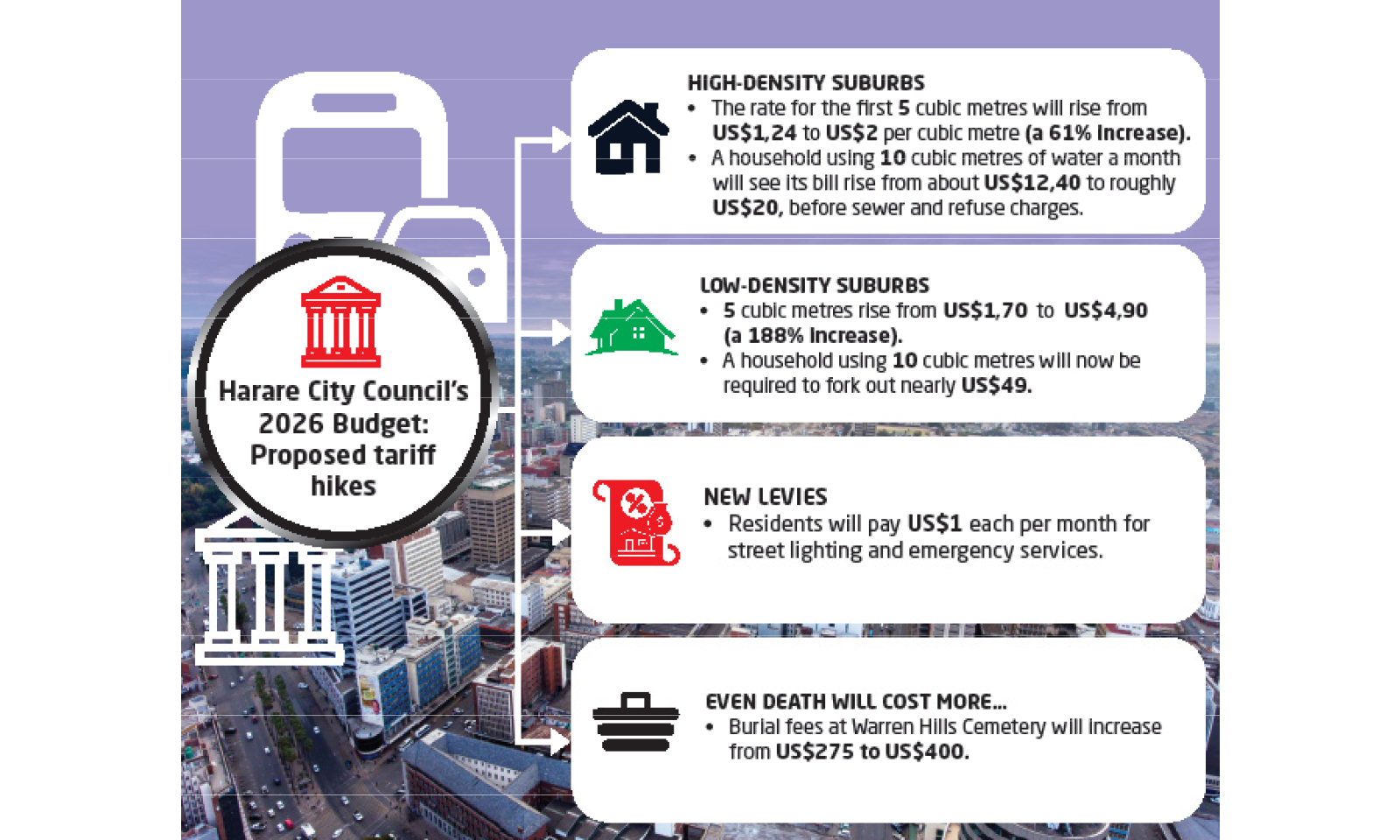
Tawanda Musarurwa and Nokuthula Dube
Check Point Desk
THE Harare City Council’s proposed US$690 million budget for next year looks like a plan to balance the books, but for residents, it means higher bills and tougher choices in a city where every dollar already stretches thin.
The proposed tariff hikes, particularly in water and burial fees, suggest that both the cost of living and dying in the capital could climb sharply.
Water — already an erratic resource — will become significantly more expensive.
For residents in high-density suburbs, the rate for the first 5 cubic metres will rise from US$1,24 to US$2 per cubic metre, a 61 percent increase.
In low-density suburbs, the same amount will soar from US$1,70 to US$4,90, a 188 percent hike.
A family in a high-density area using 10 cubic metres a month currently pays around US$12,40.
However, under the new tariffs, the same consumption could cost US$20, excluding sewer and refuse charges. For a household earning US$500 a month, water alone would eat up about 4 percent of income — double the current share.
Residents in low-density areas will feel the pinch even more: The same quantity of water could now cost nearly US$49.
New levies add to the squeeze
On top of this, residents will pay US$1 each per month for street lighting and emergency services, which is modest on paper, but meaningful when added to a growing list of municipal charges.
These levies will cost a family of five an extra US$10 a year, effectively becoming another fixed cost in a city where wages have barely moved.
Even in death, costs are set to rise steeply.
According to the budget proposals, burial fees at Warren Hills Cemetery will increase from US$275 to US$400, while exhumations climb from US$350 to US$525.
At the Mabvuku Cemetery, which used to be one of the most affordable graveyards, a standard adult burial will go up from US$150 to US$225.
For families who must fund burials from already strained incomes, these increases represent a growing financial vulnerability and burden. If the average Harare worker continues to earn US$500 a month in 2026, the cumulative effect of these proposed tariffs could push municipal-related expenses up by between 30 percent and 50 percent.
In a city already grappling with inflation and inconsistencies in service delivery, the mathematics of survival may soon become even harder to balance.
Harare residents are not amused by the budget proposals.
“We are saddened by this move; it deprives us of our fundamental right to water,” said Mr Clive Mupondi.
Glen View resident Mrs Sharon Chiguni said raising tariffs in a situation where many residents do not have water most of the time was unfair.
“As a resident, it is deeply concerning that the City Council of Harare plans to raise water tariffs while the water being supplied is often undrinkable and unreliable.
“It feels unfair to expect residents to pay more for a service that fails to meet basic health and quality standards,” she said.
“Many areas go for days without water, forcing people to buy from private suppliers, which adds to our financial burden. Before any tariff increase, the council should first focus on improving water treatment, ensuring consistent supply and providing clean, safe water.
“Raising prices without addressing these long-standing issues sends the wrong message that residents must pay more for less. Accountability and service delivery should come before higher costs.”
Various stakeholders have long called for the city to reduce water leakages.
Data from the Harare Master Plan (2025-2045) shows that the city currently loses about 60 percent of treated water through leaks, illegal connections and non-metered use.
Experts say by reducing non-revenue water from 60 percent to, say, 30 percent to 40 percent, this can effectively double the billable volume without raising tariffs, hence easing pressure on households and stabilising revenues.
Harare Mayor Councillor Jacob Mafume told The Sunday Mail that residents will be consulted on the proposals.
“We have made a proposal about a viable tariff; we will get feedback from the residents. And if there are issues . . . then we will, by all means, adopt them.”
The proposed budget will now go through a 30-day consultation period with residents, business associations and other stakeholders before being finalised.
Mayor Mafume said there were existing measures to cushion the elderly and vulnerable.
“Those who register with us pay half or less of the bill. But for us to help the poor, we must first be able to provide a viable service.”
Harare Residents’ Trust president Mr Precious Shumba said the proposed increase in costs of water is unjustifiable.
“The City of Harare is failing to provide adequate water to the residents of Harare. The Harare City Council loses approximately 60 percent of treated water through leakages and illegal connections along the water distribution network. This leaves only 40 percent of households receiving council water,” he said.
“Increasing water rates without putting in place mechanisms to plug the leakages and ending the rot that allows illegal connections is mischief of the highest order. The City of Harare is irresponsible and unnecessarily rigid when they are supposed to be practical in their interventions to enhance service delivery.”
Mayor Mafume, however, insists that the present tariffs cannot sustain the municipality’s operations.
“But at the present moment, we have tried to keep the tariff as low as possible. We have reduced revenues.
“And if you look at the budget across the board, you will find that it has drastically reduced, collapsed and streamlined a number of fees and rates that the residents were paying so that we can stimulate growth and allow people to live in the city affordably,” he said.



Harare residents only have themselves to blame. They repeatedly elected useless people into office as a way of undermining ZANU-PF in urban areas and watched the city crumbling to a sorry state it is. They cannot complain about the conditions they now live in. They made their bed, now it’s time to lie on it. Stubborn people should be allowed to stew in their misery. For years they were the most active part of the regime change agenda through swelling the ranks of opposition and repeatedly voting for a party and not for service delivery. There should be no sympathy for these people. Has anyone witnessed any demonstration against HCC for poor service delivery? No, nothing! So why worry about such people?