Online Reporter
Ray Bande
Senior Reporter
WAY back in our communities when girls used to cook nice food like their mothers before they started drinking alcohol like their fathers, marriage was something that every young woman looked up to in their life.
Back then, when skills were primarily transferred from generation to generation through informal methods, boys obtained their idea of masculine behaviour from their fathers and would not readily chose female roles in sexual relationships as they looked up to head their families like their fathers in marriage.
Basically, children, as they grew, modelled their behaviour after their fathers and mothers in that bygone era, with the ultimate aim of becoming formally married.
Funny how things have changed!
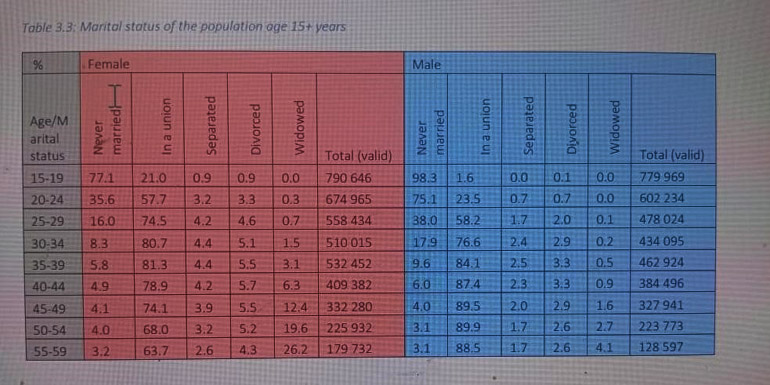
To place matters into context, the ZimStat 2022 Zimbabwe Population and Housing Census Gender Thematic Report, the latest survey at hand that touches on the matter, revealed that in the 25 to 29 age group, which has commonly seen most males and females starting their own families in recent years, 16 percent of females were never married, while 9,5 percent were already either separated, divorced or widowed.
Among the 30 to 34 females age group, 8,3 percent were never married, while 11 percent were already either separated, divorced or widowed.
Among males, in the 25 to 29 age group, a cool 38 percent were never married, while 3,8 percent were either divorced, separated or widowed.
To make matters worse off, in the 30 to 34 age group, a huge 17,9 percent of males were never married, while 5,5 percent were either separated, widowed or separated.
Father Phillip Kembo, a Roman Catholic priest ministering in the Diocese of Mutare, said:
“I think this topic you have raised is very important. I feel it should be in the paper weekly, even for a month, because it is not about marriage, but sexuality.
“This is simply because marriage comes in later on, and it comes in when someone has understood what sexuality is all about and where it leads an individual.
“We as Catholics, for instance, we teach that marriage is a sacrament or marriage is that relationship between a man and a woman, and that aspect alone is very vital. Like what the Constitution says, marriage is between a man and a woman, not a man and a man or a woman and a woman.
“And yet in today’s society, we are seeing it happening. People enter into marriage and later on start demanding the other type of intimacy. That means something went wrong in their socialisation that needs to be corrected before a person enters into marriage.”
Father Kembo went on to assert that the current generations have a totally wrong perspective about marriage, hence the factors that militate against them getting married vary.
“We also have a very important issue of delaying gratification, that is why our young people are delaying getting into marriages. Some of them are getting married at 35 or 40.
“Some are going beyond that, and not even getting married because they are getting sex from as early as 10 and keep doing it until they turn 35 or even 40. Therefore, this person does not have that conscience that sex has to be institutionalised, in particular the institution of marriage.
“This is because people a long time ago, or people in marriage, they married for procreation, to have children. So that is where sex comes in. So sex was and is only restricted in marriage, but now for the current generation, sex should not push a person into marriage. They can have it anytime with anyone.
“Therefore, such things must be discussed extensively. Marriage is so wide. Wide as it is, it deserves to be looked at from a holistic perspective so that we understand why are these young people shunning marriage. It is not about financial matters, it is not about getting settled, no, no, no!
“They are not interested in paying those bills, those rooras (lobola) just for marriage.
“They have seen it on social media, they have seen it in movies that even if you get married it is not a guarantee that you will get the sex or you will live comfortably. So all these factors militate against them getting married when making a decision to or not to,” said Father Kembo.
Many have argued that marriages or the decision to marry hinges on the ability to finance needs in a family, and in one of his online teachings, prominent cleric, Apostle Joes Daniels said: “This is a problematic issue. In as much as people say in poverty and in prosperity. A lot can survive prosperity, but very few can survive poverty.
“Marriage can survive poverty, a relationship can survive absence of money, but on one condition, and this is if there is a well laid out vision that shows why you are going through is temporary.
“If it is clear in that union that this poverty is temporary it can survive based on hope that we are doing this and that to get a better life. Women can even support their husbands to attain that vision, but when it comes a seemingly permanent issues, and when the woman starts asking questions such as until when shall I keep helping you, then there is problem.”
A local radio personality, who chose anonymity citing the sensitivity of the matter on personal grounds, said:
“Outside the economic factors such as high roora/lobola prices compared to earnings by common people, there is also generally zero motivation to commit and settle among young adults these days.
“Everyone can enjoy all the companionship and intimacy without getting married. In actual fact, common belief is that non-married people enjoy more intimacy than married people. So they ask, why should I keep the cow if I can get free milk without the expenses of acquiring and maintaining the cow?
“I think this emerging crisis is also a reflection of diminishing cultural and religious influence. Many years ago uncles and aunties would arrange for their nephews to get married if they have crossed the proverbial boundary age wise, and also at church elders would make sure they pressurise youths to commit.
“Some would even match-make the couples, but now both culture and religion are fading in terms of their influence on individual behaviour. People can delay commitment and still live freely without much societal condemnation.”
A social commentator, Mr Mathias Madakadze said: “Human behaviour is also very hard to redirect once you have directed elsewhere. Example is China, slow birth rate is due to years and years of one child policy.
“Now the one child policy is removed, people were now used to one child and even adopted zero child in their minds, so people get married for the tax benefits and still don’t have children because at one time society told them children are not important.
“For our scenario, the dynamics are accelerated by the current emphasis of a healthy stable life before marriage which can never be attained.
“If society removes the emphasis of financial stability and removes silly initiatives of contraceptives to young people, then we go back on track. Pregnancy equals marriage.”
As the debate rages on, some fierce marital wars, especially involving high profile personalities, have also scared a good number of youngsters from getting married. One example is the late prominent Cabinet Minister and national hero, Engineer Joel Biggie Matiza’s son, Batsirai and his estranged wife, Ms Kernisha Sheila Hunzwi, with their 14-month-old infant being the battlefield.
This case shines a spotlight on the principles of family law in Zimbabwe, particularly the laws governing child custody and the rescission of court judgments.
In Zimbabwe, all matters concerning the custody, guardianship, and access to minor children are governed by the Guardianship of Minors Act.
The guiding principle, enshrined in law, is the “best interests of the child.”
The High Court is considered the upper guardian of all minor children, giving it the ultimate authority to decide what is in their best interest.
While historically, there was a tendency to award custody of young children to the mother, Zimbabwean law has evolved.
The Constitution now affirms that women and men have the same rights regarding the custody and guardianship of children.
Courts are expected to weigh various factors, including the child’s health and education needs, and the character of the parents, rather than relying on gendered assumptions.
A high-stakes legal drama is unfolding in Zimbabwe’s High Court, pulling back the curtain on a bitter custody dispute involving Mr Matiza against his former wife, Ms Hunzwi.
The case has captivated public attention, raising profound questions about the sanctity of consent in divorce proceedings, the welfare of very young children, and whether power and influence can tilt the scales of justice.
The heart of the conflict lies in a divorce decree granted by consent on the February 12, 2026.
This order finalised the couple’s separation, and crucially, established a joint custody arrangement for their infant child.
The agreement stipulated that the 14-month-old would alternate between parents on a weekly basis.
However, what appeared to be an amicable resolution has now unravelled, with Ms Hunzwi launching an urgent court application to rescind, or set aside, that very judgment.
She alleges the consent agreement, which she signed, was a product of duress and fails to protect the best interests of her child.
At the core of Ms Hunzwi’s urgent application are serious allegations that she was subjected to intimidation and pressure, which impaired her ability to make a free and informed decision during the divorce process.
In a sworn affidavit, she claims she was unable to exercise independent judgment.
Ms Hunzwi alleges that she was escorted to Sam Levy’s Village to sign the legal documents and was denied access to her own lawyers at critical moments.
“I was under much pressure that I could not exercise independent judgment,” her affidavit reportedly states.
Central to her legal challenge is the well-being of the 14-month-old, who is still breastfeeding.
Ms Hunzwi argues that the weekly alternating custody schedule is fundamentally unsuitable for an infant.
She claims that during the weeks spent with the father, the baby is forced onto artificial feeding, a practice she fears could be detrimental to the child’s health.
Furthermore, she has raised concerns about the quality of care the child receives in Mr Matiza’s custody, alleging that he is often absent and leaves the infant in the care of a domestic worker.
Be that as it may, marriage institution remains under threat and one shudders to imagine what ZimStat statistics will ready like come the next data collection initiative.