admin
admin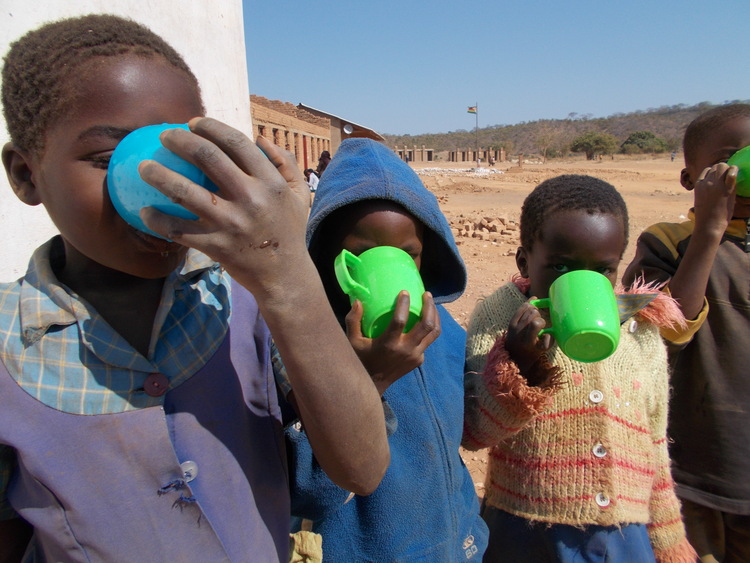
Harmony Agere
In a move that is aimed at shielding pupils from the obtaining drought-induced hunger, Government is seeking about US$200 million to fund a National Schools Feeding Programme set to begin in the second term of 2016 as part of efforts to protect vulnerable groups.
The programme will address issues related to food security, improved learner nutrition, higher retention and completion levels in schools, reduced dropouts and enhanced overall learner performance, optimal school enrolment and attendance.
The development comes after President Mugabe declared the 2015-16 cropping season a disaster due to the El Nino-induced drought as nearly three million people, particularly in rural areas, are in need of food aid.
Speaking at a community share ownership trusts conference in Harare recently, Primary and Secondary Education Minister Dr Lazarus Dokora said cabinet had given the green light to explore the possibilities of establishing a sustainable and co-ordinated school feeding programme.
While school feeding programmes have been done before, they were done at individual institution level and mainly funded by NGOs.
Dr Dokora said this time around the product will be homegrown and relevant to Zimbabwe’s current situation.
There are about four million infant, junior and secondary pupils in the country and Dr Dokora said the US$200 million can be raised through tapping into CSOTs and companies.
“The community leaders that are gathered here control local resources in terms of community share ownership of resources contributed by various mining companies. We, in the last Cabinet, were given the green light to begin the exploration on setting up the national schools feeding programme.
“So it is in the community where the resources are. Although as Government we are expected to play a part, you have to understand it from a point of view that when a country, for instance in our present circumstances, we have an emergency, we have food deficit.
“The kids that we have in our school system are eating once a day but we still expect them to perform well.”
Minister Dokora said the plan was to provide at least one meal for each student a day with schools in rural areas being the most prioritised.
He said it is difficult for pupils to perform well in school when they are hungry adding that a well nourished child has a better chance of producing good results.
The minister said Government is also planning to make the programme permanent and not a response to drought only.
According to research by the ministry, the estimated cost of feeding a learner is USc25 per meal. This translates to about US$47,50 per learner per annual school days (190 days).
For all four million pupils, an amount in the region of US$190 million is needed per year.
To make the Primary and Secondary Education Ministry will pursue various implementation approaches and linkages.
One is a phased approach starting with infant grades as the primary consideration is to target more vulnerable age groups to boost school enrolment figures.
The other is a whole system approach which recognises the current threat of climate change and food security as well as age-related nutritional needs.
Implementation linkages would see the Ministry of Primary and Secondary education working with at least eight other ministries, including those of Health, Agriculture and Finance.
The business community has hailed the proposed project saying it has a potential to stimulate agro-business in rural areas as schools will become markets for agricultural products.
Confederation of Zimbabwe Industries president Mr Busisa Moyo pledged his support to the programme saying he would plan with Government to see where the private sector could help.
“I would like to thank the minister for such a good project, we as the business community we pledge to help where we can,” he said. “We shall try to continue working with the Ministry and see where we can contribute.”
On the role of CSOTs, Dr Dokora said each community has a responsibility to develop children, especially those who are vulnerable.
“CSOTs support to school in form of funds will enable schools to purchase produce for school feeding from the community,” he said.
“The advantage will be that communities have close market and no huge transport costs. Such support to farmers will spur production of agricultural produce.”
Youth, Indigenisation and Economic Empowerment Minister Patrick Zhuwawo hailed the proposed project saying Government was working on a plan to re-conceptualise CSOTs to make them more effective, vibrant and more community-based. He said while the trusts have been doing fine so far there was need to make them more beneficial to the communities.
Other countries in Africa have been conducting school feeding programmes for a while in the wake of successive droughts in some parts of the continent.
In Ghana, contracts were signed last year by beneficiaries of Ghana’s School Feeding Programme, ensuring that caterers are able to purchase quality food directly from the farmers, allowing them to get good prices for farmer produce, and so that farmers have ready access to markets.
In Brazil, student and small scale farmers are benefitting from school feeding programs in that country.
However, the sustainability of such a programme has been questioned with some saying in low-income countries the programme tend to suffer lack of funding. Research shows that successful national school feeding programmes in middle-income and high-income countries tend to rely on local procurement of commodities, while programmes in low-income countries usually find themselves dependent on external sources of food aid.
Such models, experts say, might suggest that there is an opportunity for low-income countries to kick-start their transition, not only establishing sustainable sources for some of their commodities but also contributing to local economic development.
Progressive Teachers Association of Zimbabwe president Dr Takavafira Zhou had doubts over Government’s ability to fund the project.
“It’s not necessarily about Government having the capacity or the money. It’s about how we structure and package the programme so that those who have the money can support,” he said.
“Unicef, World Bank and other several other organisations have always been prepared to help but the little details of how the tendering process should be carried out, who will be monitoring what, have been sticking issues.”
Education expert Dr Peter Kwaira said Government should identify areas of real need to avoid being wasteful.
“I think it is a timeous programme because we are going through a drought period. But we should try to find where the need is so that we are not wasteful.
“It is in the rural areas where the real problem is, some of us have been doing researches and have realised that many of children in rural areas are going to school before meal time. So it becomes very difficult for both the learner and teacher to conduct a proper lesson.”
Dr Kwaira believes the situation is not the same in urban areas where fewer numbers of pupils are vulnerable.
World Food Programme Country Representative Mr Eddie Rowe has said they will provide technical support to Government to build capacity to manage and implement the National Schools Feeding Programme.



 Online Reporter